In Fai Baba’s cave

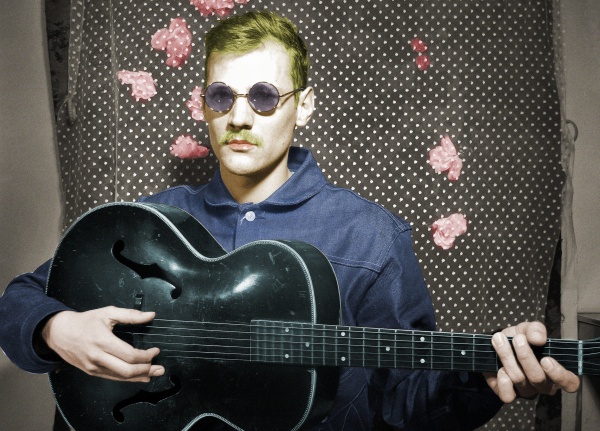
On stage at Lephoto_fai_baba_01 Bourg, Fabian Sigmund, alias Fai Baba, surprises us with a trio that’s as minimal as it is powerful. He is back at Paléo Festival Nyon, Friday the 26th of July.

First of all, there’s the voice that can scale great heights in an empowered register, something which doesn’t really go with the willowy physique and jerky body moves. An intriguing mismatch which strikes a chord straight away.

The accompanying bassist and drummer amplify and play around with these noisy blues, tinged with flashes of rock and punk.

The rhythms are broken up to make way for long instrumental sections. Thanks to two guitars, (one simple and one 12 string), and a few pedals for effects, Fai Baba puts his guts into his music without batting an eyelid.

A cover version of Townes Van Zandt and a nod in the direction of many different rock styles, all of which confirms that the man is a music freak.

Fai Baba says goodbye, announces that his CDs are on sale and gets straight to business by pulling out a suitcase from the side of the stage. Inside are his two CDs releases, including the latest “She’s the guru”. It’s a lot more orchestral than what the Zurichois has just delivered on stage despite being a work that he designed entirely on his own. Here are some insights into his work:

How did you set about making « She is My Guru » ?

Fai Baba: This LP was made in six months. I shut myself away in a rehearsal studio in Zurich and started working on some loops, experimenting with sounds on an eight-track. Within six months all the ground work was done. I then went to New York to finish the rest. I worked in the studio with Tony Maimone who was Père Ubu’s bass player for a long time.

How did you meet Tony Maimone ?

Fai Baba: By chance. I was helping a friend organise a kids’ second-hand market and whilst chatting to a woman I mentioned that I was a musician. She happened to be Tony Maimone’s sister-in-law and she hooked us up. In him I discovered a nerd who like me enjoys organic music and working with analogue sound.

Since when have you been working on your own?

Fai Baba: When I was 14, I started playing in a band and hanging out with an older friend who was clued up. He taught me how to record onto a tape deck and I immediately thought it was more cool than working with a computer.

How do you work?

Fai Baba: I’ve always played my rhythm section plus guitar. As soon as I touch an instrument I know there’s a specific sound for me to make. For example, I can make a kick drum sound with my foot, then I sample it and play it back and this gives me a base on which to build. It’s often as basic as just one simple note. This is a hip-hop technique but its origins come from the blues.

How did you get into the blues ?

Fai Baba: I used to play in a band where we went through all different styles of playing: rock à la Radiohead, then Pink Floyd style, and then Sonic Youth! Next I went off to India with my guitar, it was some travellers there who initiated me into the blues. When I got back I found myself playing the first half of a set all alone on the guitar. It was then that I realised that I wanted to play solo.

You seem to have an impressive collection of instruments and synths?

Fai Baba: I don’t know how many instruments I’ve got. They fill up a whole room, rather stressful because I’ve got to move house soon. I’ve always loved vintage sounds, the instruments used back in the day, but I’m not rich enough to have them all. Recently a friend of mine unearthed an Ace Tone organ, (a portable organ used a lot in 60s American rock), which featurs on the LP.

 You invited some musicians to join you on the LP, what did they contribute to the sound?

Fai Baba: When I ask someone to play on my record I know exactly what I want from them and the kind of sound that they’ll bring. But I also like for the process to be spontaneous and radical.

 Your album is entitled « She is my Guru ». Who is your guru?

Fai Baba: Once the recording was over, I noticed that I’d only done love songs. When we think of a guru our first thoughts are often of a man, but it amused me to say “She’s my guru”; a ‘she’ that refers to ‘woman’ in general, my muse as much as my guru.

“Julia”, a track from Fai Baba’s first LP (“Snake Snake”) is available for download on bandcamp at Swiss Vibes and can heard here:

[soundcloud url=”http://api.soundcloud.com/tracks/88381394″ params=”” width=” 100%” height=”166″ iframe=”true” /]

PS. This text was originally published in French on the 31st MAY 2013 on this blog
Bojan Z et Tobias Preisig s’envolent!

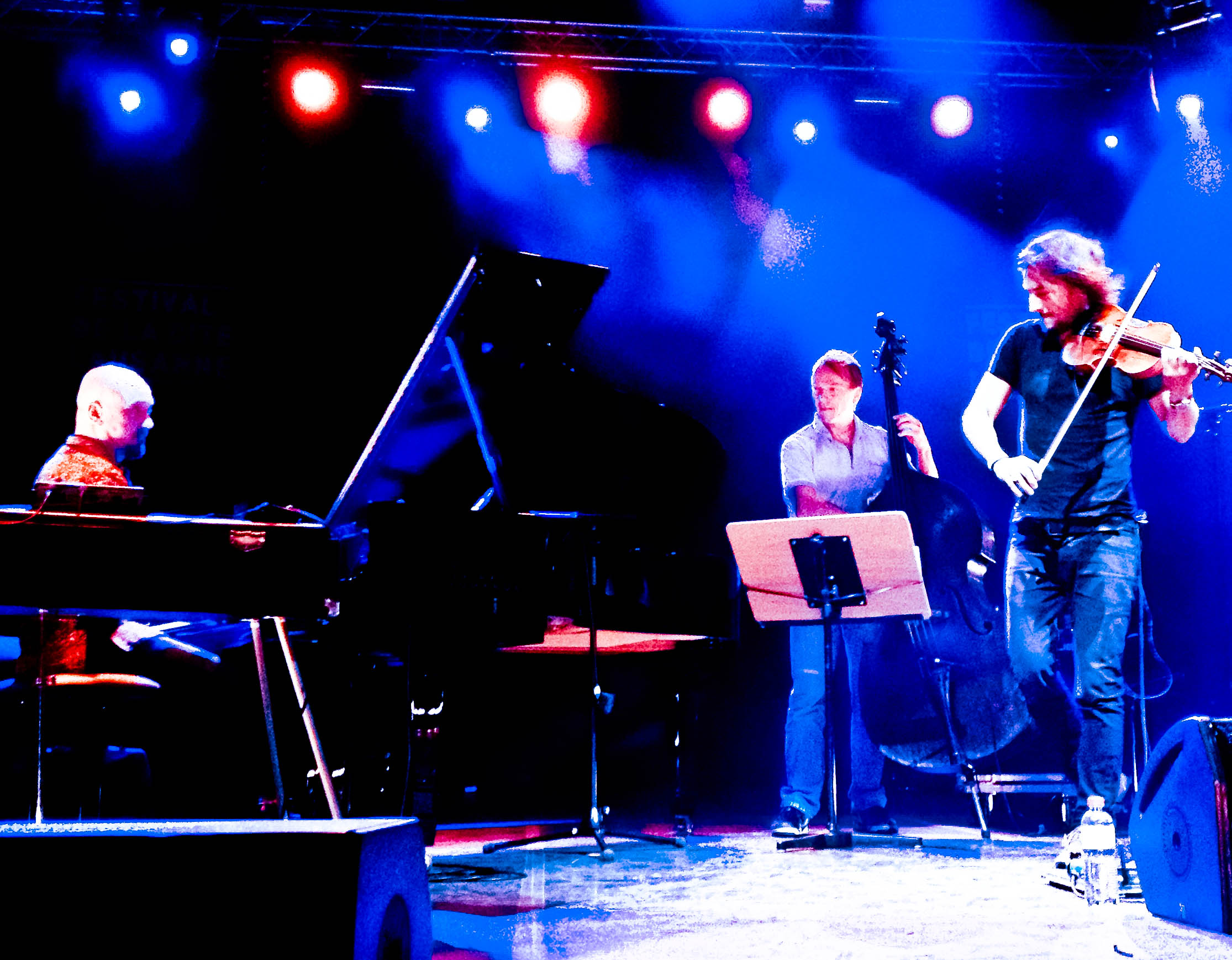
Bojan Z band feat Tobias Preisig @Festival de la Cité

Hier, au Festival de la Cité, la tension était grande. Le pianiste serbe Bojan Z qui devait ouvrir la soirée n’a pas pu prendre l’avion prévu et a fini par atterrir à l’aéroport de Cointrin à 18 h. Une heure plus tard, il était propulsé sur la scène du Château pour un mini concert d’une trentaine de minutes où il posait les bases de son univers foisonnant construit à partir des musiques ethniques, du jazz, du rock.… Après cette mise en bouche, Bojan Z devait remonter sur scène à 22 h avec son trio et un invité spécial en la personne du violoniste suisse Tobias Preisig. Les deux ne s’étaient jamais rencontrés, avaient échangé par mail et devaient répéter dans l’après-midi… Gloups.

Lorsque Tobias Preisig entre en scène, la nuit est tombée et le vent s’est levé. La tension monte d’un cran. Bojan Z annonce « Greedy (In Goods, We Trust) » dédié aux banquiers et à la cupidité. Un morceau visionnaire qu’il a fait paraître en 2009. Les musiciens s’observent, prennent leur marque. Bojan a une main sur le piano à queue, l’autre sur son Fender Rhodes. Tout d’un coup ça démarre, le violon de Tobias Preisig s’embrase, les claviers de Bojan lui répondent. Les deux semblent s’être trouvés : ils attaquent leurs instruments avec une hargne jouissive. Une forme d’agressivité magique qui transforme le négatif en positif. La rencontre est puissante et leur permet ensuite de poursuivre le dialogue dans des modes plus doux.

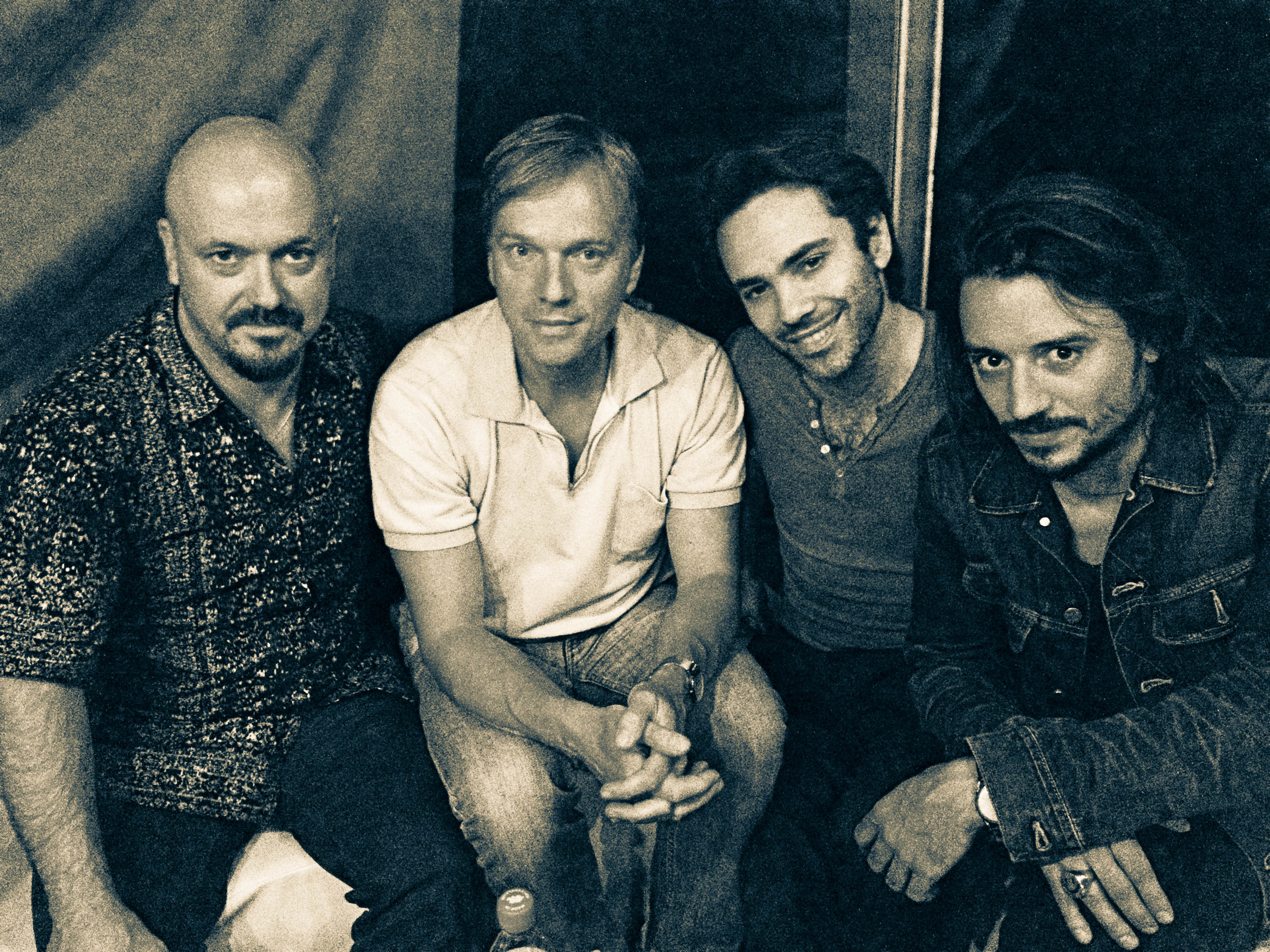
Backstage: Bojan Z, Thomas Bramerie, Fabrice Moreau et Tobias Preisig

« Finalement, c’est bien que cette rencontre se soit faite directement en public. On a été obligé de converser tout de suite. J’ai déjà joué avec d’autres violonistes à Paris, mais là c’était plus fort » explique, le sourire aux lèvres Bojan Z un peu plus tard dans les backstage.

« Je n’avais jamais fait ça de ma vie. Mais comme ils sont très forts, je n’ai pas eu de peine à entrer dans leur musique, reprend Tobias Preisig, Leur travail au niveau des rythmes est vraiment incroyable. Bojan Z a un côté franchement rock que j’adore ». Il en sait quelque chose lui qui va se produire le 18 juillet au Montreux Jazz Festival dans le cadre du nouveau projet du king de la pop helvétique, Dieter Meier.

Made in Switzerland (the pros and cons of being a Swiss jazz artist)

Swiss Vibes 2013_01_Mix 4“You can tap into resources and support and it’s there”  Leo Tardin

The Swiss jazz scene is evolving and has been for some time. Music education at institutions such as the Bern University of the Arts, professional support for artists and an expansion of the term jazz, have helped the emergence of new and award-winning talent. I asked musicians who’ve had help from Pro Helvetia, how being Swiss has impacted their music and careers and if any changes could be made for the better.

They unanimously acknowledged the funding system that exists. Drummer Florian Arbenz said financial help was a huge advantage, “Because of the spare time we have for our heads to create something…(and) work on our own concepts.” Leo Tardin, who spent a significant time building his reputation whilst living in New York, said that being abroad gave him perspective on being Swiss, “You can tap into resources and support and it’s there. It’s shrinking just like everywhere else but we’re still very privileged and that’s a fact.”

It will always be diverse, musically”  Stefan Rusconi

Several artists did refer to the Nordic scene as an example to follow, with its huge investment in jazz and organic creation of an almost tangible ‘brand’, encompassing artists from Jan Garbarek to E.S.T. However, the journalist Arnaud Robert said recently, “Switzerland creates individuals, not schools or movements of music,” and musician Stefan Rusconi agrees, “It will always be diverse, musically, I don’t think it will be like the Nordic sound, I think it will be an approach, an attitude that could come out of Switzerland.”

I would agree; as a DJ visiting Switzerland, I was drawn to the open-minded spirit of people less concerned with being cool, than being free (whilst getting things done, of course!). Humour and a spattering of crankiness are somewhere in the mix and as the Zurich-born violinist, Tobias Preisig, says, “I’m pretty amazed how small this country is but how rich it is music and cultural-wise.” Maybe this is entangled with the make up of Switzerland as noted in Wikipedia, it’s not, ‘a nation in the sense of a common ethnic or linguistic identity’ and over one fifth of the population are immigrants.

“Switzerland, for me, is a big chance”  Elina Duni

Vocalist Elina Duni says of her quartet, “This music wouldn’t exist without Switzerland because it is the fruit of bringing together my Albanian roots and my Swiss culture.” Having moved to Geneva when she was ten, Duni sees her music as building bridges between people and acknowledges the support she’s had with that, “Switzerland, for me, is a big chance.”

Andreas Schaerer also feels that being Swiss has informed his compositions and vocal work in an interesting way. He refers to the Swiss obsession with detail, “We work so long to make things better and better until every last corner of the product is perfect…What is good is if you can be brave and destroy it…so that you see these pieces of complexity (and detail) but the environment is complete chaos.”

Schaerer also observed that the Swiss are good at technology and high quality products that take the spotlight, as it allows ‘their creator’ to stay in the shadows. Elina Duni also commented on this Swiss characteristic of humility, “It allows people to learn further and go further,” but too much of it prevents the Swiss from exporting itself with pride. Rusconi pointed to the same issue, that it’s not ‘Swiss’, “to stand there and say we’re proud of ourselves, we want to get out there, we’re great.” Self-promotion is a pre-requisite in the music world today and Schaerer has had to confront his discomfort with that, “You need to get rid of it without becoming arrogant or losing respect for others.”

“It’s hard to cross borders in music and life”  Tobias Preisig

Several of the artists have lived or are living abroad. Samuel Blaser now resides in Berlin but spent time in New York. Although none of them felt that ‘being Swiss’ made them particularly exotic, Blaser felt, “It’s stronger if you live in New York because you can then ‘export’ your music back into the EU market (from the US).” Being an ‘export’ is vital to these musicians because as they pointed out Switzerland is not a big enough market for them to survive there alone. “It’s hard to cross borders in music and life,” reflected Preisig, and it’s why support to tour is key. Pianist Marc Perrenoud saw this as a positive, “I use the obligation to export yourself as a way to travel, meet people and experience other cultures.”

Being a Swiss musician is packed with advantages, not least because being brought up in a culture of excellence, passion and professionalism has impacted the standard of playing. Being a jazz musician anywhere is not an easy choice but that can’t be changed, neither can the size of Switzerland. However the discomfort with ‘blowing your own trumpet’ can be discarded along with the Swiss milkmaid. These musicians are cultivating a confidence in their own unique ‘voices’ and this needs to be reflected in the way they are promoted. I’m certain cheese and chocolate will always sell but now there’s a chance to add a new and more emotionally expressive export to the table.

Au Canada, avec le batteur des Mama Rosin

Victoriaville (Québec), le 27 juin,

Xavier Bray

J’aurais aimé prendre le temps de raconter ces quinze jours au Québec. Faire d’abord un tour rapide sur l’histoire de ce pays pour ne pas toujours tourner autour du cliché : Conquête des Amériques=Génocide des Amérindiens. Car même si Christophe Colomb a vraiment éradiqué les tribus des Bahamas de la surface de la terre, un peu plus haut, au nord il s’est passé des jolies choses. A l’époque où le Canada n’était qu’une “forêt confuse”.

Ouais ça aurait été bien de raconter comment, par le biais des “truchements”, certains européens ont donné tout son sens au mot “acculturation”. Comment au XVIIème siècle, ces mal-aimés des vieux continents ont traversé le grand océan pour devenir purement et simplement des “indiens blancs”. Raconté par les missionnaires assermentés aux états souverains cette histoire est sordide, mais raconté par ces “coureurs des bois” eux-mêmes, on se permet de rêver que l’homme a du bon en lui. Quand même. Et puis j’aurais, bien sur, pris le temps de raconter notre arrivée à Montréal, où à chaque coin de rue, tu as l’impression de revoir un vieux pote. Ici on ne dit pas “bonjour”. On dit : “bonjour, comment ça va c’matin?”. Et ça change beaucoup de choses.
Ha pis j’aurais raconté notre rencontre avec Lisa Le Blanc, ce petit bout de femme qui ne fait absolument pas semblant de chanter des chansons. Invités ici et là par les bons artistes de notre bon label Bonsound, nous nous sommes sentis simplement bienvenus.

Vous auriez bien rigolé si je vous avais raconté le matin ou j’ai confondu ma crème pour le visage (bah oui quoi… Faut s’hydrater!) avec mon dentifrice, et que…hum…ma tête…”Non madame, c’est pas le soleil, c’est mon dentifrice.” J’aurais sûrement aussi raconté notre périple au nord. Quand on a suivi le fleuve Saint Laurent qui, à 1000 km de l’océan, fait déjà 20 km de large. Les deux day off à Tadoussac qui ont été réduits à un, car on a trouvé un concert pour se payer la bouffe d’un soir. Et puis cerise sur le gâteau, ils nous ont offert un tour en ferry pour aller voir les baleines. Au large du “plus vieux village du Canada” j’aurais raconté qu’il se trouve un mélange étonnant d’eau douce et d’eau de mer qui offre aux grands cétacés de quoi se nourrir en quantité. De mon côté je vous aurais avoué que je me suis chopé une fièvre de cheval dans les 39°, donc les baleines je m’en foutais un peu (mais qu’est-ce que tout le monde a avec les baleines!?!). J’ai donc laissé les touristes japonais et leurs jumelles…(oui moi aussi j’ai trouvé louche que des japonais viennent admirer des baleines…A mon avis c’était plutôt du repérage…enfin je dis ça je ne dis rien). Je me suis donc réfugié dans la cabine pour griffonner quelques poèmes dédier à une déesse lointaine. C’est quand la biologiste a crié “A 9h!!” et que les japonais se sont rués à bâbord que j’ai daigné sortir le bout de mon nez dans le vent glacial. Et puis là, effectivement, voir un troupeau de 60 bélougas nager à coté du bateau m’a impressionné. C’est drôle ces animaux…Ça ressemble à un gros pénis circoncis tout blanc. Bon, oui pardon pour la ressemblance mais allez voir des photos ça saute aux yeux.

J’aurais expliqué comment j’ai été troublé par les indépendantistes Québécois dans ce “Grand” nord. Pas du tout gênés de chanter à tue-tête que l’ennemi juré c’est l’Anglais. J’ai tenté de leur expliquer qu’en France aussi, on avait des rigolos en Corse avec armes et cagoules (en fait non, c’est pas rigolo du tout). Ils n’ont pas aimé la relation je crois. Enfin, de toute façon, je ne me permettrais pas de donner mon avis sur la question. Car un peu chauvin, j’aurais avoué qu’il y de belles choses chez les francophones ici, et que chez les anglophones c’est pas la même.

J’aurais pu parler de la langue du coup. Et notamment d’un mot : “Tantôt”. Je l’adore. Il arrive à exprimer le passé ou le présent. Par exemple : “On ira se boire une bière tantôt” ou alors “c’était bien de se boire une bière tantôt”. Et puis j’aurais pas pu m’empêcher de parler de la peur qu’il y a ici que la langue anglaise devienne trop présente. Pourtant j’explique qu’en France on va faire du shopping alors qu’ici on fait du magasinage.

Aurais-je osé raconter nos concerts devant des Québécois souriants et étonnés de voir des Suisses faire du Cajun.
Où plutôt vous dire comment je me sens lorsque pris d’une de mes sempiternelles insomnies-mélancolie, j’ère à 4 heures du matin dans le hall de l’hôtel à la recherche d’alcool et de tabac.

Ouais, j’aurais vraiment aimé vous raconter tout cela. Mais je ne vais pas passer mon temps devant mon ordi quand même!!
Enfin. Pour certains ça va bientôt être les vacances, alors je vais me mettre en vacance de récits aussi. Et si je suis encore vivant on se verra à la rentrée.
Mais sachez que j’aurais vraiment aimé…

Après le Canada, les Mama Rosin sont visibles sur les scènes suivantes

04.07.2013 – Jazzparade, Fribourg SWITZERLAND
19.07.2013 – Colours of Ostrava, Ostrava CZECH REPUBLIC
20.07.2013 – Gartenfestival, Bern SWITZERLAND
23.07.2013 – Paléo, Nyon SWITZERLAND
24.07.2013 – Les allées chantent, Grenoble FRANCE
25.07.2013 – Les allées chantent, Grenoble FRANCE
26.07.2013 – Les allées chantent, Grenoble FRANCE
27.07.2013 – Blue Balls, Luzern SWITZERLAND
01.08.2013 – Yverdon-Les-Bains SWITZERLAND
02.08.2013 – Esperanzah Festival, Namur BELGIUM
10.08.2013 – Guiness Festival, Sion SWITZERLAND
11.08.2013 – Heitere Open Air, Zofingen SWITZERLAND
16.08.2013 – Sounds of the Forest, Erbach GERMANY
17.08.2013 – Zone Piétonne, La Neuveville SWITZERLAND
18.08.2013 – Theaterspektakel, Zürich SWITZERLAND
20.08.2013 – Mardi Sablés, Excenevex FRANCE
22.08.2013 – Nest Collective / SBC roof top, London UNITED KINGDOM
23.08.2013 – Purbeck Folk Festival, Purbeck UNITED KINGDOM
25.08.2013 – Towersey Festival, Towersey UNITED KINGDOM
26.08.2013 – Greenbelt Festival, London UNITED KINGDOM
16.10.2013 – MaMA Festival, Paris FRANCE