De Bienne à Zurich, de Genève à Berne, la scène musicale suisse explose de talents, pour la plupart inclassables. Et cette fois nous allons vous le prouver! Le Centre culturel suisse a en effet invité Swiss Vibes le temps d’une carte blanche, le temps de trois double-concerts aux couleurs forcément éclectiques.
Dans l’agréable centre de la rue des Francs-Bourgeois, défileront donc dans l’ordre:
Aventureux et bluffants, les musiciens suisses que vous proposent Swiss Vibes et le Centre culturel suisse assument tous avec fierté leur particularisme et leur diversité culturelle.
Jugez plutôt en écoutant la sélection ci-dessous et suivez l’actualité du blog ces prochains jours pour avoir plus d’informations sur chacun des groupes présentés. Et surtout, amis parisiens, sortez vos agendas et venez au Centre culturel suisse de Paris les 2, 3 et 4 juin 2015!
Described as “a laboratory of ideas, where you will assist the birth of creation live and direct, public jam sessions, pure sound research”, there’s a sense of anticipation in the air as I wait for The Treichler-Pizzi-Trontin Experience to take to the small stage at the Hundred Blue Bottle Club. It’s the last night of their OFF festival residency in Cully and a tightly-packed crowd of loyal Young Gods fans of all ages are giving off the distinct impression that something thrilling and unique is about the take place. It’s the coming together of well-seasoned, deeply-connected musical partners still capable of enthralling their audience with new ideas and aural concepts. The three musicians share a musical history of almost 30 years, yet everybody present knows that old school nostalgia is not on the menu tonight.
A tight whirlwind of gripping sound
Indeed, for those not familiar with the three-decade towering inferno that are Treichler and company, it might be a surprising sight to see men over 50 producing such a tight, trancy, experimental, head-nodding wall of sound. From the get-go there is a sense of journey, like being yanked onto a rhythmic train moving with pleasant urgency from station to station, hypnotising you with varying degress of intensity and volume along the way. Rhythms are created slowly, electro beats taking their time before coming at you like a whip and ensnarling you into a tight whirlwind of gripping sound.
It’s a technological playground for bedroom rockers
Franz Treichler, the archetypal gum-chewing rock legend, weaves his often unintelligeble vocals in and out of the soundscape tapestry. His words are at times irrelevant and haphasard but serve to add a darker edge to the swirling, dubby rhythms. Interesting effects are used to create echo, reverb, loops and playback – it’s a technological playground for bedroom rockers who like their soundtrack trippy, hypnotic and just that little bit sinister. When things get a little too bouncy, Treichler comes in with a good dose of tough-love guitar to remind us there is beauty in light and shade. However, for me, the greatest of props go to drummer, Bernard Trontin, who steers a tight ship full of funky breakbeats and unparalleled rhythmic structure. Watching his dexterity and joy behind the drumkit is a rare delight.
Four questions to Franz Treichler
What was your reasoning behind “a laboratory of ideas”?
Franz Treichler: We were invited to do a residency at the Hundred Blue Bottle Club as part of the OFF festival at Cully Jazz. It seemed a perfect occasion to try out new ideas without the pressure of having to play Young Gods material. The OFF festival attracts a very open-minded audience at Cully, the atmosphere on stage is very free, basically ‘anything goes’. This felt appropriate for the band. Some ideas were born in the afternoon and played out the same night. Tracks changed every evening. I played guitar in a style I don’t normally use for The Young Gods, the same for my vocals – I couldn’t really call it singing, it was more sound improvisation and throwing things into the mix. There weren’t even any track titles, each piece was considered a session, a one off.
Why didn’t you bill yourselves as The Young Gods?
Franz Treichler: This would have changed the expectations of the audience and would have limited our freedom to experiment. We really wanted to create a mysterious vibe during the residency, encourage the listeners to be curious and progressive with us. Expect the unexpected.
What was happening on stage from a technical point of view?
@J.-Ch.Arav www.sweat-and-tears.ch
Franz Treichler: Cesare and I both had computers loaded with programmes that activate sound, sequencing, loops and pitch. Our computers were synchronised so that I could affect what he was playing and vice versa whilst keeping in rhythm. It was a very free and interactive process, although I must admit that there were times when it was hard to know who was doing what! What we set out to create was a sound of elevation, (music doing the job of the drugs!)
Is this in some way the future sound of The Young Gods?
Franz Treichler: We’d like to do something for the next album that’s in a similar vein, by that I mean not totally sequenced. We’ve always been categorised somewhere between rock and electronic music. It would be good to expand our experimental ambiant side, something less structured, more free.
Band line up:
Franz Treichler – vocals, guitar
Cesare Pizzi – keyboard, sample
Bernard Trontin – drums
“It’s more like being a company than being a musician”
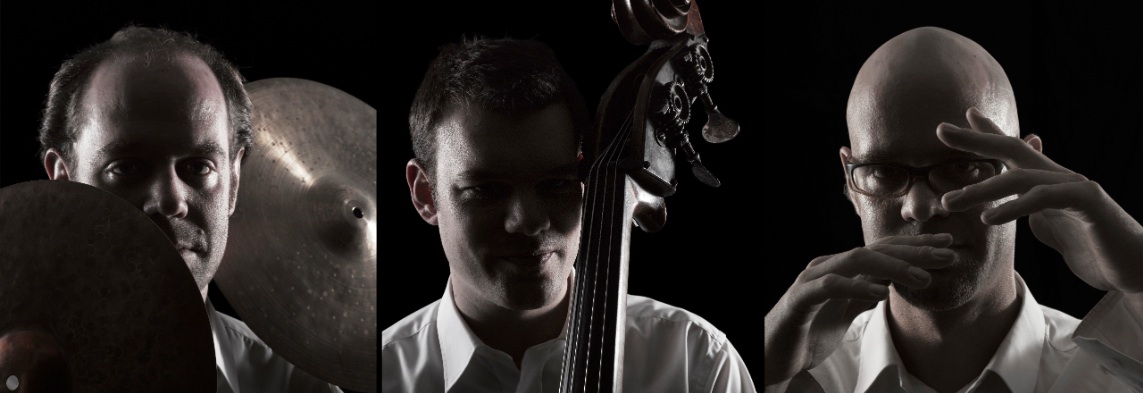
Vein know the business of music. Having met their drummer, Florian Arbenz and pianist, Michael (his twin brother) one thing is clear to me, they have a quiet but effective strategy for being a working band. Stay focused on the goal, don’t be afraid of the dirty work and take risks. Along with double bass player, Thomas Lähns, they also work hard. “Today as a musician you can’t say, ‘I just want to have my fee and that’s it,’ explains Michael, “you have to invest some money sometimes and if you do it right you get it back. It’s more like being a company than being a musician just practising and dreaming – that would be very nice!”
Vein are building their career, brick by brick. Jazz Talks is Vein’s ninth album and features legendary American saxophonist, Dave Liebman. His career includes stints with Miles Davis and Chick Corea – a tangible link to the heritage of jazz of which Vein are clearly so passionate when you hear ‘Walking With a Start’ or ‘Black Tortoise’. Live, Michael ripples with influences from Stravinsky to Bill Evans, but Vein are so steeped in the jazz tradition that they are able to weave in their own voices. Not an overnight achievement. “I think it’s more honest to find something personal and stay with it,” says Michael when we discuss their music style.
Hooking up with celebrated artists has been useful, it nurtures their skills and can connect them to foreign audiences. However, it takes some guts (and talent) to achieve. Greg Osby of the infamous M-Base Collective was the first Michael approached when he was just 23 years old. “It was back in the old days – there was a fax number on the back of one of his CDs and I faxed him and he was very open to play with young musicians, he still is.”
“The good thing was that it was normal to be a musician”
Vein not only make these approaches (a collaboration with a UK saxophonist is next in the pipeline) they also do all the administration and manage themselves. If you check their tour dates below you’ll see what they achieve. Also when you have someone like Liebman in the band, the hotels and travel need to be well organised. Did having parents involved in music (they are both musicians and teachers) help them to understand the business? “The good thing was that it was normal to be a musician,” he says, as musicians can face opposition from their own family, “but it’s more like we’re not afraid to do the dirty work, to call people, it’s a lot of work that’s not nice to do.”
Their curiosity for the piano their father played had them starting music as early as 4 or 5 years old. “The music education was very present but my parents didn’t push us, so it was very natural to get into it.” They also both learnt drums and Michael recalls that making music together was a form of playtime for the brothers, “And after, in our teenage years, it became more serious and it was great to have someone who was the same age and had the same interests.”
“I think we were attracted by the very positive mood of it”
They began listening to their parent’s jazz records and heard Louis Armstrong, Art Tatum and Fats Waller. “I think we were attracted by the very positive mood of it, also it’s kind of virtuoso, and rhythmical with the drums…but I think when we were kids we weren’t analysing it…Louis Armstrong: it’s almost like a celebration or something and we were attracted by that.”
For me, there is almost a telepathy between Michael and Florian onstage but Thomas is an equal member of the crew. “Vein is a collective and this is an important philosophy of the trio…We try to develop to find more possibilities and more freedom on how to play together on an equal level.” The band are always looking for how they can break the traditional roles of a piano trio and be truly multi-dimensional. When I ask what he wants to work on he replies, “Everything…I don’t like to relax and think, ‘Oh now I can do what I want,’ this is dangerous for music. I like to go on and improve everything: to compose better, play better and have more to say – that’s the most difficult”.
16. April VEIN feat. Greg Osby, De Singer, Antwerpen/BE 17. April VEIN feat. Greg Osby, Jazz Celebrations Gorzow/PL 19. April VEIN feat. Greg Osby, Künstlerwerkstatt Pfaffenhofen/DE 20. April VEIN feat. Greg Osby, Jazzkongress Freiburg/DE 21. April St. Ives Jazzclub/UK 22. April Grimsby Jazz/UK 23. April Newcastle/UK 24. April Capstone Theatre. Liverpool/UK 2. Mai Jazzkeller Frankfurt/DE 8. Mai Jazzfestival Schaffhausen/CH 26. Mai VEIN feat. Dave Liebman, Band on the Wall/UK 27. Mai VEIN feat. Dave Liebman, Porgy and Bess, Wien/A 28. Mai VEIN feat. Dave Liebman, Vortex London/UK 29. Mai VEIN feat. Dave Liebman, Jazzlines Birmingham/UK 30. Mai VEIN feat. Dave Liebman, Porgy en Bess, Zeeland/NL 31. Mai EIN feat. Dave Liebman, Platformtheater Groningen/NL 27. Juni Glasgow Jazz Festival/SCO 10. July Montreux Jazz Festival, Château de Chillon
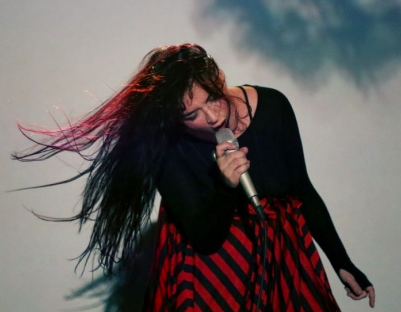
Mains jointes ou offertes, poing tendu, le corps ondulant ou sautillant, la chanteuse Claire Huguenin impose d’emblée son style très particulier. La vocaliste de Bulle dont tout le monde parle a choisi de dévoiler en formule acoustique son premier projet solo, Jibcae, au Temple de Cully. Jibcae est un OVNI musical qui tente des ponts audacieux entre des penchants musicaux et sentimentaux extrêmements variés. Claire Huguenin est du genre à frapper vite et fort. Pour donner le ton, elle enchaîne trois morceaux d’une intensité folle, dont un a cappella poignant. Elle happe ainsi l’auditoire dans son monde d’introspection, un monde le plus souvent obscur qu’elle illumine de son sourire, de sa voix et de sa gestuelle.
Les limites du 100% acoustique
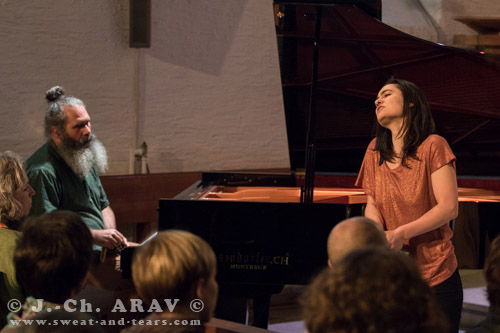
A ses côtés, le grand manitou du piano, Malcolm Braff, s’essaie à la retenue, la harpiste Julie Campiche développe les myriades de notes de son instrument avec parcimonie pendant que le bassiste Jeremias Keller (le seul instrument électrique) s’occupe de la ponctuation. Le concept des concerts du temple est de ne jamais sonoriser les ensembles. Difficile dès lors de brider les instruments par nature plus forts, dont l’imposant piano à queue de Malcolm Braff.
Little big woman
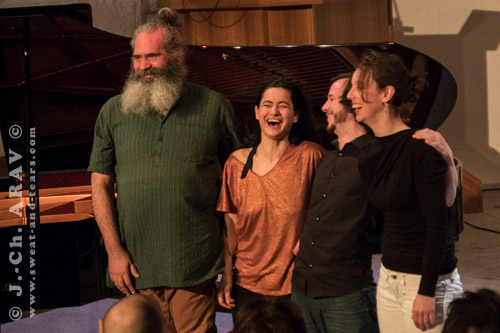
Ce qui n’empêche pas Claire Huguenin de continuer sans faillir son évocation de l’intime, des sentiments à fleur de peaux, des sensations pas forcément agréables, comme ce « Weary Dany » en duo voix-contrebasse qui évoque l’ennui. Le monde de Claire Huguenin est peuplé d’esprits, de gens qui ne communiquent plus, de ruptures, de fracas. Et sa voix fonctionne comme un écho à ses ruptures, ses cabosses, ses éclats de rire. Evidemment, l’équilibre est périlleux, difficile à tenir de bout en bout. Variant les modes, déstabilisant l’auditeur en jouant sur le tragi-comique, Claire Huguenin et ses musiciens taillent néanmoins leur route. Il faudra encore certainement quelques prestations live pour que ce projet atteigne sa pleine puissance. Mais le potentiel, la grâce et la trempe de cette « little big woman » (pour reprendre l’expression d’un Internaute subjugué) sont de ceux qui marquent durablement. Merci !
Elina Duni moved to Switzerland when she was ten, five years after she’d first stepped on a stage to sing in her homeland, Albania. Later, studying music in Bern led to a crucial meeting – with pianist and composer, Colin Vallon. It’s Vallon, along with drummer Norbert Pfammatter and now Patrice Moret on bass, who held a mirror up to Elina so she could see who she is and be free to draw on the rich cultural soil of the Balkans.
Elina’s second album for the major label ECM is Dallëndyshe (The Swallow) and listening to it immersed me in a bubble of ancient and distant lives where women call their loves ‘Ylber’ (rainbow) as they watch them leave green hills for work or, war. With titles such as ‘Nënë moj’ (O, Mother) and ‘Kur të pashë’ (When I Saw You), Elina describes them as ‘songs of love and exile’ but somehow the purity of the melodies and simplicity of delivery make them timeless.
What were you driven to express and explore in this album?
Elina Duni I think the word ‘timeless’ is very important in this case…You can feel the songs’ strength because they’ve crossed centuries and the melodies are archaic and deep. It’s this mixture of the contemporary perception each one of us has being a musician living in today’s world and the fact [the songs] are related to something that concerns all of us – we are all migrants, it’s the fate of all human beings: leaving behind something you love, going abroad, going from countryside to city, themes that are universal.
Where and how are did you find these traditional songs?
Elina Duni You may be surprised or maybe not, I found them on YouTube! Albanian friends are always suggesting songs and a friend of mine living in Greece put ‘Fëllënza’ on my wall on Facebook.
‘Fëllënza’ has a melody that has my dopamine triggers firing like Dirty Harry and Elina’s voice is so intimate you feel she’s singing with her head next to yours on a single pillow. Colin Vallon’s tangential arrangement steers it clear of saccharine-slush whilst on ‘Unë në kodër, ti në kodër’ (Me on a Hill, You on a Hill) he hypnotises, plucking piano strings like a cimbalom.
Elina Duni This is one of the songs where Colin wrote the arrangement with the bassline and the ‘mantra’, I had the melody and rhythm but he takes the song to another level…The three of them are wonderful musicians, they never play ‘1st degree music’. For me, art is the distance we take from things, it’s playing or looking at them in the 2nd, 3rd and 4th degree…Balkan music can be so pathetic [evoking pity] and it’s really a trap, somehow this distance from the pathos is the art.
When I started singing these songs Colin told me to imagine how Miles Davis would sing these themes – as simple as possible. When I do an ornament then it’s really thought out, I try not to do too much so when I do something it stands out. It’s the manner for the whole quartet.
You said that we live in a time where there is a need for poetry, say more about this.
Elina Duni Poetry has its own music, you can listen to a poem that you don’t understand and still cry with it… [the language] Albanian has something very interesting, it has a lot of sounds in it and it is a very, very old European language. It has Latin and Turkish words and, they say, also from the Celts, and it has something very deep and at the same time, strange.
Tell me about your childhood in Albania and how you feel about your homeland now.
Elina Duni There is a phrase, ‘there are two tragedies in life: to have a wonderful childhood and to have an awful childhood’. So, I had a wonderful childhood. In Albania it was another time that doesn’t exist anymore, there were no cars, no consumerism, no Coca Cola, no aluminium…we used to be happy when we could eat a chewing gum because it was very rare, or chocolate. We were raised in the neighbourhoods, everybody was going to everybody’s houses…and we were free. We grew up jumping, climbing the trees and running and fighting and being outside all the time…the imagination played a very important role. Everyone was writing poetry and reading…I think this was a golden time.
For me Albania is always inspiring, I go very often, it’s like all the countries that are transforming themselves, they have something alive there. Unfortunately Albanian society is still macho and patriarchal, it’s changing slowly, but there is a lack of models for women…The best thing is to educate women…and to show that being free is not being a sexual object which is hard because the media promotes this – and the singers too. There are so many in Albania, every good-looking girl puts on a mini skirt, makes a video clip and she’s a ‘singer’. I try to do my best to promote another model of woman.
What other projects are you doing?
Elina Duni I’ve been doing a solo project where I sing Albanian songs with guitar but I also did an album a year ago as a singer/songwriter where I wrote songs in Albanian so I’m going on writing, in French and English too…I love the quartet but I am trying to diversify so I’m writing as much as possible to find my way into music – which is not as simple when so many things have been done and you want to find your own original way at looking at things.
I still don’t know where all this is going to lead, the thing is I love acoustic music so maybe this can be a duo with voice and piano, it depends on who your partners are on the adventure, who you find. I would like to go more electric because it is a sound that really attracts me. These days there are no boundaries and you can explore without losing your identity. I love to sing my songs, that’s my biggest dream.
Elina Duni Solo
12.04.15 Cully Jazz Festival – Cully, CH Elina Duni Quartet
21.04.2015 Jazzkaar Festival – Tallinn, Estonia
22.04.2015 Viljandi Folk Music Center, Estonia
24.04.2015 Salle des Fêtes de Carouge – Genève, CH
26.04.2015 Dampfschiff – Brugg CH
29.04.2015 Centralstation – Darmstadt, Germany
09.05.2015 Treibhaus – Innsbruck, Austria
10.05.2015 Bee-Flat im Progr – Bern, CH
27.05.2015 Moods – Zürich, CH
29.05.2015 Paradox – Tilburg, Netherlands
31.05.2015 Rote Salon – Berlin, Germany
13.06.2015 Schloss – Thun, CH
21.06.2015 Bibliothéque Universitaire et cantonale – Lausanne, CH
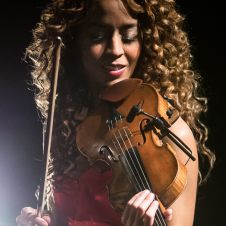
Bringing a myriad of verve, elegance and exotic rhythms to the Swiss jazz scene is Havana-born Yilian Cañizares. Classically trained violinist, singer, songwriter, dancer, teacher – there are many feathers to her cap. With a highly acclaimed 2nd album, ‘Invocación’, recently released on Naïve Records and an anticipated live performance at this year’s Cully Jazz festival, Yilian talks about the music that has shaped her and the important role that Switzerland has played in her musical evolution.
How did the violin become part of your life?
Yilian Cañizares: I come from a sporty, musical family and a country where music, singing and dancing are a big part of the cultural identity. As a three year old, singing came first followed by dancing. At music school aged 7, I was directed towards the piano but the minute I saw the violin I felt such a pull towards it that I knew it had to be MY instrument, even though my family thought I was crazy. I still use the piano for composing but then transfer everything to the violin. I’ve had a very strong classical training, but thankfully through the songwriting I’ve been able to develop my own style. At 16, I went to Caracas, Venezuela, to study with the ‘El Sistema’ youth orchestra where violin tuition was more developed than in Cuba. There I had a French violin teacher who told me that Europe was the epicenter for classical violin studies, so I came to Switzerland especially because of Gyula Stuller, (no.1 solo violinist with the Lausanne Chamber Orchestra). The technical and musical level was just of another standard, I benefitted from all the rich musical heritage that had formed Gyula.
How has moving to Switzerland impacted your musical career?
Yilian Cañizares: The impact has been enormous! There is more cultural diversity happening in Switzerland than people think. Geographical centrality is a key element which means that all that’s happening musically and artistically in Europe is within easy reach. Cuba is culturally rich but is locked inwards, not many international artists go there to play, you can’t always hear or get immediate access to what’s happening musically in the world, the learning curve gets cut short. My 15 years in Switzerland have exposed me to so many different styles of playing, listening, learning and teaching. Being here has made me the musician I am today, my style of playing has grown in a way that would have been impossible to imagine in Cuba. There are so many gifted artists in this small country, I feel very lucky to be part of the dynamic Swiss jazz scene. My cultural heritage is respected and welcomed as a richness that can be ploughed back into this multicultural scene. I’m also touched that major Swiss institutions such as Pro Helvetia, La Ville de Lausanne and Swiss Music Export are helping me develop my career, taking me on as a newcomer and helping me transform into a headline act. They believe I am a good ambassador for the young Swiss scene, as well for Cuban music.
How has being in a Francophone environment affected you?
Yilian Cañizares: I once heard someone say that every time you learn a new language you gain a ‘new soul’. Becoming a French speaker has developed a new sensibility in me and a different aesthetic, it’s all part of the person I’ve become. I can now sing and write in French even if it’s harder for me compared to Spanish, but very much part of my musical direction. I feel an affinity with the language and would like to touch as much of the French-speaking audience as possible, so it’s no coincidence that I’ve signed to a French label, Naïve Records in Paris.
Why did you go to Sweden to record your latest LP?
Yilian Cañizares: Compared to my first LP, I knew I wanted to go onto the next level with regards to my sound. I noticed that a lot of great current music I’ve been listening to has been recorded in Sweden. They have such great studios, such savoir faire, their culture of sound is really unique. So I was very clear about wanting to use Lars Nilsson at Nilento Studios.
What are the musical genres that have shaped you and your style?
Yilian Cañizares: I come from a very classical background where Santería music was coming from next door and Cuban jazz from down the street. Then here in Europe I discovered Stéphane Grapelli and what can be done with the violin especially in the jazz context. I’d say that jazz, as opposed to ‘world music’, is what defines me best because of its power of rebirth, improvisation and freedom. I don’t want to be classified as strictly ‘Afro-Cuban’ since musical evolution and transformation is key to what I do and my aim is to be open to many different spheres.
How would you describe your latest LP, ‘Invocacion’?
Yilian Cañizares: This is my most honest work to date, a real portrait of myself, my lived experiences and all that has shaped me. Above all it’s a homage to loved ones no longer here: my grandfather, family friends, slave ancestors, singers and poets who have taught me so much. Clearly it’s a very personal, heart-felt work with lots of different influences ranging from a Yoruba traditional prayer to Edith Piaf’s ‘Non, je ne regrette rien’. I hope people can feel the Cuban influence in my work, but also all the other important musical journeys that have helped me evolve. I feel a certain responsibility to represent the ‘new Cuba’, a country with a fragmented population struggling to open up to the world. I am so very Cuban, but for now my place is in Europe.
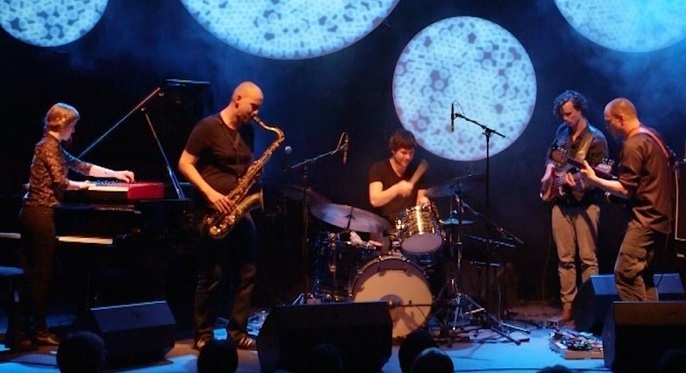
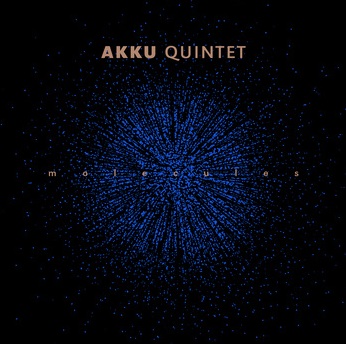
Maja Nydegger’s delicate piano sets up a repetitive motif As readers may know, I like space in music. When I first saw a group of Swiss artists jam with the legendary saxophonist, John Surman, the most impressive were those who knew when to ‘shut it’, to avoid an ugly cacophony. Akku Quintet share this sensitivity and aren’t afraid to step away from the mic. Formed by drummer, Manuel Pasquinelli in 2010, Molecules is the quintet’s second release on Pasquinelli’s own label, Morpheus. It’s an EP more than an album and my sense is they are a band in development.
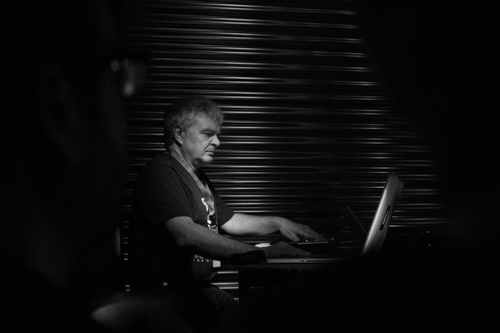
They carefully creep into each track, as in ‘Fluid’ and ‘Schneeman’ when Maja Nydegger’s delicate piano sets up a repetitive motif, almost acting as a mantra for the piece. This is perfectly balanced by the tenor saxophone of Thierry Lüthy who has an assured and warm tone. His notes waft around the piano melody as if the two are in a quiet conversation. When he builds to a sort of circular breathing in ‘Phase Transitions’ it brings a ripple of excitement.
Guitarist Markus Ischer soars through with a woozy-stoned solo
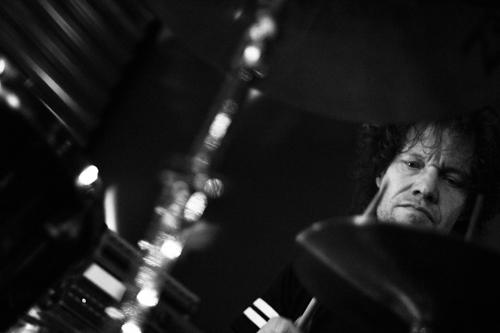
Despite being Pasquinelli’s project he keeps his crisp beats sparse, playing a supportive role and taking time before coming in with off beats, mini-patterns, or simple, unadorned snare and bass drums. Considering the power an electric bass can wield I was rarely aware of it, Andi Schnellmann excels at enmeshing his sound into the others’ like a soft echo of the music.
The best moments come when they suddenly switch the vibe, such as in ‘Schneemann’ when six minutes in, guitarist Markus Ischer soars through with a woozy-stoned solo and Maja subtly responds with low church organ chords and pithy alien-like beeps. Markus Ischer’s guitar is the strongest voice, it resembles Lüthy’s consciousness but with extra drive. He interrupts ‘Phase Transitions’ with a warbling and affected guitar before changing his touch with metallic stabs and long haunting notes, keeping you entranced.
There’s a need to develop grit and emotional vulnerability
Akku are creating soundscapes with tracks lasting 10 to 15 minutes (apart from the quirky and jaunty, ‘Freeze’), however, at times I wanted them to turn up the intensity, the music could become so laid back I became disengaged. There’s a need to develop grit and emotional vulnerability in their themes and playing. They are working with media artist Jonas Fehr for their live shows and I liked the cover artwork by Sandro Galli. Pasquinelli has invested in a limited edition of hand-printed covers for the vinyl edition but his next focus should be developing the band’s voice so it stays relevant and is not shy of demanding to be heard.

 De Bienne à Zurich, de Genève à Berne, la scène musicale suisse explose de talents, pour la plupart inclassables. Et cette fois nous allons vous le prouver! Le Centre culturel suisse a en effet invité Swiss Vibes le temps d’une carte blanche, le temps de trois double-concerts aux couleurs forcément éclectiques.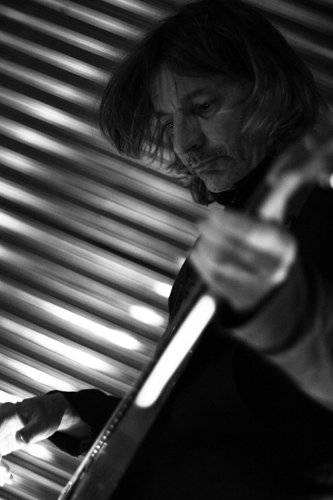
 Vein are building their career, brick by brick.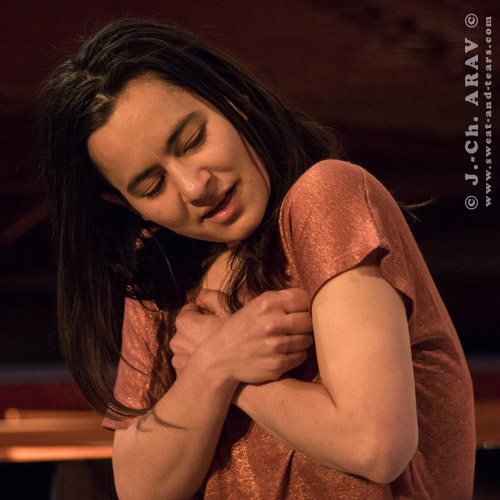
 Mains jointes ou offertes, poing tendu, le corps ondulant ou sautillant, la chanteuse Claire Huguenin impose d’emblée son style très particulier. La vocaliste de Bulle dont tout le monde parle a choisi de dévoiler en formule acoustique son premier projet solo,
  A ses côtés, le grand manitou du piano,
  Ce qui n’empêche pas Claire Huguenin de continuer sans faillir son évocation de l’intime, des sentiments à fleur de peaux, des sensations pas forcément agréables, comme ce « Weary Dany » en duo voix-contrebasse qui évoque l’ennui. Le monde de Claire Huguenin est peuplé d’esprits, de gens qui ne communiquent plus, de ruptures, de fracas. Et sa voix fonctionne comme un écho à ses ruptures, ses cabosses, ses éclats de rire. Evidemment, l’équilibre est périlleux, difficile à tenir de bout en bout. Variant les modes, déstabilisant l’auditeur en jouant sur le tragi-comique, Claire Huguenin et ses musiciens taillent néanmoins leur route. Il faudra encore certainement quelques prestations live pour que ce projet atteigne sa pleine puissance. Mais le potentiel, la grâce et la trempe de cette « little big woman » (pour reprendre l’expression d’un Internaute subjugué) sont de ceux qui marquent durablement. Merci !