Jeden Frühling wird das Gefieder erneuert. Für Swiss Vibes bedeutet dieser Gefiederwechsel eine Zeit der Unterbrechung. Wie ihr wisst, ist der seit fünf Jahren existierende Blog Swiss Vibes ein Sprachrohr der schweizerischen Musikszene, angeregt und belebt durch Journalisten aus der Schweiz, Frankreich, Deutschland sowie England. In seinen Anfängen (im Jahre 2009) war Swiss Vibes jedoch nur eine einfache Zusammenstellung, ein Sampler, der von Pro Helvetia* ins Leben gerufen und jedem Abonnenten des französischschweizerischen Magazins Vibration zugestellt wurde. Der Erfolg dieses ersten Samplers führte 2011 zur Fortsetzung. Zu dieser Zeit entwickelte sich die Idee eines Blogs, welcher mehr Informationen enthält und somit der schweizerischen Musikszene, welche sich im Aufschwung befindet, größere Bedeutung zukommen lässt.
Aus einem einfachen Blog, bei dem ich die einzige Redakteurin, Animatorin und Aktivistin war, entwickelte sich schnell ein Webmagazin mit Artikeln auf verschiedenste Sprachen, welche aus den Federn leidenschaftlicher Journalisten entstanden : Beatrice Venturini, Debra Richards und HP Kuenzler (für die englischen Teile), Oliver Hochkeppel, Benedikt Sartorius, Souri Thalong, Benedikt Wieland (für die deutschen Teile) et Timothée Barrière, Jean-Cosme Delaloye, Sophia Bischoff und Ich (für die französischen Teile). Innerhalb kurzer Zeit wurde Swiss Vibes von Schweizer Musikern anerkannt, welche bei jedem neuen Projekt unsere Dienste ersuchten. Manche haben sich sogar aktiv beteiligt, indem sie ein Logbuch schrieben oder uns Fotos ihrer Tourneen sendeten. Danke an alle, für diese wertvollen Beiträge!
Heute, Pro Helvetia – welche die einzige Struktur ist, die Swiss Vibes finanziert – hat entschieden ihre Internetstrategie erneut zu überdenken. Swiss Vibes nimmt sich daher Zeit für Überlegungen und wird die regelmäßige Veröffentlichung von Artikeln unterbrechen. Ich persönlich nehme nach fünf fruchtbaren und bereichernden Jahren Abschied von Swiss Vibes. Tausend Dank an alle und bis bald, auf neuen musikalischen Abenteuern.
A chaque printemps sa mue. Dans le cas de Swiss Vibes, cette mue va prendre les allures d’un temps de suspension. Comme vous le savez, Swiss Vibes est, depuis plus de cinq ans, un blog porte-parole d’une scène musicale suisse actuelle et active. Il est animé par des journalistes suisses, français, allemands et anglais. A ses débuts (en 2009), Swiss Vibes n’était pourtant qu’une simple compilation, un sampler, produit par Pro Helvetia*, envoyé aux abonnés du magazine helvetico-français Vibrations. Fort du succès remporté par ce premier sampler, l’opération fut reconduite en 2011. C’est là que l’idée germa de créer un blog afin d’amener plus d’informations et d’ampleur à cette scène suisse en pleine expansion.
D’un simple blog, dans lequel j’étais la seule rédactrice, animatrice et activiste, Swiss Vibes s’est rapidement développé en un webmagazine avec des articles en plusieurs langues signés de la plume aiguisée de journalistes passionnés : Beatrice Venturini, Debra Richards et HP Kuenzler (pour la partie anglophone), Oliver Hochkeppel, Benedikt Sartorius, Souri Thalong, Benedikt Wieland (pour la partie germanophone) et Timothée Barrière, Jean-Cosme Delaloye, Sophia Bischoff et moi-même (pour la partie francophone). Rapidement les musiciens suisses ont adopté Swiss Vibes et nous sollicitaient à chaque nouveau projet. Certains ont même participé activement, écrivant journal de bord ou nous envoyant des photos de leurs tournées. Merci à tous pour ces précieuses contributions !
Aujourd’hui, Pro Helvetia – qui reste la seule structure à financer Swiss Vibes – a décidé de repenser sa stratégie Internet. Swiss Vibes prend donc le temps de la réflexion et interrompt la mise en ligne régulière d’articles. Quant à moi, je prends congé de Swiss Vibes après ces cinq années d’échanges fructueux et enrichissants. Merci encore 1000 fois à tous et à bientôt pour de nouvelles aventures musicales !
Springtime brings change. In the case of Swiss Vibes, this change translates as putting things on pause. As you know, Swiss Vibes is a website that has been higlightning the current Swiss music scene for over five years. It is run by Swiss journalists in French, German and English. At the start in 2009, Swiss Vibes was just a simple compilation, a sampler produced by Pro Helvetia*, sent to subscribers of the Swiss-French magazine ‘Vibrations’. Building on the success of this first sampler, the operation was extended in 2011. Hence, the idea arose of creating a blog to give more information and scale to this booming musical Swiss scene.
From a simple blog, for which I was the only editor, writer and activist, Swiss Vibes quickly developed into a web magazine with articles in several languages penned by enthusiastic reporters: Beatrice Venturini, Debra Richards and HP Kuenzler (in English), Oliver Hochkeppel, Benedikt Sartorius, Souri Thalong and Benedikt Wieland (in German), Timothy Barrière, Jean-Cosme Delaloye, Sophia Bischoff and myself (in French). Swiss musicians quickly adopted Swiss Vibes, coming to us with each new project. Some even participated actively by submitting their diary entries or sending us pictures of their tours. Thank you all for these valuable contributions!
Today, Pro Helvetia (which remains the only structure to finance Swiss Vibes) has decided to rethink its Internet strategy. Swiss Vibes therefore is taking time out to reflect and will interrupt the regular posting of articles. As for me, I’m signing off from Swiss Vibes after five years of fruitful and enriching exchanges. Thanks again a 1000 times to all of you and hopefully see you soon for new musical adventures!
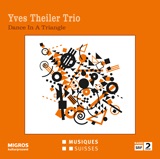
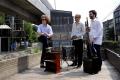
Vor vier Jahren erschien das Debut-Album des Yves Theiler Trio und wurde von der SRF2-Kulturredaktion gleich zum Trio-Album des Jahres gekürt. Eigentlich hätte er schon früher nachdoppeln wollen, sagt der 28jährige Pianist aus Zürich, aber ein Personal-, beziehungsweise Instrumentenwechsel hatte eine Verzögerung zur Folge. Statt dem Fretless-Ebass von Valentin Dietrich ist nun der Kontrabass von Luca Sisera zu hören, mit dem Theiler auch in der Band Roofer zusammenspielt. Der Klang des Instrumentes zusammen mit Siseras fluid-melodischem Stil verleihen dem rhythmisch explosiven und doch kristallklar präzisen Sound des Trios eine geradezu sonnige, neue Wärme.
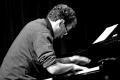
So viel wird bereits im ersten Stück des von Radio SRF2 ko-produzierten Zweitlings “Dance in a Triangle” klar. Es heisst “For Bass” und beginnt mit einer fast zweiminütigen Einführung, wo eine fein gesponnene Bassmelodie von einer insistenten, einzelnen Pianonote und Perkussion vorwärtsgetrieben werden, ehe Theiler einen druckvollen Groove und eine labyrinthartige Melodie ins Geschehen einführt, die irgendwo zwischen Afrika und Erik Satie angesiedelt ist.
Mit dem Perkussionisten Lukas Mantel arbeitet der Pianist seit zehn Jahren zusammen. Das daraus resultierende telepathische Verständnis erlaubt es dem Trio, die überaus subtile Komplexität von Theilers Kompositionen – sie beginnen zumeist mit einer Improvisation allein am Klavier – mit einer rhythmischen Dynamik auszuleuchten, welche der atemberaubenden Virtuosität des Gebotenen einen starken, emotionellen Rückhalt gibt. Mit jugendlicher Verspieltheit jongliert Theiler mit Techniken und Stilen aus der ganzen Welt zwischen Eritrea, Ahmad Jamal und Post-Rock. Dennoch tritt nie das Gefühl auf, man habe es mit einer Elster zu tun, denn jeder Musiker hat seine eigene Stimme und schreckt nicht dafür zurück, sie laut und deutlich einzusetzen. Ein Album voller Witz, Energie und kühnen Kurven.
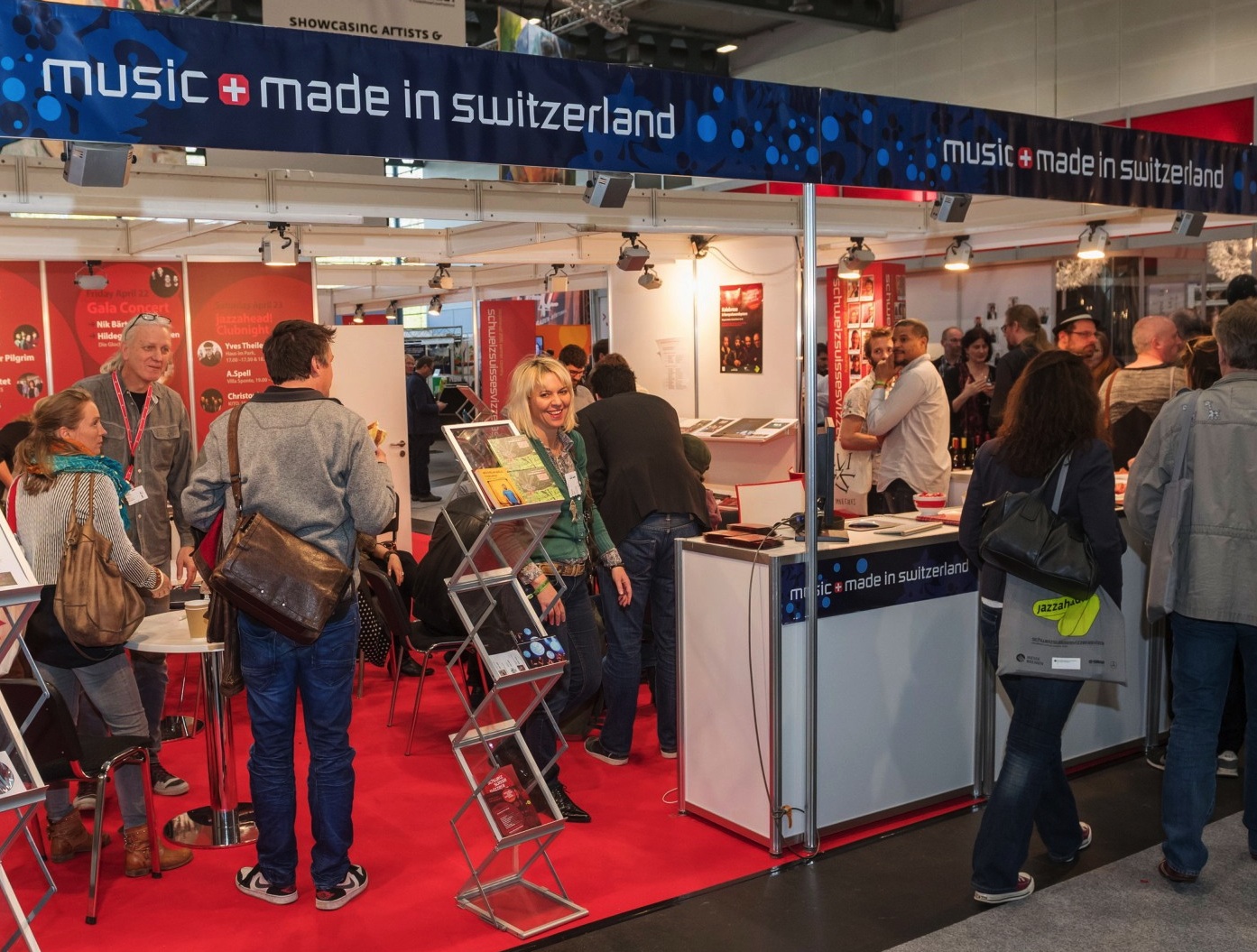
It’s a strange beast: the jazz trade fair. There’s networking, business talks and sets of exactly 30 minutes, with audiences legging it from one hall to another to catch as much music as they want. It’s pretty intense. Wisely, Erika Stucky, with Marc Unternährer and Lucas Niggli, had been invited to open Jazzahead – not only is she an anarchic ‘force of nature’ but she embodies a side of the Swiss spirit I like: bohemian, gifted and pushing music as far as they can (see video of her in the men’s toilets at Jazzahead below).
Erika Stucky with Lucas Niggli and Marc Unternährer, filmed by Chris Philips of Jazz FM.
“I see what you mean about the drummer.”
Generally, the Swiss night was one of super-quality, despite most bands starting nervously. The better musicians were able to get drawn into their own sound and so, lead the audience into places where magic can happen. I wrote of Elina Duni‘s voice before and it rang clear and true in this gig with her quartet – I wasn’t the only one whose neck hairs were electrified when she sang ‘Fëllënza’. I’d pointed out to a UK promoter how wonderful Norbert Pfammatter is in the band, his playing is so sensitive it’s as if there is no drummer but a sweeping landscape in which Elina stands. During the gig this promoter leant over and said, “I see what you mean about the drummer.” From the audience’s response to Elina they were equally captivated. In the future, whatever context she performs in, I want to see her going places.
Maybe the most obviously successful act was Julian Sartorius’ drum solo
Someone else who made their mark was Christoph Irniger, warming into Pilgrim‘s set and launching a cracking sax solo that blew the cobwebs away. His time in New York came
Plaistow. Photo: Ingo Wagner
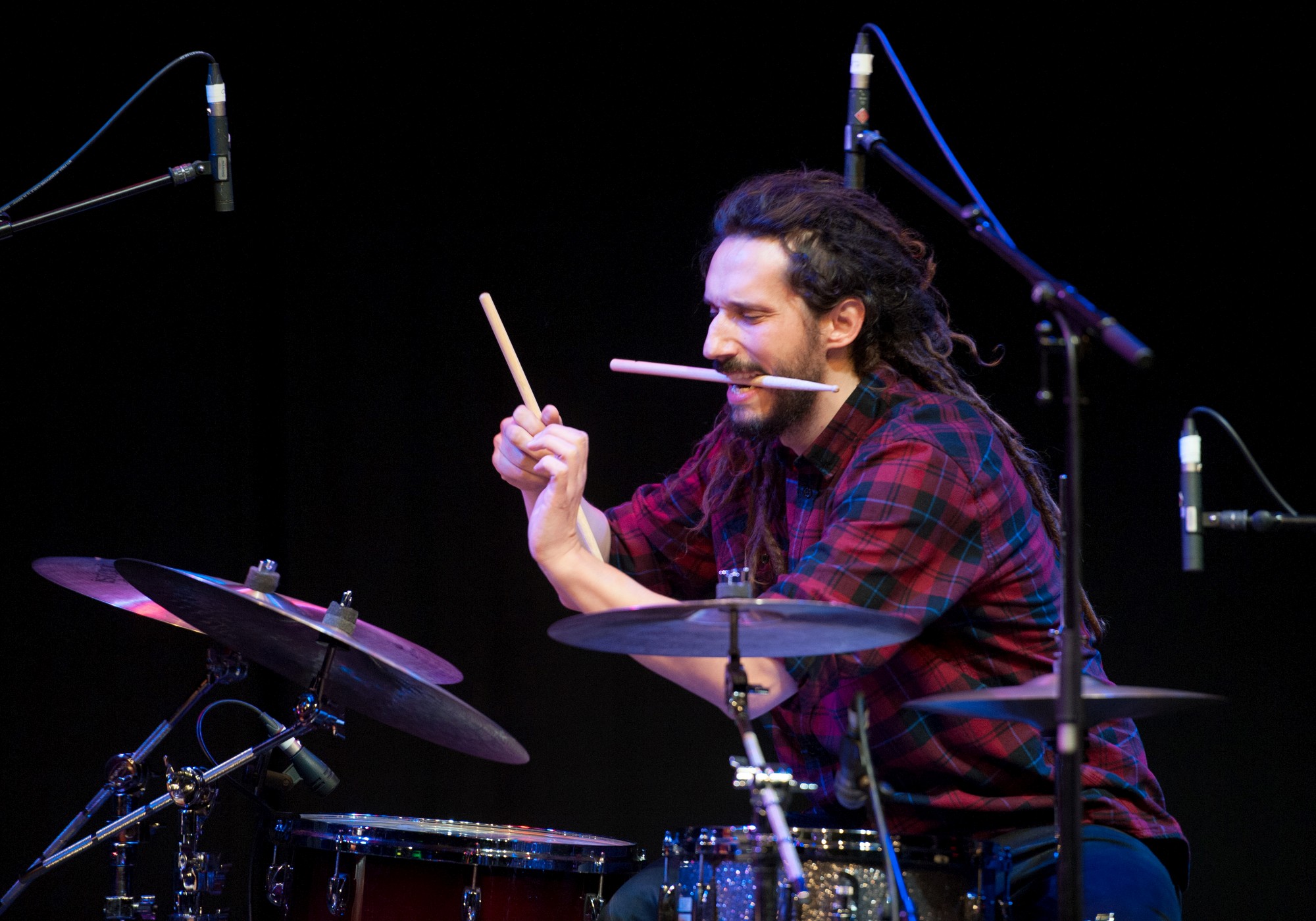
through in the attack he gave it. I was holding my breath at the start of Plaistow‘s gig because like so many bands they are an experience that needs time and a concentrated atmosphere – not what you get in a showcase. However, their narcotic concept with it’s fascinating rhythms had a booker for a big London club tell me they were the most engaging band of the night. Another, and maybe the most obviously successful act was Julian Sartorius‘ drum solo. It was a big ‘wow’ and my mate, Jez Nelson, a key jazz radio presenter said, “It’s hard to do something like that, but he was genuinely inventive.” Elisabeth Stoudman gives a wonderful in-depth review below.
Next year I expect to see more Swiss women onstage
Julian is also part of the Colin Vallon Trio – another artist I expect much of. His set was not only elegant but so assured; it showed the quality of Swiss musicianship. Luca Sisera’s Roofer played a more traditional style well, whilst pommelHORSE had more character but were also left wanting. To be fair they’d been delivered a bit of a blow when key member, Lukas Roos, left the band two weeks before this gig. I see a nugget of some possibility, especially with Olivier Zurkirchen on keys and one UK programmer said the band brought a narrative to their music he liked. Weird Beard looked more comfortable on stage than they did last year and delivered their ideas clearly with Martina Berther on bass. Next year I expect to see more Swiss women onstage – and that’s an order…
Thomy Jordi nearly blew my hair off
It was a pleasure to attend the Gala Concert at Die Glöcke with Nik Bärtsch’s Ronin and Hildegard Lernt Fliegen because this is where some of the showcase bands could be heading: a high level of recognition with audiences delighting in their music. Both received genuine standing ovations. Ronin’s music and lighting design isn’t messing. It delivers punch after punch, even when Sha is at his most sublimely subtle with his saxophone becoming a hoarse and whispering human voice, or when Nik delivers a melody so painfully sweet that it’s a beautiful surprise. Kaspar Rast is equally imaginative on drums and Thomy Jordi nearly blew my hair off with some electric bass notes worthy of Goldie’s Metalheadz label.
Hildegard Lernt Fliegen. Photo: Ingo Wagner
Such a touching ending
Hildegard’s show was a superbly staged bonanza of ingenious ideas with Andreas Schaerer even conducting the band in an improv – pretty risky in such a context. You may think a vocalist sounding a muted horn or beatboxing whilst singing isn’t your thing, but I would challenge anyone not to fall under his spell. The highlight was how the band brought it right down to such a touching ending. In the encore they sat with their legs dangling off the front of the stage, looking like a bunch of kids playing a charming round on blockflutes. It was a rip-roaring success. Schaerer has driven himself hard since I first saw Hildegard play in 2012 and he’s showing how Swiss music can make a big impact on the world out there. Boom!
Julian Sartorius @ jazzahead! 2016 by Elisabeth Stoudmann
Julian Sartorius
Unlike Colin Vallon or Elina Duni who are already well known on the European jazz scene, Julian Sartorius is the new boy at Jazzahead! Although his solo project is not constrained by any genre barrier, he’s been considered before, part of alternative rock circuit. Backstage, Julian is tense: he’s coming down with the flu and fears this will hinder him. The Bernese drummer comes on stage, as always, aloof and a little shy. Had he not been announced, one could almost have mistaken him for the technician come to do one last check before the set. He sits down and turns instantly into a one-man band.
The audience holds its breath…
Sartorius puts on an impressive show. As expected, there are rhythms that interlock with each other like pearls in a necklace. Some sequences are set up in advance, others are totally improvised. His pockets brimming with drumsticks, Julian Sartorius stays unperturbed throughout. He can drop the sticks at any second to suddenly strike a percussion with his hand or place a felt mat on a cymbal. He then puts odd objects on his snare drum: percussive bits and pieces that he strokes, rubs and strikes with amazing feeling. Tension mounts in a jubilant crescendo. The audience holds its breath, captivated, when without warning, Julian Sartorius stops everything. Time’s up. The thirty minute showcase – that only felt like five – has passed. The audience is galvanized, excited, happy. We can only hope that Julian Sartorius has the flu before every gig. It seemed to serve him well!
Le duo genevois The Chikitas sort son troisième album, « Wrong Motel », sur fond rock décomplexé.
À tous ceux qui cherchent un rock lisse et sans saveur, passez votre chemin. The Chikitas représente l’antonyme même de ce concept. Le duo féminin genevois s’illustre par la fureur de sa proposition. Chant et riffs de guitare électrisants délivrés par Lynn; rythmique défoulante portée par Saskia. Leur union explore et triture toutes les facettes les plus brutes et authentiques du rock, en y infusant le meilleur du punk et du grunge.
Dès la naissance de leurs deux premiers albums, « Butchery » (2011) et « Distoris Clitortion » (2014), The Chikitas ont convaincu par la qualité et le tempérament de feu de leur univers. Après avoir écumé les scènes suisses, les Romandes sont parties à l’assaut de la France, de l’Europe de l’Est et, point d’orgue à leur palmarès, du CMJ de New-York. Reconnaissance scénique, couronnée par les professionnels d’un Rock-Award à la Demotape Clinic 2015 du m4music et d’un Rock-Award au Swiss Live Talent 2015.
Pour leur troisième album, The Chikitas ont posé leurs instruments à Tucson, en Arizona (USA), pendant vingt jours. Avec la complicité du producteur Jim Waters (Sonic Youth, The Jon Spencer Blues Explosion), le duo a relevé le défi d’un enregistrement analogique pour cristalliser l’essence du son qui l’incarne. Le résultat ? « Wrong Motel » un album qui se doit d’être vécu comme un voyage d’une délicieuse brutalité. L’atmosphère est rythmée par ce crin tantôt punk, tantôt grunge, toujours rock. Un rock sans compromis hurlé, tourmenteur, déchaîné. Un rock qui, parfois, se laisse toucher par du beat-box et du rap, qui se calme pour mieux se rebeller, qui se dévoile sous un groove suggéré.
Au final, « Wrong Motel » est un concentré d’une lourdeur et d’une ferveur tumultueuse; une compilation savamment réfléchie de compositions métalliques, directes et sincères. La seule chose qui pourrait nous manquer, c’est de voir les morceaux prendre vie sous les coups, riffs et hurlements de The Chikitas. Mais ça, c’est pour très bientôt.
Chaque mois, Swissvibes vous présente un nouveau titre extrait de « Inappropriate Behaviour », le nouvel EP de Rootwords.
Incontournable de la scène musicale suisse, Rootwords puise la source de ses créations dans la culture hiphop. Loin de se contenter de recréer l’actuel ou le passé, le rappeur genevois d’origine américaine et zambienne allie des influences éclectiques à son style de prédilection. Le résultat ? Des univers hétéroclites, entre tendances et old school, guidés par le verbe consciencieusement aiguisé de Rootwords, qui mènent l’auditeur dans un voyage musical aux multiples facettes.
Après avoir présenté son premier album, « The Rush » (en 2014), et les EPs de ses débuts sur les scènes suisses, françaises, italiennes, allemandes ou encore chinoises de renom, Rootwords aborde 2016 avec un nouvel EP au concept peu commun. Composé de six titres qui sortiront au compte-gouttes tout les 25 du mois,« Inappropriate Behaviour » oscille entre titres solo et collaborations avec des artistes des quatre coins du monde, encrant ainsi Rootwords un peu plus dans la lignée des artistes citoyens du monde. Chaque mois, nous découvrirons un nouveau chapitre de cet EP avec l’impression de Rootwords sur ce dernier.
Rootwords a levé le voile sur « Inappropriate Behaviour » au travers de titres aux mille couleurs. De lourdes basses vibrantes (« Move (feat. Muthoni The Drummer Queen) »), une escapade au rythme africain (« Voodoo (feat. Blitz The Ambassador) ») et une mélancolie assumée (« She ») qui se relie d’un fil mélodique à l’atmosphère qui plane sur le titre dévoilé aujourd’hui. « Your Kingdom » se dessine sur un fond mélodique composé un beatmaker suisse habitué aux collaborations qualitatives : Celloprod (CasaOne Records). Après avoir façonné des harmonies pour Youssoupha ou encore Keny Arkana, le compositeur s’est laissé inspirer par un sample tiré de « Transients (feat. Szjerdene) » du producteur anglais Bonobo pour offrir le nuage envoûtant qui porte « Your Kingdom ». Sur ce titre, Rootwords reçoit l’artiste chinoise ChaCha à évoquer l’influence que peut avoir la société sur la créativité :
« La vie sur terre peut parfois être perçue comme un long et fastidieux chemin vers notre propre tombe. On se lève, mange, travaille, mange, travaille, joue, mange, dort, et on recommence. A chaque étape, on a souvent l’impression que ce n’est pas assez. On se pose des questions sur nous-même, sur le sens de la vie, on regarde le ciel et tout autour de nous, sans jamais obtenir de réponse satisfaisante. Si je ne vivais que pour moi-même, je ne pense pas que ce serait aussi difficile. Mais aucun homme n’est une île, et en tant qu’être humain, on dépend des uns des autres. Chacun contribue à la vie en société. Mais, à quel point la société me le rend à son tour ?
C’est un cycle sans fin.
En tant qu’artiste, je suis particulièrement sensible aux effets néfastes de la société sur ma créativité. J’ai décidé de collaborer avec ChaCha sur cette chanson car c’est une femme également sensible, en phase avec les ondes électromagnétiques de notre monde. Elle a voulu exprimer le même émerveillement, les mêmes douleurs et craintes que moi lorsqu’elle a entendu cette instru de Cello Prod inspirée d’un sample de Bonobo (qui au passage, a apprécié le morceau). »
One night: eight showcase-acts: the Swiss Night on April 21 will be a highlight of this year’s live program at Jazzahead! Find out more about the eight Swiss bands below. You can also listen to a track of each band selected at jazzahead! here. If you are not attending jazzahead! this year, Arte Concert is streaming the concerts played at Kulturzentrum Schlachthof live there. Alternatively you can also watch all videos of the showcases the next day on www.jazzahead.de In other words, you have no excuse not to follow those guys live or on Internet!
Last week the editor of a UK jazz magazine said how much the office had got into Plaistow’s album Titan. I think they are something special. Plaistow is an acoustic piano trio driven by experimental dance musics, ancient drones and a desire to distill their sound to its most ‘alcoholic’, most potent. Plaistow make for a thrilling listen. At first I wasn’t sure of Geneva-based Cyril Bondi’s drumming style, it seemed to lack swing, bashing the air out of a beat, but at a sweaty, rammed Berlin Jazz Festival club last November, he was brilliant. Unique and aggressive with an engaging, rhythmic sensibility – perfectly coupled with the imaginings of pianist Johann Bourquenez. Irritating, repetitive notes hypnotise under his touch and at other times he sweeps you off your feet with a sweet melody as in ‘Enceladus’ – it has me in a whirl. Johann’s music is so fresh. Growing in confidence is Vincent Ruiz on bass. His sensitivity connects and subtly reflects the band’s ambitions. To learn more about Plaistow, read our selection of articles on Swiss Vibes!
I’ve never seen Colin‘s own trio and am curious, especially as I felt his last ECM album, Le Vent (2014) fell into the ‘contemplative hole’ that undoes many an artist exploring prepared or experimental piano. I suspect Colin is currently going through a time of musical reflection about his direction. His trio is a pretty high-powered crew with drummer Julian Sartorius (who impressed London’s Cafe Oto in March) and Patrice Moret on bass and his appearance at jazzahead! will be a chance to discover where he is now – and what he wants to say. To learn more about Colin Vallon, read our selection of articles on Swiss Vibes!
Seeing Elina playing solo at Cully Jazz last year elevated her even more in my estimation. That woman can sing! She’s been performing since she was five years of age in her native Albania and although she moved to Switzerland when she was ten, you can almost taste her culture and country when she sings. Her experience comes through too – she moves an audience, but is never cloyingly sentimental. I think the drummer Norbert Pfammatter is key to the band, almost the yin to her yang (yes, that way round), responsive to her and tuned in, whilst Colin Vallon leads the music into imaginative landscapes, provoking her to stretch her ideas. The recent addition of Lukas Traxel on bass adds a sparkling energy as I saw when they played the EFG London Jazz Festival last year. I’ve spoken before about Elina evoking universal goosebumps with her emotive expression and that sold-out gig was no exception.
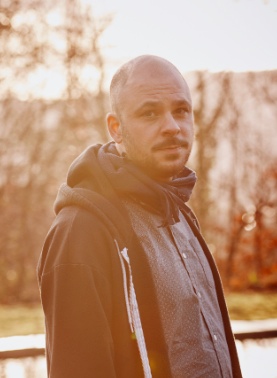
Pilgrim includes Stefan Aeby on keyboards and Michi Stulz on drums – I know their work as part of Tobias Preisig’s quartet and both were crucial to the innovation of Preisig’s album, Drifting. In Pilgrim, Aeby draws on his ability to play an evocative jazz, informed by artists such as Bill Evans in order to echo Irniger‘s direction. Stulz walks an intelligent line between the past and the now and his interplay with Irniger, Aeby and bassist Raffaele Bossard, makes the band something special.
I like Irniger’s choice of electric guitar and Dave Gisler is a highlight of the track ‘Italian Circus Story’ from the album of the same name. Here, Christoph almost whispers in evocative drawls on the saxophone; he tells his tales in a spacious and thoughtful style. Along with the Christoph Irniger Trio and other projects with New York-based artists, he uses trips to the US to immerse himself in the heritage of jazz whilst carefully searching for his own expression.
This confident and original Bernese quintet are a refreshing flight of fancy on the Swiss jazz scene. They inhabit a surreal terrain somewhere between mutant jazz, prog rock and synthy ambiant rhythms. Cleverly creating a story and atmosphere in each track, they juggle an abundance of patterns and ideas always leaving room for improvisation, tempo changes and general dashing about. With tracks entitled ‘Drunk on Christmas eve’ and ‘The circus is closed and all the animals have gone wild’, it’s impossible to resist their playful attitude and experimental forms, both dark and light. Very popular on the live circuit, PommelHORSE are currently working on their third LP.
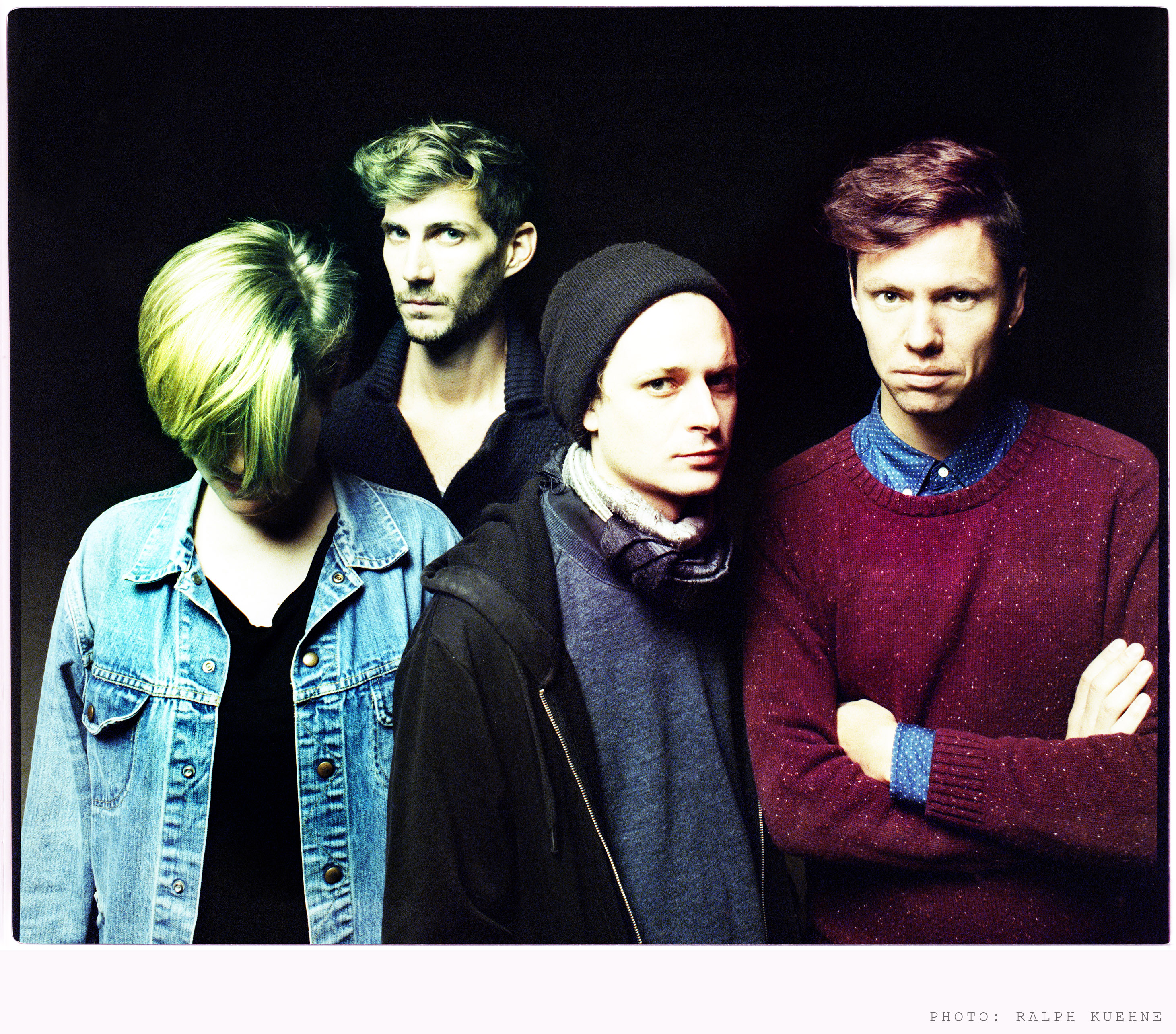
Representing the exciting non-conformity of the contemporary Swiss jazz scene, Weird Beard is a quartet led by saxophonist Florian Egli, featuring guitar, electric bass and drums. The weirdness of their beards is less a facial hair reference, more a hallmark of their musical individuality. A band rooted in the jazz tradition in terms of improvisation and composition, but sonically pulled towards trashy metal, punk riffs and quirky noise. Both lyrical and totally unpredictable, their elegant, laconic sound designs can go off in all directions. ‘Everything Moves’ is their second LP just out on Intakt Records and comes warmly championed by Bugge Wesseltoft who describes the group as having ”musical ideas and inspirations merged into a very fresh and new sound.”
The Swiss musical ecosystem is a richer place because of drummer Julian Sartorius. What David Attenborough is to nature wildlife documentaries, Sartorius is to the world of sound: a beat explorer, a sound forager, a sonic researcher. His gigs are a masterclass in bashing, crashing and smashing – not just the ordinary drum skin or commonplace cowbell, but squeaky toys, handcrafted gongs, hairdryers, electric toothbrushes. Can he hit it? Yes he can.
Agile in pushing boundaries of the percussive sound from hip-hop to abstract electronica, Sartorius opens up endless possibilities and range. His latest video features cymbals rolling along a studio space, poetically crashing about at will. Previous works include a 12 LP box set called ‘Beat Diary’ composed of 365 analogue beats, each one painstakenly researched and accompanied by its own visual. A true artist in every sense of the word, a national treasure.
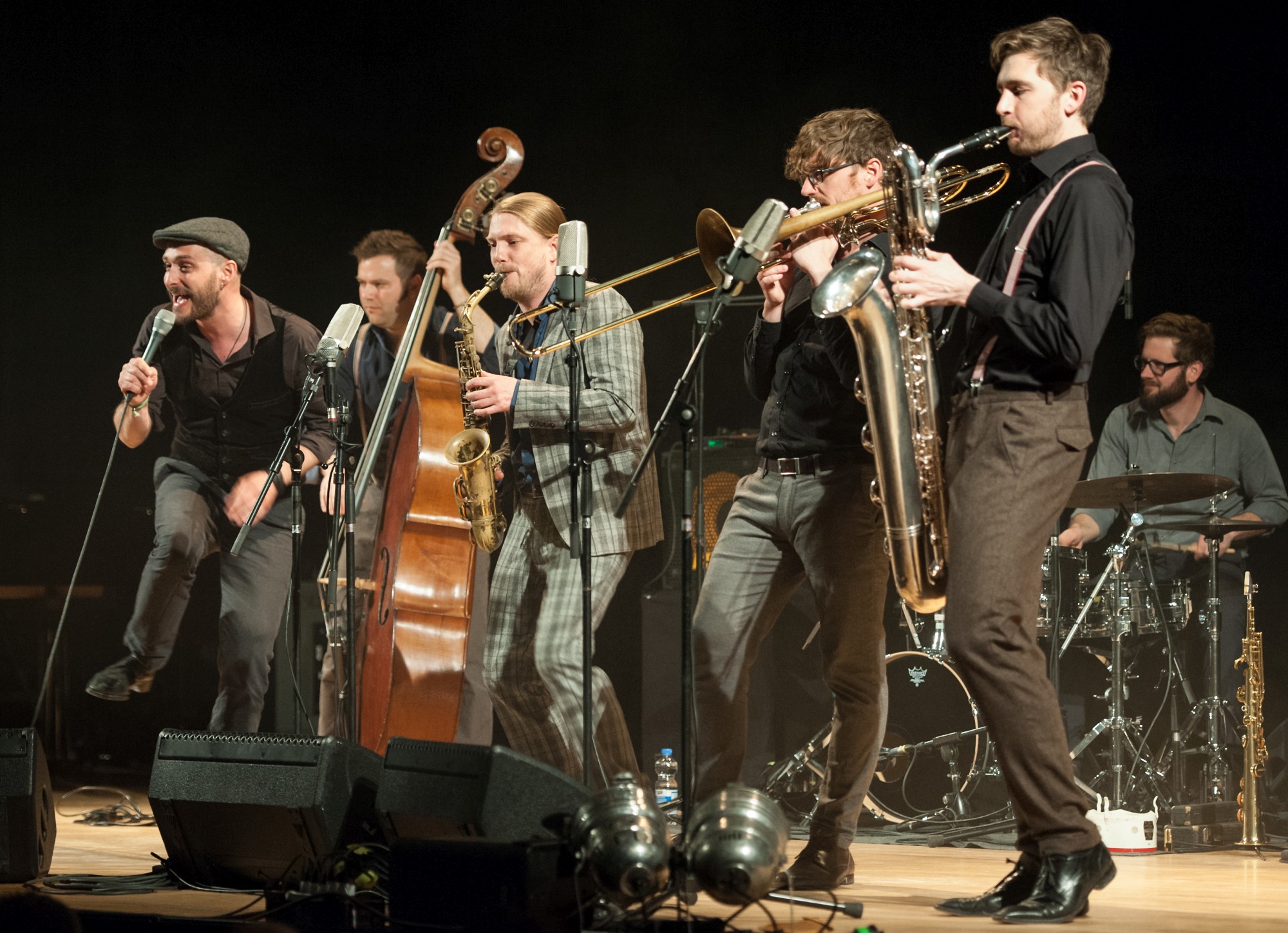
Luca Sisera is a well seasoned Swiss double bass player whose ROOFER quintet describe their sound as “contemporary, liberated jazz music”. Negotiating the fine line between improvisation and composition, the five elements come apart and then reunite in equal measures. There’s a theatrical edge to their music thanks to the horn section adding a lovely big band swing to the complex equation. One minute groovy, sexy, full of bump and grind the next angular, frenetic, swarming around one another like agile birds. The interplay between the musicians is extremely confident and general mood leans towards the playful. An exciting band to watch live because of their warm, busy and inventive approach.
Supporting a very traditional jazz vocalist, (Dianne Reeves), the Akku Quintet played as a very untraditional ‘jazz’ quintet – holding their weight very well as the alternative, slightly dark option on the Cully musical menu. A year ago the band were described as a work in progress, today the quintet comes across as a well-oiled machine full of maturity and articulation.
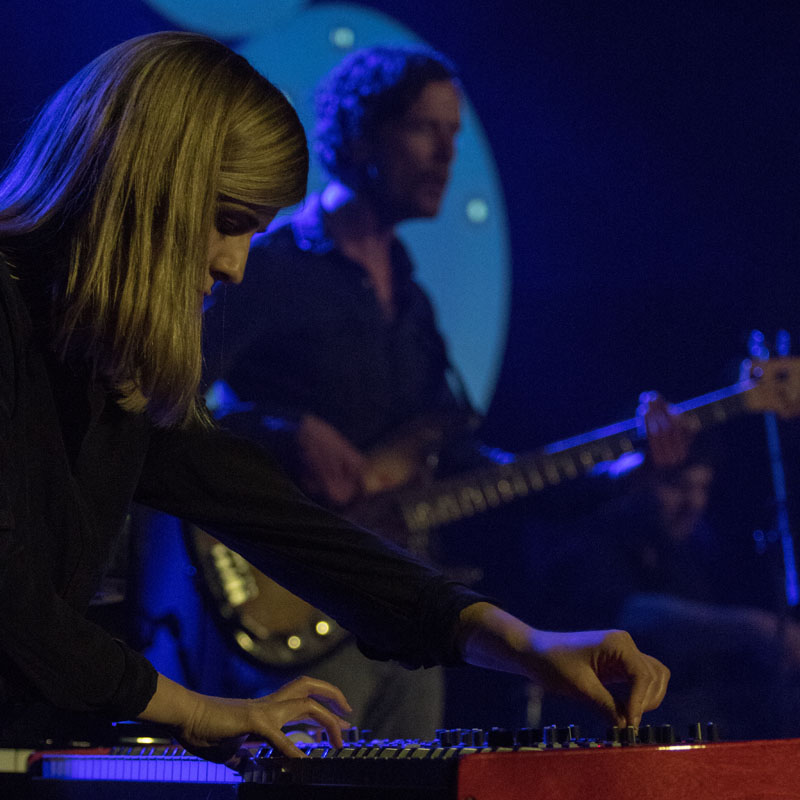
Underpinned by a definite focus on rhythmic and repetitive elements laid down essentially by the drums and keyboards, this quintet is not in a hurry. Their spacious, unhurried approach leaves plenty of room for interplay between all members who get to shine in totally different ways at very different times.
@J-C Arav
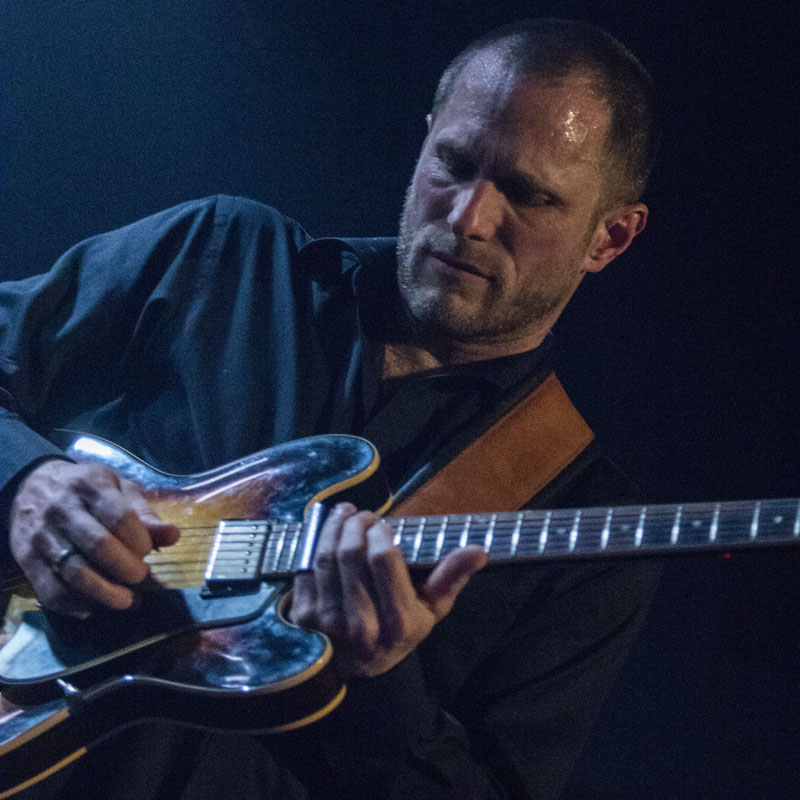
The most attention-grabbing sound is Markus Ischer’s electric guitar which verges towards the psychedelic and is played out to full effect, fuelling the terms ‘jazz rock’ and ‘jazz fusion’ that the band is often labelled with.
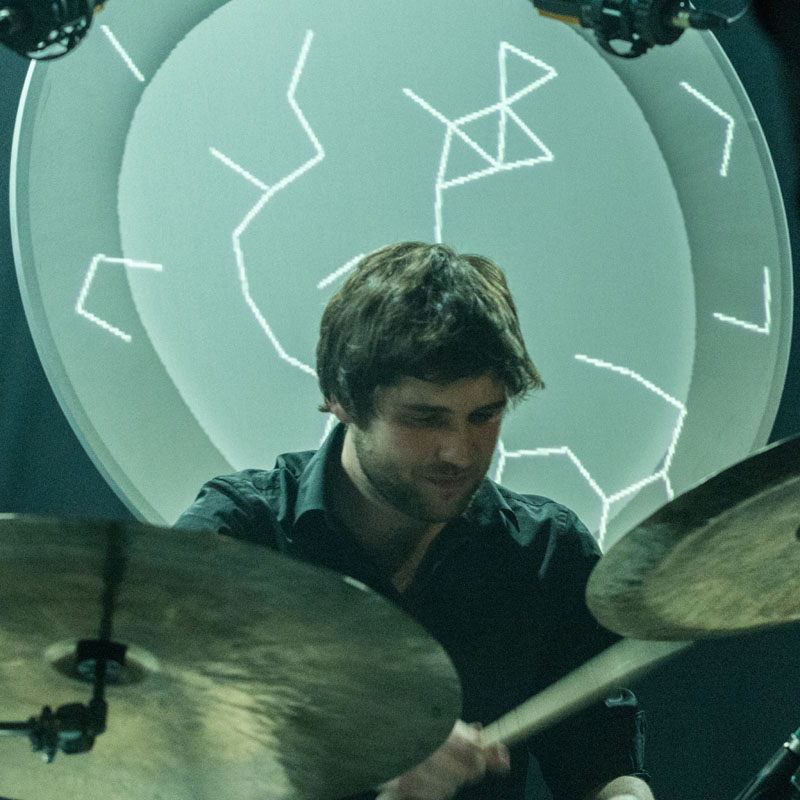
Some of the sound particles in the Akku atmosphere are made of of bleeps, hallucinogenic wails, squeaky outbursts. Music to immerse yourself in like a rich, pulsating heart-beat which occasionally slows down, skips and jerks. As Jonas Fehr’s live visuals suggest, the molecules are in gradual full expansion. Expect a new LP from Akku Quintet in spring 2017.
Some questions and answers with AKKU Quintet drummer and bandleader, Manuel Pasquinelli:
Describe the musical dynamics within the quintet
@J-C Arav
Manuel Pasquinelli: We are a quintet with saxophone, but the the sax is not the only leading instrument. The focus on an instrument changes all the time. We are all leading at different times, each member influences the whole thing. Groove and mood are as important as the solos. A solo is always part of the composition and leads from one part to the other. We try to create a piece of music as a journey. We leave space and don’t always play everything we could. We don’t tell a prefabricated story to the listener, so that the listener can derive their own story or mood.
Do you think you fit easily into the ‘jazz’ genre?
Manuel Pasquinelli: People often say to me “I don’t usually like jazz, but I really like what you do”, so I think that ‘jazz’ is maybe not the right word to describe our music. It’s minimal, ambient, rock with the playfulness of jazz, influenced by different kinds of music (from Nik Bärtsch to Steve Reich, Yann Tiersen, Pink Floyd and beyond).
Manuel Pasquinelli – drums & composition
Michael Gilsenan – sax
Markus Ischer – guitar
Maja Nydegger – keys
Andi Schnellmann – bass
Jonas Fehr – live visuals
‘Levitation’ by Tobias Preisig & Stefan Rusconi – Le Temple, Cully, 9/4/16
@J-C Arav
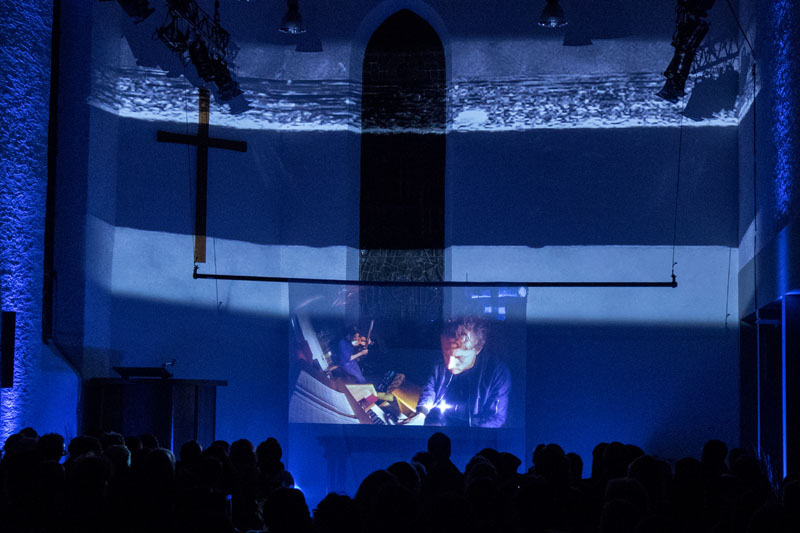
Tobias Preisig and Stefan Rusconi are Swiss pillars of the Cully Jazz musical institution. Their Saturday night performance at Le Temple church marked a return to sacred ground that the duo had already trodden a few years ago. This is the venue that inspired and housed their Levitation project that tonight is played out to an eager audience, most of whom are already familiar with the powerful, intimate exchange between violinist and pianist.
The key feature of the Levitation project is the sensitive, gradually drawn out soundscape created in great part by Rusconi on the church organ which is then supported and teased out by the strings. In practical terms this means having the two musicians play upstairs in the church gallery, heard but not seen from the audience down below. Deciding that this year’s jazz audience needed something to look at, the entire concert was projected on screen at ground level, which, ironically – because of the very bright projector light that was aimed right at the audience – meant that many of us listened with eyes tightly shut, (it was a bit like staring at the solar eclipse without eye protection). Possibly the best way to appreciate the moody, almost Gothic sounds raining down from above.
Some questions and answers with violinist Tobias Preisig:
What’s your relationship to the Cully Jazz festival?
Tobias Preisig: I have a special attachment to Cully Jazz. I’ve been playing here for the last 6 years, I started off in a small caveau as part of the ‘OFF’ programme, then they offered me residency, then larger stages as part of the main programme. There’s a extremely open-minded attitude here and strong commitment to push the next generation. Young and unestablished musicians find a stage here, right next to the superstars. Playing at Cully is definitely the highlight of the year for me. It’s become almost a family gathering with musical professionalism.
Was the material for ‘Levitation’ tailor-made for Cully?
Tobias Preisig: We played as a duo here at Le Temple in Cully a few years ago, performing for the first time with the church organ. Again, it was an opportunity that the festival gave to us. We fell in love with the sound and came back one summer to record at Le Temple for 5 nights. This music is now released as an LP called ‘Levitation’ and yes, it’s definetely tailor-made. So what’s nicer than to celebrate a recording that was actually made in this enviroment?!
Will there be more live gigs with the ‘Levitation’ project?
Tobias Preisig: This is a special side project for both Rusconi and I whose friendship and collaborations go back a long time. So far we’ve only played the material from Levitation live twice! There are a lot of underplayed organs and oversized churches, so we are looking forward to exploring them and awakening them with new music.
 Jeden Frühling wird das Gefieder erneuert. Für Swiss Vibes bedeutet dieser Gefiederwechsel eine Zeit der Unterbrechung. Wie ihr wisst, ist der seit fünf Jahren existierende Blog Swiss Vibes ein Sprachrohr der schweizerischen Musikszene, angeregt und belebt durch Journalisten aus der Schweiz, Frankreich, Deutschland sowie England. In seinen Anfängen (im Jahre 2009) war Swiss Vibes jedoch nur eine einfache Zusammenstellung, ein Sampler, der von Pro Helvetia* ins Leben gerufen und jedem Abonnenten des französischschweizerischen Magazins Vibration zugestellt wurde. Der Erfolg dieses ersten Samplers führte 2011 zur Fortsetzung. Zu dieser Zeit entwickelte sich die Idee eines Blogs, welcher mehr Informationen enthält und somit der schweizerischen Musikszene, welche sich im Aufschwung befindet, größere Bedeutung zukommen lässt.
 Vor vier Jahren erschien das Debut-Album des
  So viel wird bereits im ersten Stück des von Radio SRF2 ko-produzierten Zweitlings “Dance in a Triangle” klar. Es heisst “For Bass” und beginnt mit einer fast zweiminütigen Einführung, wo eine fein gesponnene Bassmelodie von einer insistenten, einzelnen Pianonote und Perkussion vorwärtsgetrieben werden, ehe Theiler einen druckvollen Groove und eine labyrinthartige Melodie ins Geschehen einführt, die irgendwo zwischen Afrika und Erik Satie angesiedelt ist.
 Mit dem Perkussionisten Lukas Mantel arbeitet der Pianist seit zehn Jahren zusammen. Das daraus resultierende telepathische Verständnis erlaubt es dem Trio, die überaus subtile Komplexität von Theilers Kompositionen – sie beginnen zumeist mit einer Improvisation allein am Klavier – mit einer rhythmischen Dynamik auszuleuchten, welche der atemberaubenden Virtuosität des Gebotenen einen starken, emotionellen Rückhalt gibt. Mit jugendlicher Verspieltheit jongliert Theiler mit Techniken und Stilen aus der ganzen Welt zwischen Eritrea, Ahmad Jamal und Post-Rock. Dennoch tritt nie das Gefühl auf, man habe es mit einer Elster zu tun, denn jeder Musiker hat seine eigene Stimme und schreckt nicht dafür zurück, sie laut und deutlich einzusetzen. Ein Album voller Witz, Energie und kühnen Kurven.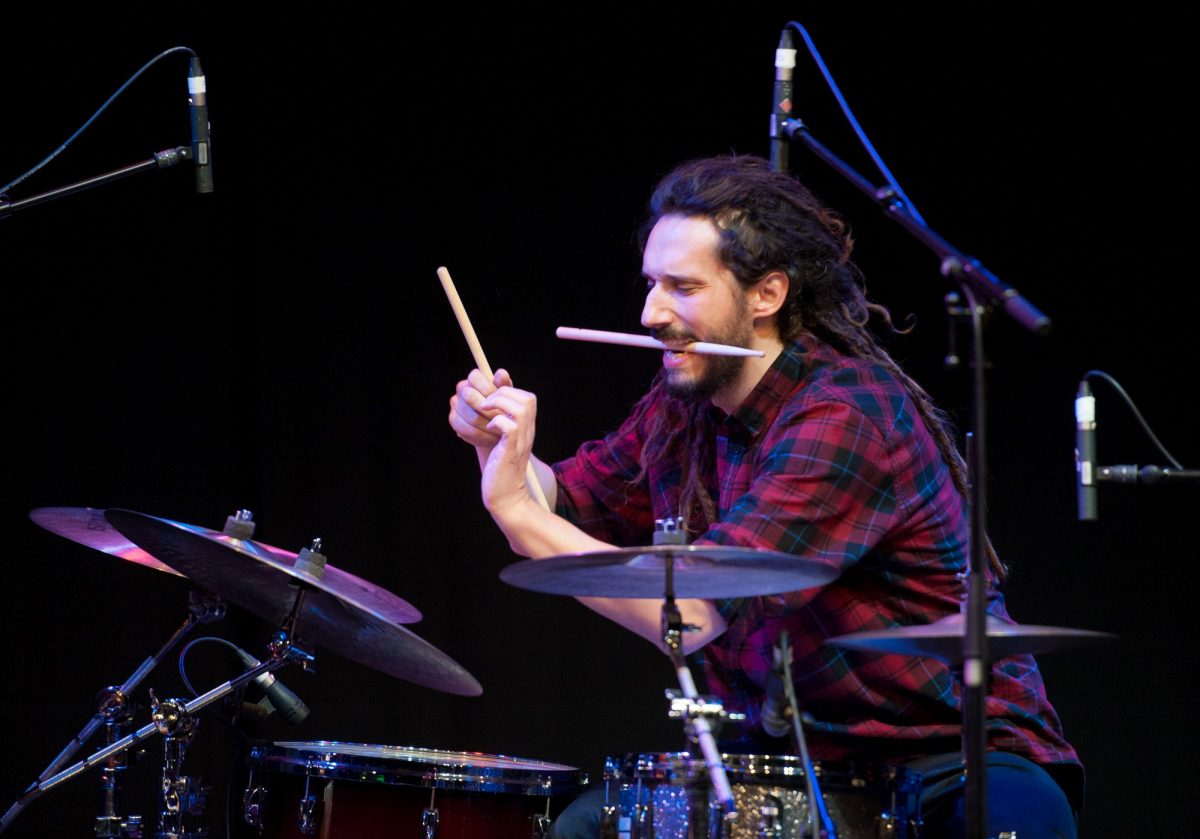
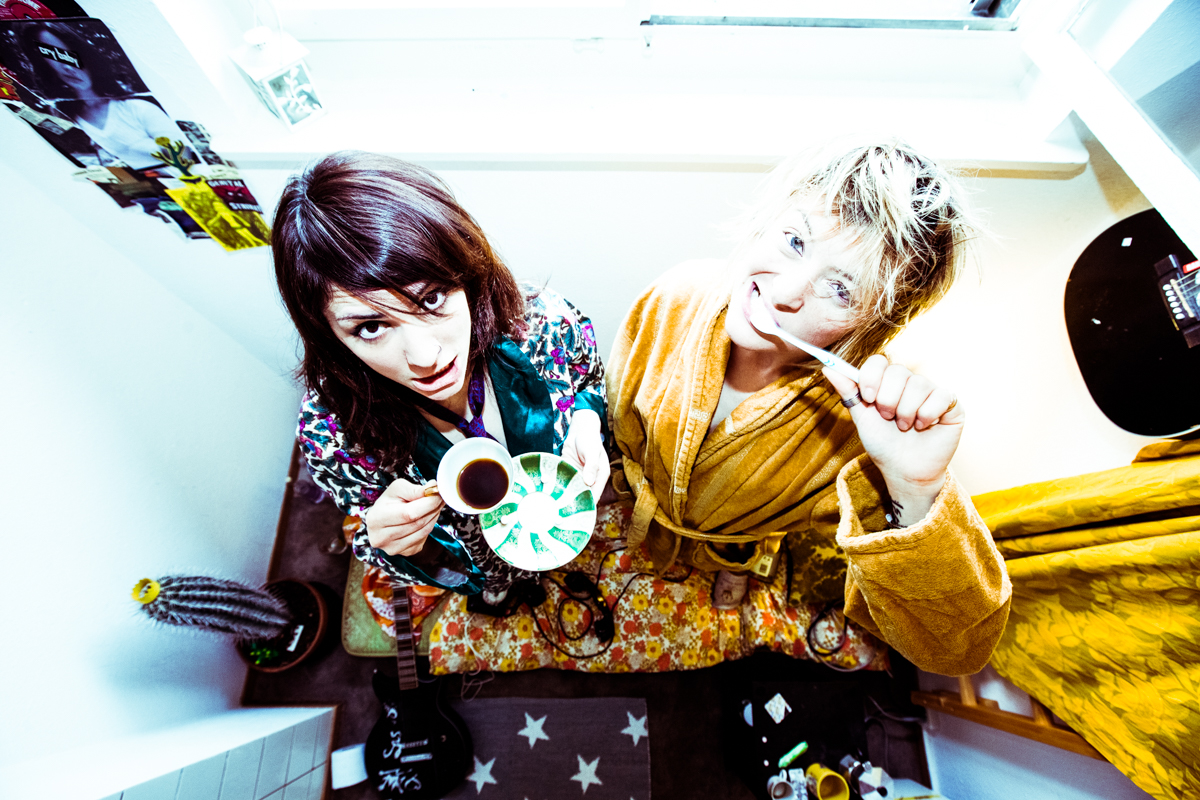 À tous ceux qui cherchent un rock lisse et sans saveur, passez votre chemin. The Chikitas représente l’antonyme même de ce concept. Le duo féminin genevois s’illustre par la fureur de sa proposition. Chant et riffs de guitare électrisants délivrés par Lynn; rythmique défoulante portée par Saskia. Leur union explore et triture toutes les facettes les plus brutes et authentiques du rock, en y infusant le meilleur du punk et du grunge.
 Pour leur troisième album, The Chikitas ont posé leurs instruments à Tucson, en Arizona (USA), pendant vingt jours. Avec la complicité du producteur Jim Waters (Sonic Youth, The Jon Spencer Blues Explosion), le duo a relevé le défi d’un enregistrement analogique pour cristalliser l’essence du son qui l’incarne. Le résultat ?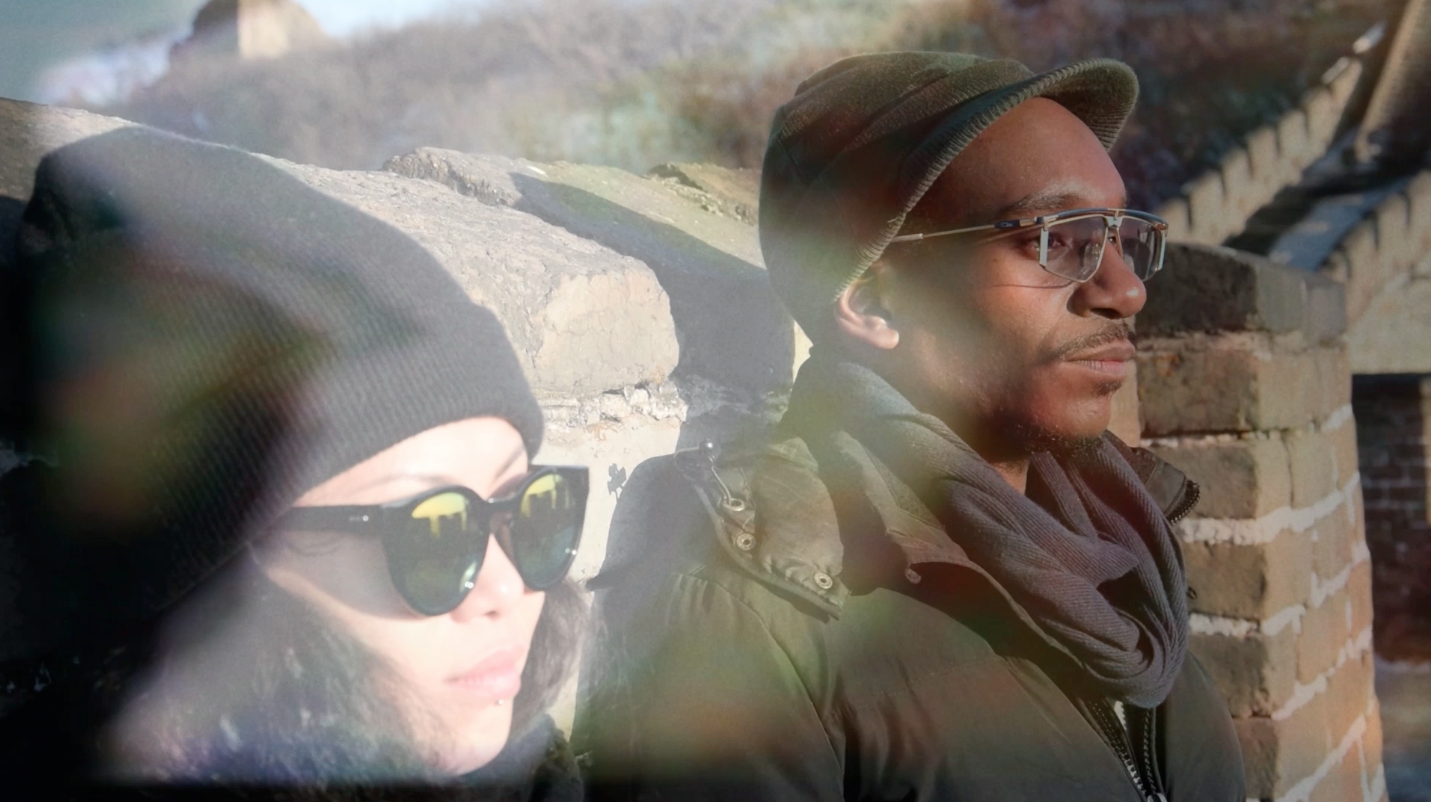

 Last week the editor of a UK jazz magazine said how much the office had got into Plaistow’s album Titan. I think they are something special. Plaistow is an acoustic piano trio driven by experimental dance musics, ancient drones and a desire to distill their sound to its most ‘alcoholic’, most potent.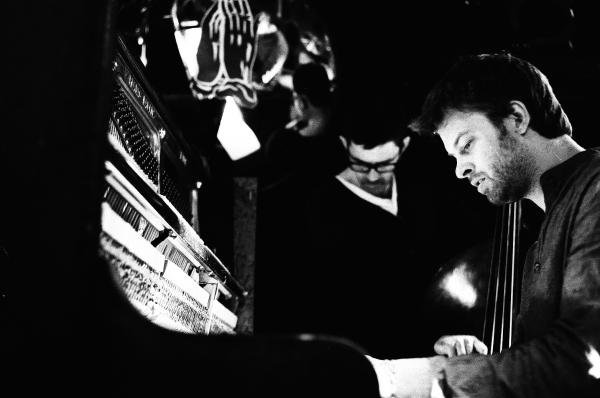
 Pilgrim includes Stefan Aeby on keyboards and Michi Stulz on drums – I know their work as part of Tobias Preisig’s quartet and both were crucial to the innovation of Preisig’s album, Drifting. In Pilgrim, Aeby draws on his ability to play an evocative jazz, informed by artists such as Bill Evans in order to echo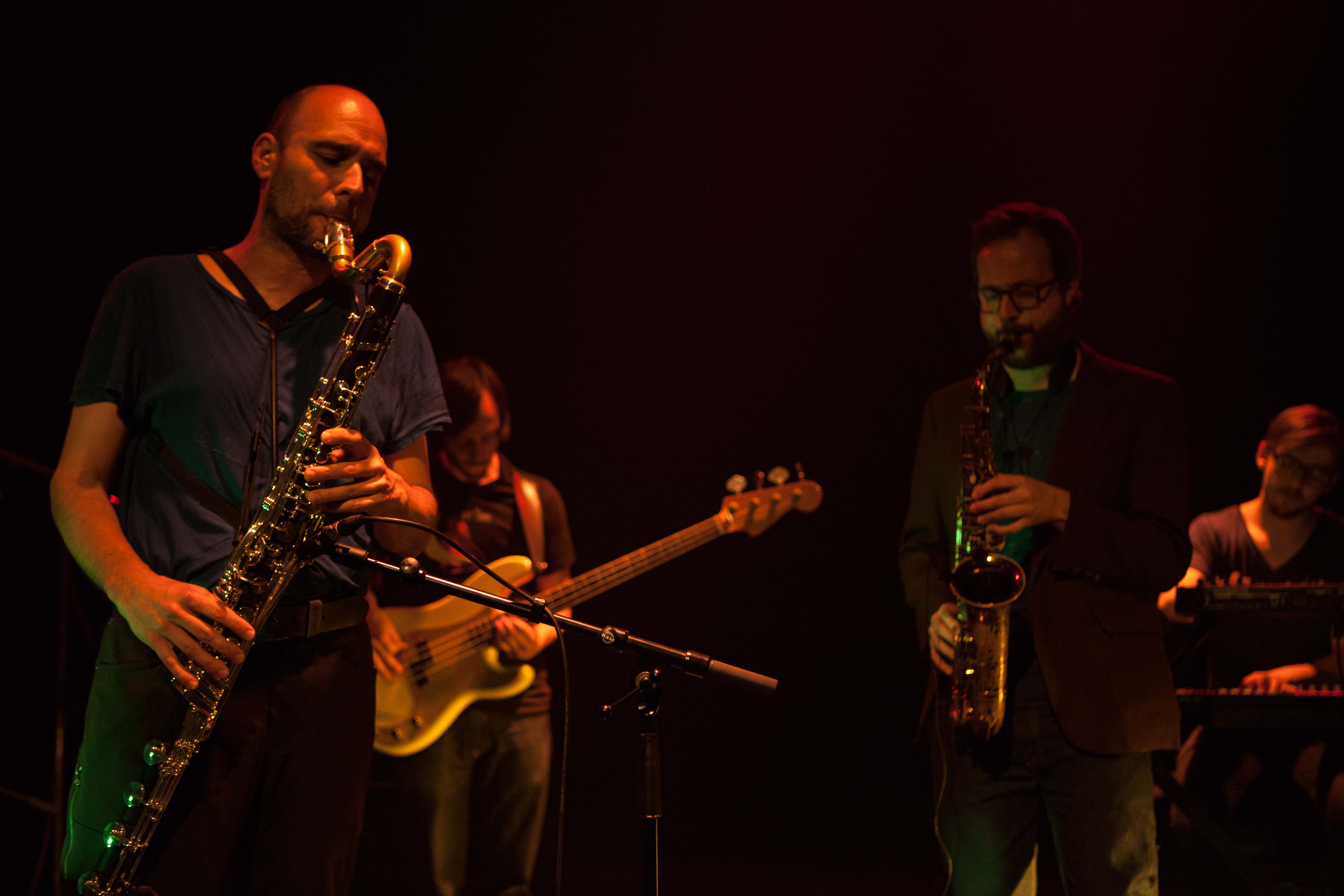
 Representing the exciting non-conformity of the contemporary Swiss jazz scene,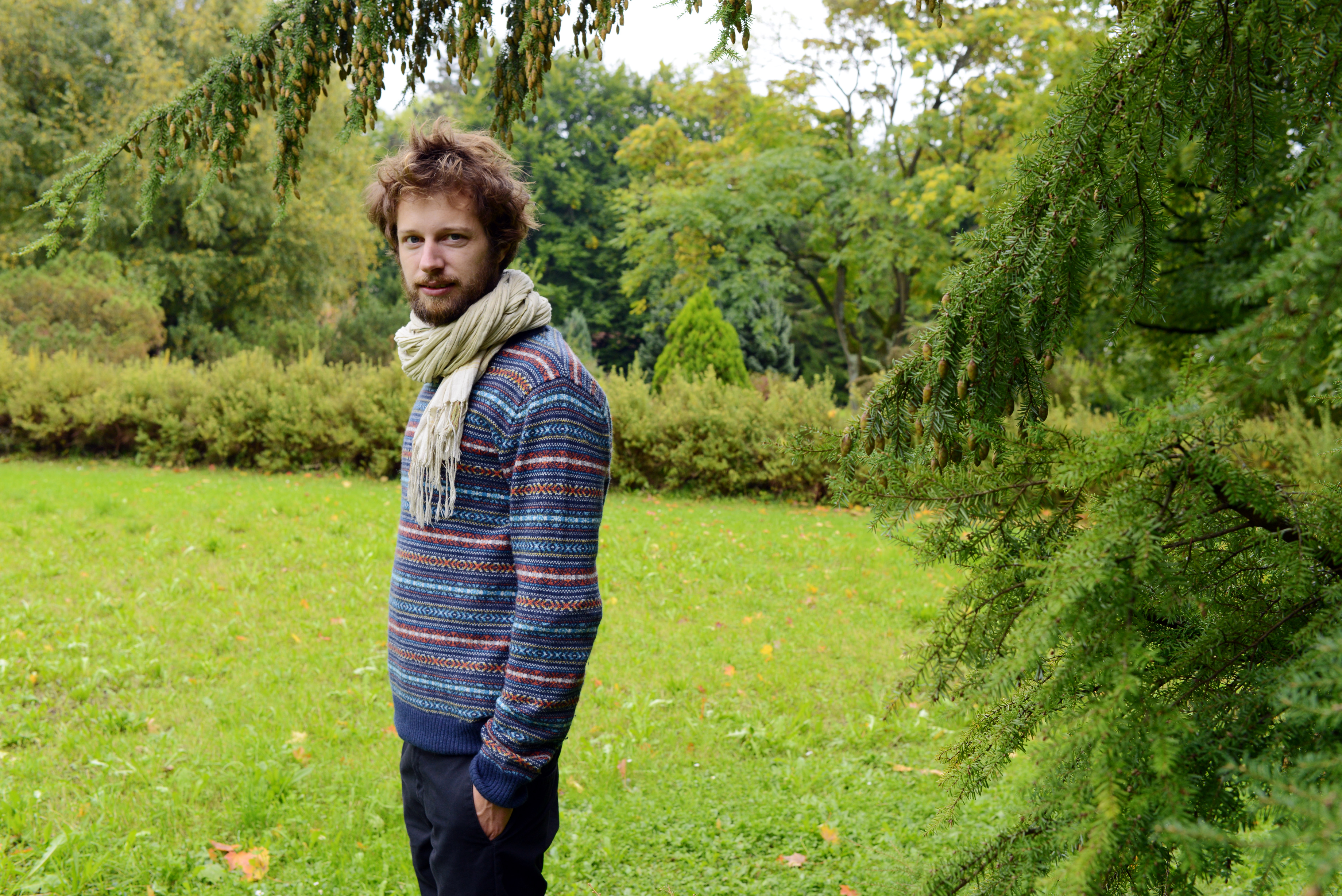
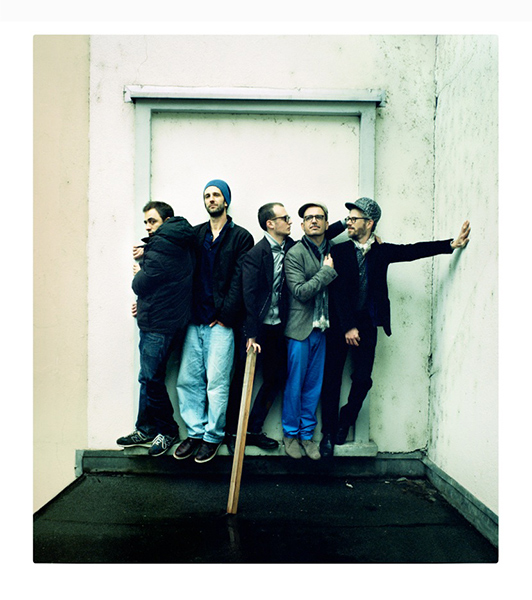 Luca Sisera is a well seasoned Swiss double bass player whose