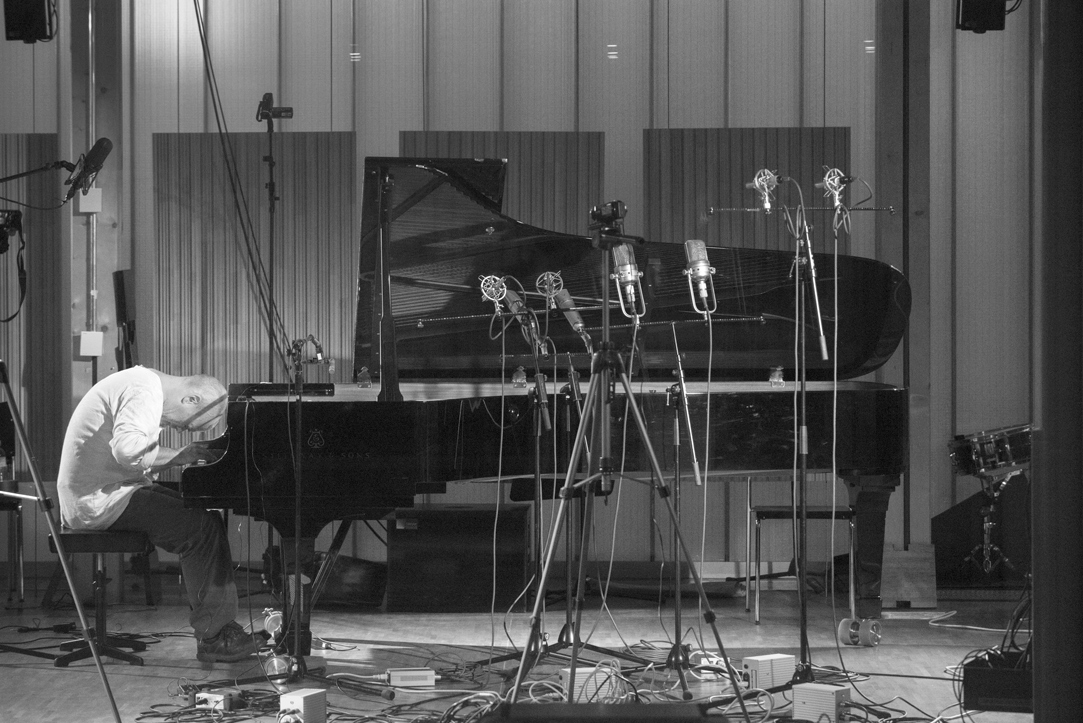
Gleich bei der sinnigerweise „Ghost Fun“ benannten Einstiegsnummer raschelt und klappert es im Hintergrund, eine weit entfernte Stimme schnauft und singt – oder besser spricht –die Motive ansatzweise mit, die das Klavier fiebrig anreißt. Dass Klappern beim Genfer Pianisten und Komponisten Michel Wintsch zum Handwerk gehört, darf man indes schonb lange vor seinem neuen Album „Roof Fool“ behaupten. Schon immer hat sich der mittlerweile 51-Jährige für die Interferenzen und Interpolationen von Musik interessiert, für den Beiklang ihrer Entstehung, für die Hörbarkeit von Ursache und Wirkung. Schon als Kind wurde Klavierspielen für ihn zu einer Art „unverzichtbarer Askese“, wie er es selbst beschreibt, und das Erschaffen von Klängen zu einer Lebensweise. Was an Musikschulen gelehrt wird, hat ihm deshalb nie genügt, Wintsch suchte seine Inspiration immer in den verschiedensten, nicht unbedingt alltäglichen oder offensichtlichen Quellen.
Urklänge mit vielfältigen Bausteinen
So ist Wintsch immer ein Avantgardist gewesen; einer freilich, bei dem die als klassische Avantgarde angesehene Moderne Musik nur ein kleiner Baustein ist. Der Spirit des Freejazz, die formalen Strukturen der Orchesterkomposition, die radikale Reduktion der Minimal Music, die Energie des Progressive Rock, die Sounderweiterungen der Elektronischen Musik – all das fließt in seiner Musik zusammen. Das machte ihm zum idealen Gefährten von Freigeistern wie Han Bennink, Ray Anderson, Michel Doneda, Fred Frith (zusammen mit der Schweizer Experimental-Vokalistin Franziska Baumann, der chinesischen Pipa- und Guqin-Spielerin Yang Ying oder dem Quintett desjungen Schweizer Trompeters Marco von Orelli; zu einem gefragten Theater- und Filmmusikkomponisten, zum Beispiel für zwei Spielfilme von Alain Tanner; vor allem aber zum immer noch unterschätzten spiritus rector diverser eigener Projekte, vom Trio WWW mit Christian Weber und Christian Wolfarth bis zum Sextett Face Nord.
Abstrakte Musik für den Live-Moment
Dazu kommt mit „Roof Fool“ jetzt wieder ein Soloprogramm, das den eingeschlagenen Weg fortsetzt. In den meisten der 14 ganz disparaten, oft ganz auf eine starke Idee vertrauenden und deshalb erfreulich kurzen Stücken brodelt ein nach allen Seiten offener Urklang vor sich hin. Es kann dann ganz atonal und sprunghaft werden („Shopping Ladies“), aber auch sphärisch-melodisch („Phytihob Wag“), mal ein Spiel mit Pausen und Anschlägen („Là où y a des croîtres“), ein wilder rhythmischer Parforderitt („Si c’est assez, cessez“) oder eine locker vor sich hinschaukelnde Miniatur („Adroit à gauche“). Selbst wenn die technischen Anforderungen hoch sind wie bei „Dyuke“ und das Timekeeping in die Nähe des Schlagzeugspiels rutscht wie beim Titelstück, steht das Pianistisch-Virtuose nie im Vordergrund, stets geht es um die Klangidee.
So bleibt Wintschs Musik abstrakter, weniger gefällig und schwerer zugänglich als die der meisten anderen Pianisten – selbst wenn manches nicht eines erfrischenden Humors entbehrt, wie ja schon der Name von Wintschs bekanntestem, seit 1998 bestehenden Trio mit dem US-Schlagzeuger Garry Hemingway und dem Schweizer Bassisten Benz Oester: The Who Trio. Seine Musik ist oft eins mit ihrem Entstehungsprozess. Schon deshalb ist die Aufnahme hier in besonderer Weise nur ein Hilfskonstrukt zur Bewahrung dessen, was eigentlich ganz dem Moment gehört. So wird der Spezialist „Roof Fool“ mit viel Gewinn hören, die meisten Hörer aber werden sich anstrengen müssen. Für sie dürfte es äußerst hilfreich sein, Michel Wintsch beim kreativen Akt beobachten zu können. Diese Gelegenheit ergibt sich am 30. August beim Willisau Jazzfestival, wenn Wintsch sein Album vorstellt. Alleine am Flügel, aber mit dem für das Projekt äußerst wichtigen Soundmann Benoit Piccand – womit wir wieder beim Rascheln und Schnaufen sind.
I can’t pay a bigger compliment to Klaus Johann Grobe than to say they make me want to learn German (I’m actually looking at courses in London now). For the moment I freely sing along to their album Im Sinne der Zeit not knowing what on earth I’m saying. When I got the CD I played it every morning, over and over, because it made me so happy.
A minor-key world of melancholy and sensuality
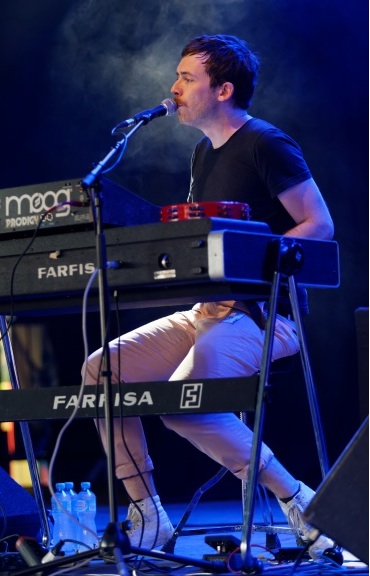
My interest in KJG was immediate. I was due to see them at the Great Escape festival in Brighton in May and so I did some research on YouTube (of course). I found a live version of ‘Traumhaft’ and the very first chords of Moog/Farfisa synths pricked up my ears – the sound was so dandy, almost comical, and yet honest and soulful. The vocals seemed to dwell in a minor-key world of melancholy and sensuality, entwined with a thread of quiet optimism. It sounded nostalgic for DIY culture and a time of simplicity yet was progressive and fresh.
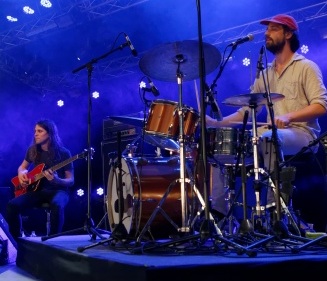
Their show confirmed me as a fan and I literally barged people out of the way so I could be near the front (I avoided the very front row as I was aware my stalker-grin might scare the band). It was the irresistible synth sensibility of Sevi Landolt that drew me to them, but the equally genuine and clever rhythm section of Daniel Bachmann on drums and Stephan Brunner on bass (for the live shows) made this trio greater than the sum of its parts. I cornered their manager (who happens to be a great guy from Liverpool), gushed about how much I liked them and got a CD – then I gushed about how much I loved the CD cover. My gushing hasn’t stopped.
A serious depth of musical knowledge
On the album, tracks such as ‘Koffer’ give a sense of The Doors metamorphosing into The Jam via Herb Alpert. There are wafts of garage band, psychedelia and post-punk outfits like Howard Devoto’s sharp and lyrical, Magazine. Sevi throws us scraps of groove that the keyboard King, Jimmy Smith, would even nod his head to. You sense there is a serious depth of musical knowledge that underpins their unique ideas, but they draw on influences without being derivative.
These guys aren’t afraid of an easy listening sway
‘Les Grecks’ still makes me chuckle as it wafts in memories of Peter Fenn’s music for the TV quiz show, ‘Sale of the Century’. These guys aren’t afraid of an easy listening sway or blowing an unashamedly romantic mist onto tracks like ‘Vergangenes’. If they keep their timing, simplicity and never try to be anything except genuine, I’m sure I will stay hooked. In fact I’m coming all the way to Switzerland to see them play the For Noise Festival in Pully on Thursday 20 August (I’ll be near the front with a big stalker-grin on my face…).
Not a great fan of distorted digital noises of any kind, I was not prepared to like the work of Blaise Caillet – AKA Sknail – the main perpetrator of the nu-electronica subgenre called ‘glitch jazz’. However, one must always be ready to eat one’s hat. In the intelligent hands of Caillet, the Sknail project is carried off with such graceful modernity and beauty that no one could begrudge him a few mechanical distortions here and there.
A mercurial soundscape
« Snail Charmers » is the second LP that spearheads this sci-fi fusion of jazz and the dark side of modern electronics. Listening to the album is like stepping into a mercurial soundscape where drums are replaced by subtle, finely-tuned scratches and digital malfunctions. Thanks to Caillet’s gifted production skills, they actually are made to sound beautiful, sitting perfectly at ease next to six professional jazz musicians and their elegant experimentation. The LP is a seamless work, fabulously suited to the soundtrack of a would-be Nordic thriller set in a misty land of half human, half robotic jazz warriors.
This Mad Max journey of confrontation between man and machine.
The chilly, not-quite-human electronic glitches are woven with great craftmanship into the sinuey hues of voice, trumpet, bass clarinet, piano and double bass. The result is a silvery, thin blanket of sound that is far warmer and more welcoming than expected. ‘Snail Charmers’ and ‘Something’s got to give’ are probably my favourite tracks of the year so far. Rapper/narrator/singer, Nya, works wonders with his languid, lilting vocals, adding the needed human guidance along this Mad Max journey of confrontation between man and machine. This work is cleverly thought-out and studied from every angle: concept, sound and visuals. Glitch jazz is indeed a product of our digital times, proving that the conquering and innovative spirit of jazz can be merged with anything, even “the aesthetic of failure”.
In conversation with Blaise Caillet:
Did you come up with the term ‘glitch jazz’?
Blaise Caillet: Glitch jazz is a subgenre of electronica. When I checked it on google, the term “glitch jazz” already existed. There are mostly DJ productions, in other words an electro beat with jazz samples and some little glitchy sounds thrown in. When I created the “Sknail” project, I wanted to take the word “glitch jazz” quite literally, ie: real glitches with real jazz! It felt really new. Now when you google “glitch jazz”, the first result that appears is sknail.com.
How was your first LP, ‘Glitch Jazz’ received?
Blaise Caillet: Some listeners were shocked and still are now! The first time I heard Alva Noto (pure glitch music) I was shocked too but it’s good to be troubled or affected when listening to new music. Personally, I always look for this sensation when listening to music. The first Sknail LP was generally well received by people looking for these kind of sensations. I prefer developing an original musical project, taking a path where nobody has gone before, even if it’s something shocking or displeasing.
Drums? Is this the role of the glitches?
Blaise Caillet: Yes, you can look at it this way. The glitches are micro samples and micro sounds stemming from machine failures, electronic malfunctions. When these micros samples are cut, clipped, treated, stuck together, you can get a very smart and definite percussion sound. In the end, the way to give a pulse to a track doesn’t matter, the important thing is getting the pulse, feeling the vibe. Also, using glitch rhythms in electronic music gives a different, finer sound than the “classical” electro drum machines. It results in a different aesthetic.
A lot of the tracks on both LPs have a very filmic, soundtracky quality. Do you plan to work in this domain?
Blaise Caillet: Yes I do. I worked last year with a French producer to adapt a Sknail track for a short movie that was featured in the “Nuit des Images” at Lausanne’s Elysée photography museum.
The timbre of the music has a beautiful melancholic quality. Do you think glitch jazz can ever be upbeat and joyful?
Blaise Caillet: I always use minor and modal (without harmonic changes) tonalities in this project. That gives a very specific mood to the music with a melancholic timbre. This timbre is specific to a certain kind of avant-garde jazz and, when it’s mixed with a cold and clinical electronica glitch music, it transcends itself. This is what I’m into: mixing the timbre and the styles, finding new aesthetics. At the beginning, I tried to make some tracks that were joyful and upbeat, but that didn’t work. They had a kitschy side, a kind of a hopping experimental electrojazz house sound which wasn’t what I was after.
Your rapper, Nya, touches on some relevant points about today’s decaying society, (especially in ’Slow Poison’). Is the band more a celebration or an attack on the digital age and what’s it’s brought to the world?
Blaise Caillet: I’ll let Nya answers this question: “It’s neither an attack nor a celebration of the digital age. It’s a balancing act, as with so many things in life. Trying to stay true to our human selves while at the same time evolving and adapting to our environment. Never losing sight of the essential things.”
How important are the visuals to your music? Who’s in charge of them?
Blaise Caillet: It’s very important. When you listen to music, you automatically create images and scenes in your mind. So I think it’s a very smart way to deliver the sound and the image of the music together, to suggest an entire artistic concept to the listener. And the aim is the same as the music: to create something innovative. Online, I met Efrain Becerra from Phoenix, Arizona, I stumbled upon his FB page and was very impressed with his 3D graphical work. I contacted him with the instruction: “Imagine how a jazz club might be in the year 3147 ». We had a lot of brainstorming ideas and exchanges via e-mail, Facebook, Whatsapp but I still haven’t seen, touched or talked to him yet face to face. Welcome to the 2015 dematerialized world!
What’s the Sknail live experience like?
Blaise Caillet: It’s important to understand that my musicians have never met (for both albums!). I recorded each musician one by one and created the tracks layer by layer because I’ve got only one microphone and because I really didn’t know where this project was going at the start. My objective was to realize an entire project by myself: artistic concept, creation, composition, arrangement, recording, mixing, promotion. The only thing I haven’t done myself is the mastering. I’m now working on how to produce the live show. First I have to find the adapted hardware and software, then, figure out how to perfectly synchronize the glitches with the double bass player to make the perfect rhythm section. In a live situation, I want the musicians to be very free like in a “classic” jazz concert, we play the theme and/or the vocal part very straight and arranged, and then the improvisations take off with great interaction between musicians.
Do you have any other music projects outside of Sknail?
Blaise Caillet: I did all the electronic musical arrangements for the last album of Ultra Dieez from Geneva, (Mathieu Delieutraz: composer, singer and guitarist who plays French rock/folk). When we decided to work together, I mixed the electronica glitch timbres to his roots bluesy French rock music and the result was great.
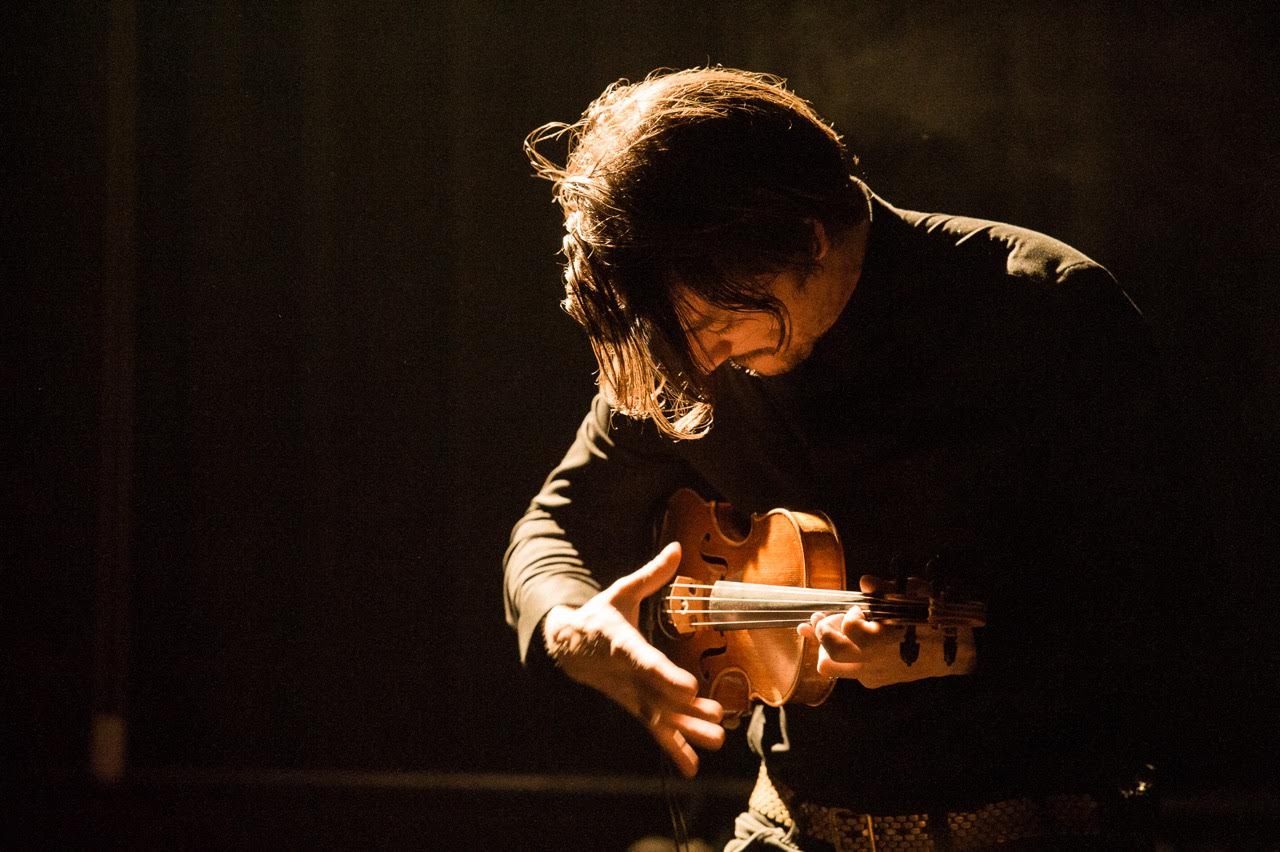
Après nous avoir séduit avec son quartet, après nous avoir surpris avec son projet électro Egopusher, le violoniste Tobias Preisig s’attaque à un autre exercice de haute voltige : le solo. Une première à voir dans le cadre des soirées Swiss Vibes du Montreux Jazz Festival au Château de Chillon le 10 juillet (quelques places sont à gagner, voir au bas de cet article). Autre invité de la soirée, l’excellent trio suisse-allemand, Vein, que nous vous avons déjà présenté sur ce blog. Alors qu’il st entrain d’enregistrer à Chamonix, Tobias Preisig a répondu à nos questions par téléphone.
Pourquoi avoir choisi d’essayer la formule solo ?
Tobias Preisig: C’est un nouveau défi pour moi. Faire un concert en solo implique de gérer en même temps les rythmes, la mélodie, la situation du moment. C’est très difficile, très extrême, mais ça amène aussi des nouvelles idées, ça permet d’avancer musicalement. Le pianiste Bojan Z m’a dit une fois « playing solo makes you stronger ». C’est très vrai. Pour une prestation solo, on doit être très conscient de ce que l’on est et de où on veut aller.
Cela dit, un concert de violon solo est moins courant qu’un concert de piano-solo ?
Tobias Preisig: Oui bien sûr. Le piano est à la fois un instrument mélodique, harmonique et rythmique. Il se prête plus facilement à l’exercice du solo. Evidemment avec le violon, c’est plus risqué. Pour être honnête, j’avoue que ma grande crainte est d’ennuyer les gens, un peu comme une chanteuse d’opéra qui chanterait pendant une heure… Le plus dur de ma tâche consiste à garder l’attention, captiver le public pendant toute la durée de mon solo.
Est-ce que vous allez utiliser les pédales d’effet que vous utilisez dans le projet électro Egopusher ?
Tobias Preisig: Le top du top serait bien sûr de faire un concert solo avec seulement un violon. Un peu comme Marc Ribot le fait avec une guitare solo. Les concerts en solo de Marc Ribot sont d’ailleurs une source d’inspiration pour moi…
Ceux du chanteur Phil Minton aussi, même si les deux n’ont rien à voir.
https://vimeo.com/90025844
Mais, je n’en suis pas encore là ! J’utilise quelques pédales d’effets sur certains morceaux, mais j’ai aussi plusieurs morceaux où je ne joue que du violon.
Avez-vous créé un répertoire spécifique pour ce concert ou réadaptez-vous d’anciens morceaux ?
Tobias Preisig: C’est un répertoire entièrement nouveau. Je ne trouve pas très intéressant de reprendre des anciens morceaux et de les adapter. C’est plus excitant de faire quelque chose d’entièrement nouveau
Pourquoi le choix du violon ?
Tobias Preisig: J’ai toujours joué du violon. Je ne sais pas pourquoi. Ça a été un choix intuitif. En même temps, le violon n’est pas si important pour moi. Quelque soit l’instrument, le musicien dévoile sa personnalité musicale. J’aime sincèrement le violon, mais je pourrais aussi jouer d’un autre instrument. C’est la même chose pour mes différents projets: en quartet, en duo ou en solo, je parle toujours la même langue.
10 places à gagner pour ce concert pour les 10 premiers mails envoyés à e.stoudmann at gmail.com et intitulés “Invitation 10.07” avec nom et prénom du participant.
The TWO have been making waves on the Swiss blues scene for the past three years, bringing depth, integrity and colour to what sometimes feels like a long-lost musical tradition. Made up of Mauritian Yannick Nanette (lead vocals, guitar, harmonica) and Swiss Thierry Jaccard (lead guitar, backing vocals), this tight unit is highly thought of in the Swiss blues community and has even caused ripples abroad by reaching the semi-finals of the International Blues Challenge in Memphis earlier this year.
The blues musical tradition has never felt so alive
Watching them play live at La Fête de la Musique at Lausanne’s The Great Escape, I was struck by how authenticity and simplicity are key to their success. Totally committed to their honest, organic sound without a hint of flim-flam to embellish all that is beautiful in its raw and rootsy state. Inhabited by some past life blues ghost once guitars are in hand, The TWO postively levitate with a feel-good factor even when the timbre is plaintive and sombre. The enthusiasm for their musical mission is palpable. The audience are with them, behind them, for them. The blues musical traditon in their hands has never felt so alive. « I’ve got blues in my bones, I’ve got groove in my soul » wails Yannick with a fire-breathing intensity and a voice that bridges the distant Creole with the Delta. It’s a haunting voice that cannot fail to penetrate, transmitting despair in a way that’s more unique than rare, thankfully it is equally uplifting in parts reminding us that the blues is also a music of hope and dreams.
“The blues is an enormous canvas to paint on”
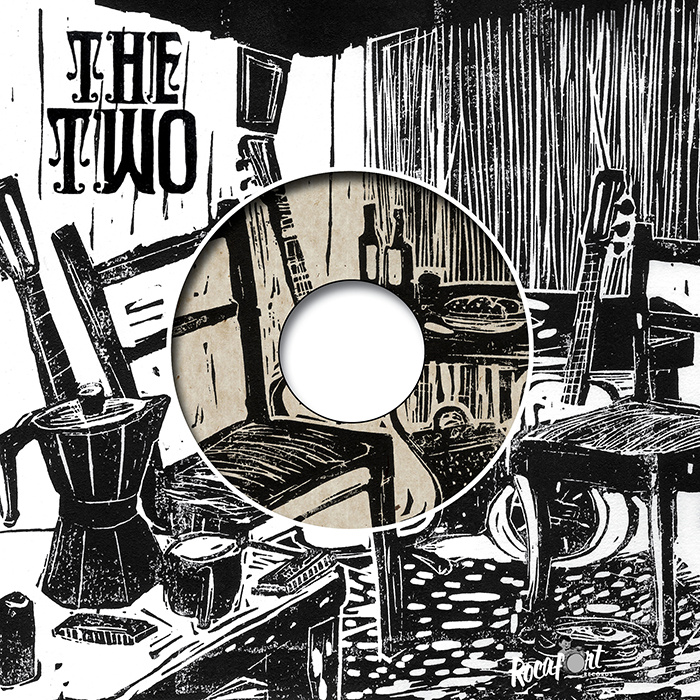
I recently came across this quote from Roger Daltrey talking about his early influences with The Who: « Because it’s so simple and heartfelt, the blues is an enormous canvas to paint on ». Much from little is exactly the tradition that The TWO are carrying forward with effective heart and spirit. Their album ‘Sweet, Dirty, Blues’ was released last November off their own backs and is an honest, raw, relevant work reminding us that all forms of popular music stem from the stripped down simplicity of a nifty guitar riff and a pained, sincere voice. They’ve also just put out an 7-inch single on Lausanne’s Rocafort Records which can only be purchased at their live gigs. I have a hunch that more people will be talking about this vibrant, engaging duo after their first official appearance at Montreux Jazz this summer.
Some questions and answers with The TWO:
How and where did you meet? How long have you been playing together?
The TWO: We met five years ago in Sierre. Thierry was playing at the Hacienda concert hall with the funk band, Brainless. I loved their sound so much that I (Yannick) asked if I could join in for a jam session at the end of the show. They agreed, I rushed home, got dressed nicely, took my harmonica and the story began. Since then I’ve been touring with the Brainless band. Thierry and I quickly saw we had a special feel for the blues and soon decided to work together. Three years have gone by since then and we’ve been grooving restlessly wherever the music takes us.
Name some of the blues inspirations that have impacted on your sound and style of playing.
The TWO: Eric Bibb, Keb Mo, Ray Charles, Eric Triton, Menwar, Zanzak, Baster, Kaya.
There’s not a lot of Swiss blues music around, do you feel like a rare breed?
The TWO: The blues can be everywhere as long as the music is honest, as long as one drives it out from one’s soul, as long as the music is vital, as long as it is an urge to sing or die. What we mean is that the blues is not an aesthetic, some kind of drawer where one is categorised to suit a music market. In the beginning black people were singing to find a light, to cheer up and encourage themselves to bear the conditions of slavery. The blues was a prayer, a cry to come together, to be one, united to face hardship and suffering. Our blues comes from here and we sing with our soul, this same desire to make people come together and move for change. In Switzerland artists like Mark Kelly, Sophie Hunger and many more sing with this fervour, honesty and soul, which for us is the blues.
How did your trip to Memphis affect you?
The TWO: We were really happy to go there, proud to sing our blues where the blues was born. It was some kind of pilgrimage but there in Memphis, many questions came up. We realised that the blues cannot be imprisoned in a place. Music is art and if try to hold it for yourself, keep it in a museum, it withers and dies. The blues is everywhere! No matter where you are, no matter who you are and where you’re from, you can have the blues. It is not an American thing, it is a human thing.
Are The Two always going to be just you two?? Will there be more musicians featured on your forthcoming work?
The TWO: Music is about meeting people and sharing. From time to time we play with a drummer, Felix Bergeron and a violinist, Bastoun. In any case, The TWO is more than just two guys playing their guitars. So many people work behind the scenes, are unseen and these people help our music to be what it is. For now we are touring with our album ‘Sweet, Dirty, Blues’ that came out last year. Time, music and crossroads will tell what happens next.
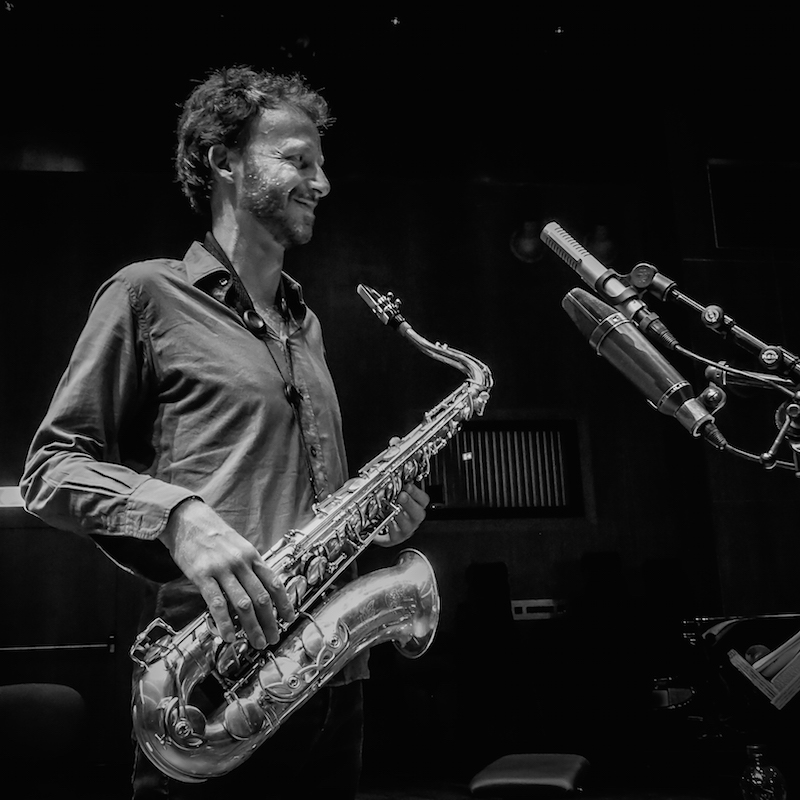
A l’écoute des ondes méditatives de « Many More Days » de Third Reel, on peine à croire que le saxophoniste et clarinettiste Nicolas Masson a fait ses débuts dans la musique à la guitare, en fan de heavy metal.
En fait, c’est à un concert du groupe de hip hop hard funk allumé, Fishbone qu’il découvre le saxophone ténor du chanteur Angelo Moore. Fasciné, il décide d’en louer un. Quelques temps plus tard, adolescent en vacances sur les hauts de Montreux, il profite d’un billet gratuit offert à sa grand-mère pour se précipiter au concert du World Saxophone Quartet. Nous sommes en 1989 et les dés sont jetés. Notre homme se met alors à dévorer du jazz, de la musique classique du XXème siècle (« parce que beaucoup de jazzmen faisaient explicitement référence à cette musique ») et à jouer en autodidacte. En 1992, on le retrouve à New York sur les traces de Cecil Taylor, Fred Hopkins, Frank Lowe, Makanda Ken McIntyre. Il se sent à l’aise dans cette scène free. En 2000, après un séjour d’une année à New York, il monte sa formation américaine avec Russ Johnson (trompette), Eivind Opsvik (basse) and Mark Ferber (batterie).
En parallèle
Quinze ans plus tard, Nicolas Masson est une figure majeure de la scène jazz suisse à la tête de deux projets bien différents : Parallels avec Colin Vallon (piano), Patrice Moret (contrebasse), Lionel Friedli (batterie) qu’il qualifie lui-même de projet « enraciné et viscéral, structuré et incantatoire ». Et Third Reel avec le Tessinois Roberto Pianca (guitare) et l’Italien Emanuele Maniscalco (batterie) à l’approche climatique, aux références minimalistes.
Les choses sérieuses pour ce trio ont commencé à l’invitation de Paolo Keller qui organise des concerts de jazz pour la radio suisse italienne. Sans les en informer, ce dernier passe en douce l’enregistrement radio de l’ensemble à Manfred Eicher, big boss de ECM, qui apprécie. Le premier disque du groupe sera enregistré à la RSI après une brève rencontre d’une demi-heure avec Manfred Eicher. « Le studio dans lequel nous avons enregistré avait été conçu plutôt pour de la musique classique. L’acoustique était différente de ce à quoi nous étions habitués. On a dû s’adapter. Ce fut un traitement cathartique qui nous a amené vers plus d’intériorité. »
Deuxième enregistrement sur ECM
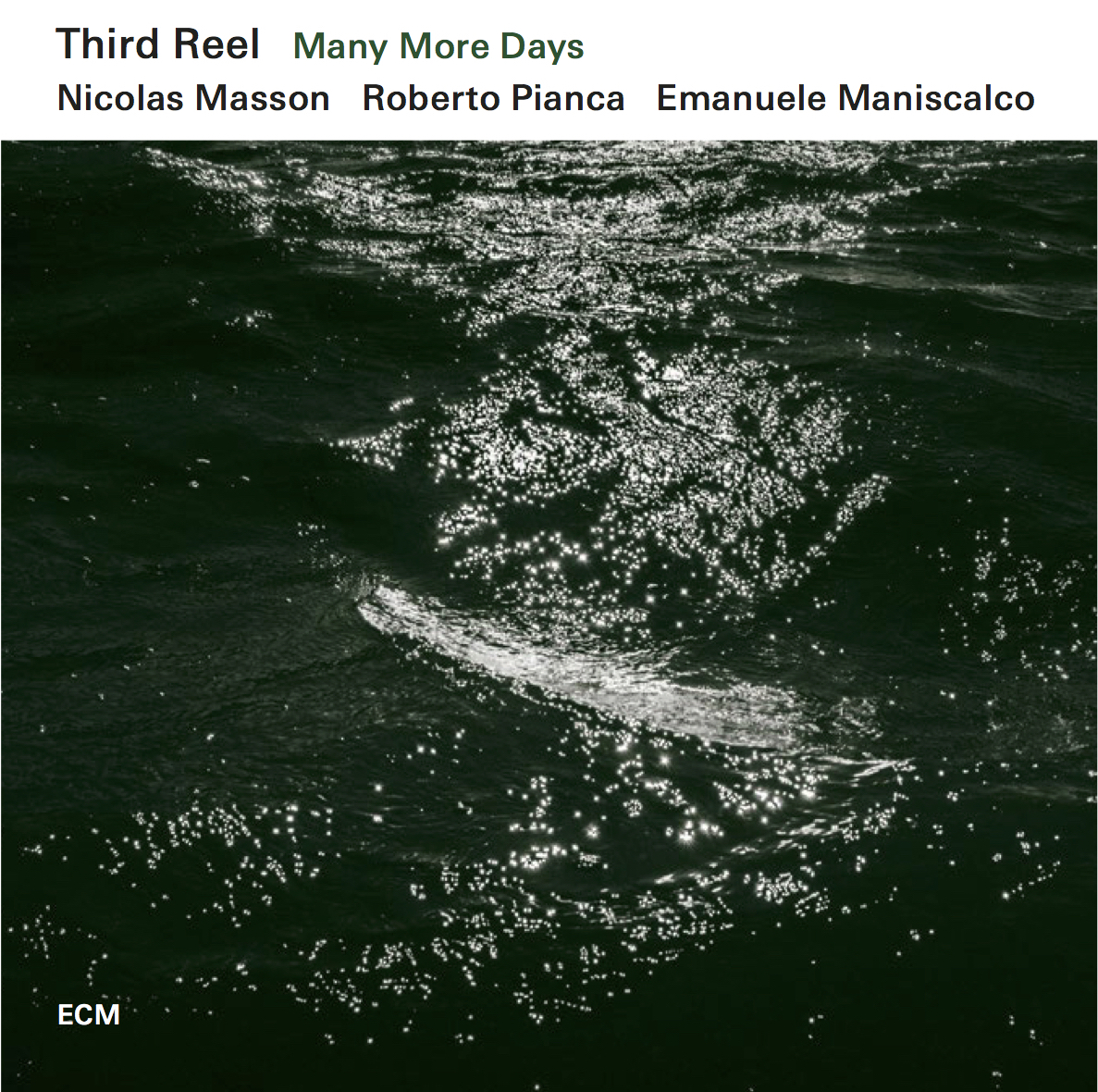
Aujourd’hui, « Many More Days » confirme que Third Reel a trouvé sa voix. Nicolas Masson y est très présent. Le ton de son saxophone ténor est grave, son style épuré, essentiel, en connexion subtile avec ce qui l’entoure. Batterie et guitare se meuvent à l’unisson. Les ambiances se concentrent et se diluent comme une étendue d’eau qui afflue et reflue, à l’image de la pochette du disque. Souvent construit autour d’une ou deux phrases musicales, la liberté reste le dénominateur commun de ces trois instrumentistes. « White » renvoie à l’univers du pianiste japonais Masabumi Kikuchi. « J’ai composé ce thème chez moi face à une fenêtre à travers laquelle je voyais les arbres enneigés. Ce morceau est un reflet de ce que je ressens à propos de cette musique. C’est un titre contemplatif, à la fois fragile et brut ».
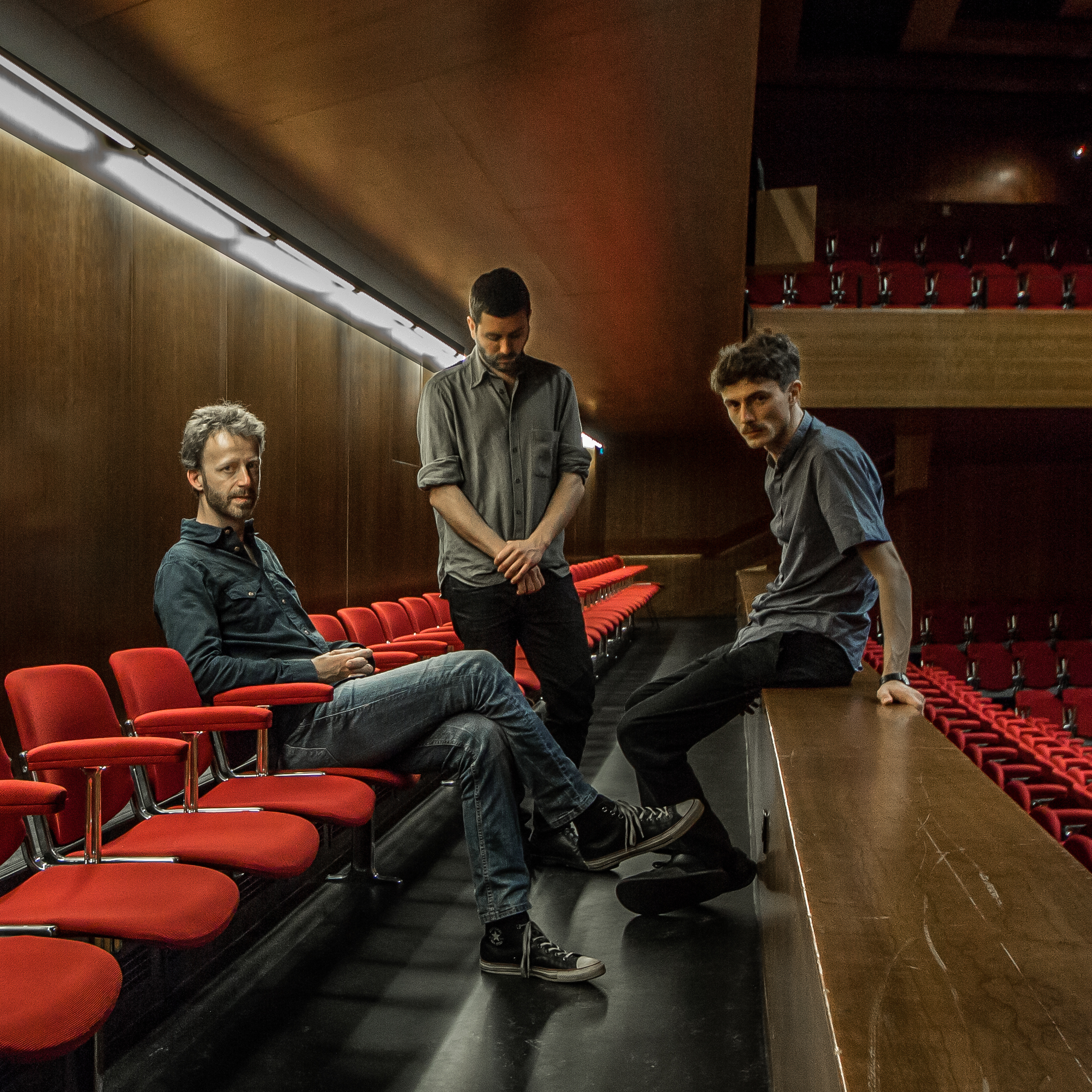
Sur la scène du Sud des Alpes le 21 mai 2015, les trois comparses sont rejoints par le contrebassiste Thomas Morgan (connu entre autres pour son travail avec Paul Motian) et c’est comme si on avait brassé les cartes et que la musique de Third Reel était redistribuée. «Nos compositions sont très ouvertes, conçues pour être réinventées à chaque concert. Avec Thomas Morgan, cela a rendu les choses encore plus créatives puisqu’il considère que les instruments n’ont pas de rôle déterminé ». La texture musicale de Third Reel est la même, mais le jeu d’interactions, l’instinct, la transcendance, la personnalité des uns et des autres s’affirment plus concrètement. Avec sa clarinette, Nicolas Masson semble explorer les sons « J’ai beaucoup plus travaillé le saxophone que la clarinette. Du coup, j’ai une approche plus archaïque de cet instrument, avec moins d’automatisme. C’est plus naïf et, dans un sens, plus libre. »
En collaboration avec le Centre culturel suisse de Paris, le Genevois Polar a imaginé pour le Montreux Jazz Festival un projet solo exploratoire dialoguant avec le Château de Chillon entre climats pop et rock.
Au cours des dix premières années de son parcours de chanteur, Eric Linder, alias Polar, avait donné naissance à trois beaux albums de folk-pop anglophone intimiste. De subtiles variations sur un même thème délaissées ensuite pour deux albums pop-rock francophiles extravertis et mélodiques. Cinq ans après French Songs, Polar a renoué l’an dernier avec la langue de Shakespeare pour l’impressionniste Empress. Un sixième album en seize ans que le Genevois a imaginé panoramique, lumineux et exploratoire, empruntant à la pop ses lignes de force mélodique, au rock son intensité et à la folk ses racines.
Aujourd’hui, le remuant Genevois d’origine irlandaise prend encore la tangente en imaginant pour le Montreux Jazz un projet en solo dont l’ambition est un dialogue majestueux avec le Château de Chillon. La proposition, que le Festival lui a adressée suite à sa récente carte blanche au Centre culturel suisse de Paris, enchante le musicien et chanteur. En tant que directeur et programmateur musical du Festival genevois Antigel, dont la spécificité est de programmer des spectacles dans des lieux atypiques, l’idée l’a immédiatement séduit. D’autant que l’image évocatrice du «fameux album de Bill Evans At The Montreux Jazz Festival, avec une vue du château depuis le Léman sur la pochette (1968) et qui fait partie de mes disques favoris, m’est aussitôt venue à l’esprit».
Pas de déclinaisons jazz pour autant en perspective dans la prestation de Polar. « Ce sera un concert avec guitare acoustique et électrique et le registre sera donc différent de mes concerts en solo habituels teintés folk. Il y aura par exemple des parties instrumentales insérées dans les titres chantés de mon répertoire anglophone. L’idée est de m’imprégner des lieux, de son acoustique et de sa réverbération, pour esquisser une prestation pop qui soit des plus oniriques ». Des atmosphères plutôt pop et rock donc pour celui qui s’est produit à Montreux pour la première fois en 1998, au Miles Davis Hall, et qui y a aussi vécu les concerts mémorables de Neil Young, Wilco, James Blake ou Kendrick Lamar.
En cette première semaine du mois de juin, le Centre culturel suisse se présente sous ses plus beaux atours. En plein cœur du Marais, la devanture de la libraire fait de l’œil au passant en exposant ses sacs Freitag bien en évidence. Passé les lourdes portes en bois les cours intérieures fleuries transportent en un instant le passant de l’ébullition de la rue des Franc-Bourgeois au calme d’un bâtiment historique. Intra muros, place à la création contemporaine avec Marc-Antoine Fehr et l’installation sonore et visuelle de Dominique Koch.
Les deux directeurs du Centre culturel suisse, Olivier Kaeser et Jean-Paul Felley et leur équipe, travaillent d’arrache-pied pour faire « connaître en France une création contemporaine helvétique ouverte sur le monde et y favoriser le rayonnement des artistes suisses ».
Ça tombe bien, au rayon musique, c’est exactement la même ambition qui anime le blog swissvibes.org. Les grands esprits se sont donc rencontrés au Ccs du 3 au 6 juin 2015 pour présenter trois soirées de concerts aux couleurs musicales différentes. Grâce au soutien de Pro Helvetia (la Fondation pour la culture suisse) et de Swiss Music Export, l’entreprise dut une réussite tant au niveau de la qualité artistique, des échanges que de l’affluence. L’union fait la force!
Mardi 3 juin Swiss Vibes goes rock
Pour cette soirée étiquetée rock, la Zurichoise Evelinn Trouble et les Biennois de Puts Marie ont joué des reprises surprenantes.
Evelinn Trouble se sent un peu à l’étroit dans l’auditorium du Ccs et elle le fait bien savoir : en milieu de set, elle attaque le répertoire de Tina Turner plus qu’elle ne la reprend. Pour mieux convaincre des vertus de son « What’s Love Got to Do with it » revu et corrigé version 2015, Evelinn Trouble grimpe les escaliers entre les chaises des spectateurs et se lance dans un ping pong vocal mi-hurlé mi chanté avec les trois autres membres de son groupe. Et si le prochain album « Arrrowhead » de l’excentrique diva zurichoise est censé se décliner en version trip hop, cela ne l’empêche pas de rester une rockeuse et une funky woman infernale qui balance du lourd et séduit par la puissance de sa voix et par son caractère bouillonnant.
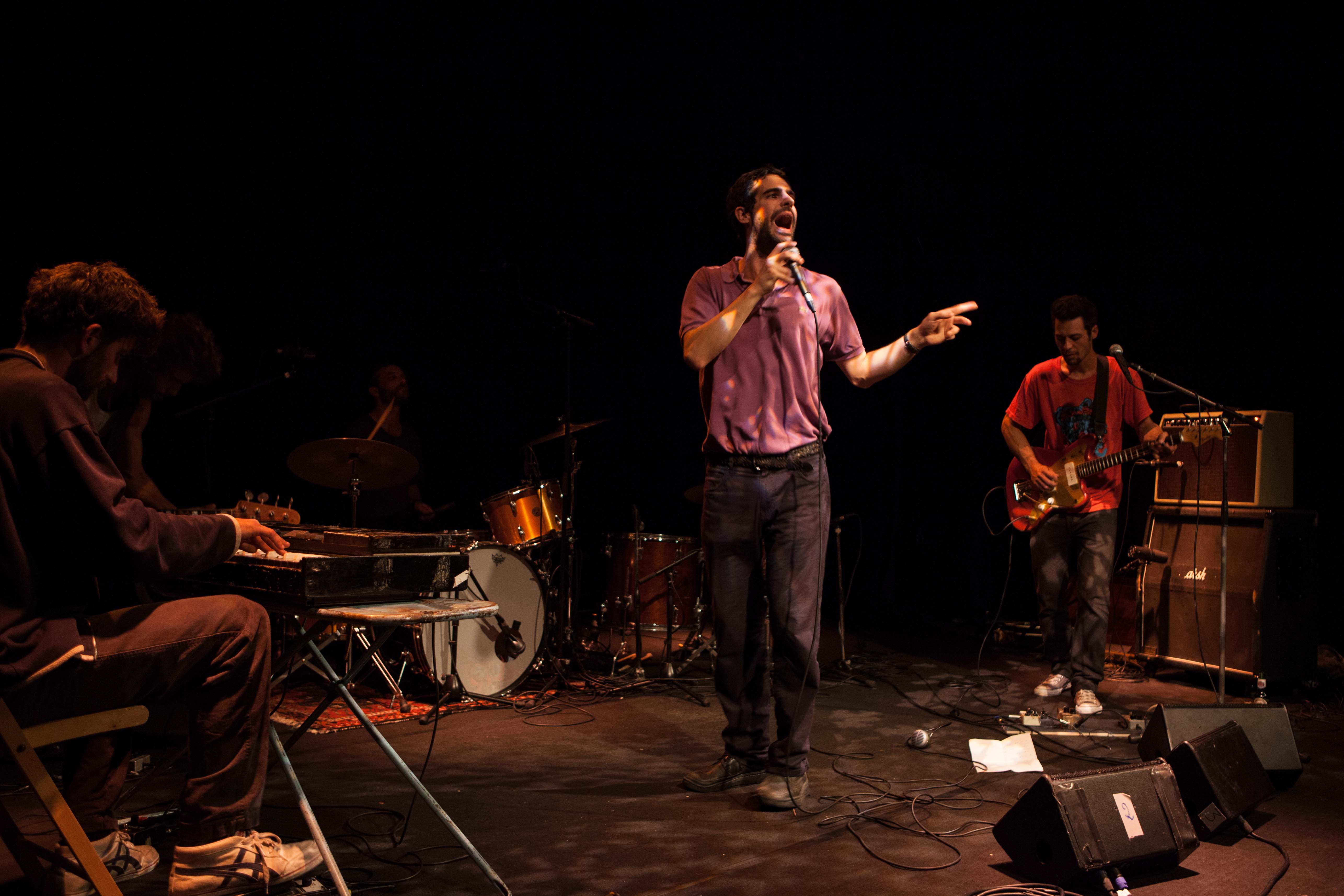
Puts Marie choisit quant à lui d’évoquer Sun Ra, le roi du free jazz psychédélique. Sun Ra, le cosmos, la folie : un univers qui parle bien au chanteur Max Usata et à ses acolytes biennois, tous bien barrés et en même temps tellement soudés. Evidemment c’est le chanteur qui attire d’abord l’attention, avec sa gestuelle saccadée, sa voix schizophrène (très haute puis presque cassée), ses deux micros qu’il ne cesse de manipuler, dévisser ou jeter. Mais le groupe disposé en arc de cercle autour de lui n’est pas en reste. Incroyablement soudé rythmiquement – alors que le batteur et le bassiste sont deux nouveau venus -, il expérimente aussi les digressions sonores et les expérimentations en tous genres. On colle volontiers à Puts Marie l’étiquette de blues psychédélique, mais au vu de l’univers développé dans leur prestation d’à peine une heure, cette étiquette semble bien réductrice.
Mercredi 4 juin Swiss Vibes goes électro
Même décor, autre ambiance le lendemain avec les expérimentations électro de Larytta et Egopusher.
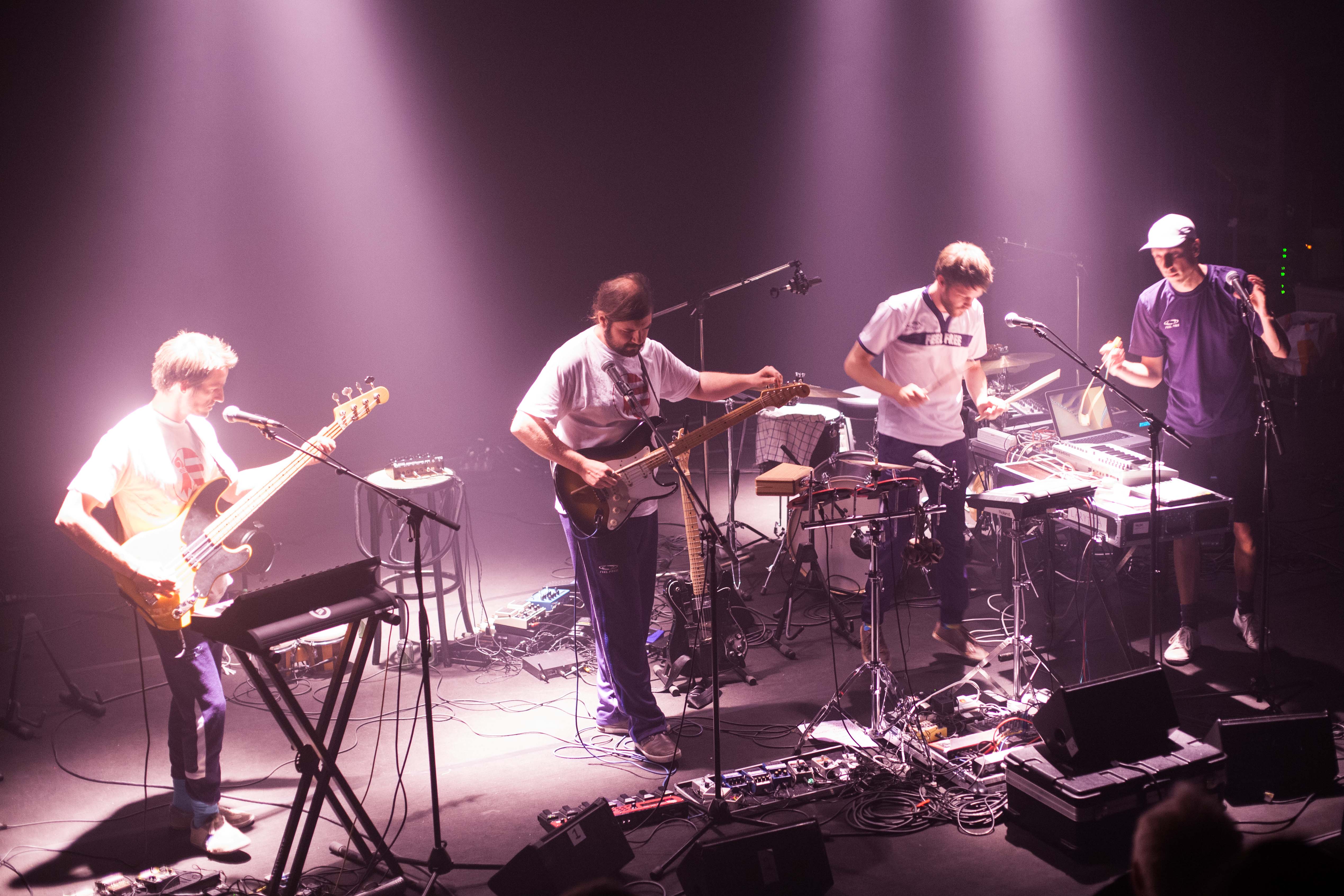
Le duo lausannois constitué du designer graphique Guy Meldem et du performer sonore Christian Pahud nous avouait dans l’après-midi fonctionner comme un « vieux couple infernal ». Depuis la parution de son nouvel album « Jura » l’an dernier, il a décidé de faire peau neuve: de deux, les voilà passés à quatre, ajoutant des vrais instruments à leurs machines, ordinateurs et pédales.
Résultat : un show ultra-enjoué qui multiplie les clins d’œil musicaux; ici des guitares africaines, là un chant en portugais. Funky ou techno, les musiciens sautillent comme des balles de ping-pong et ne cessent de changer de place, d’instruments. C’est ludique, dynamique, même si parfois ce chant à quatre voix sur des micros sans cesse différents pose des petits soucis de calage. Une phase de transition pour cette formation qui a plus d’un tour dans son sac et qui sidère par son énergie communicative.
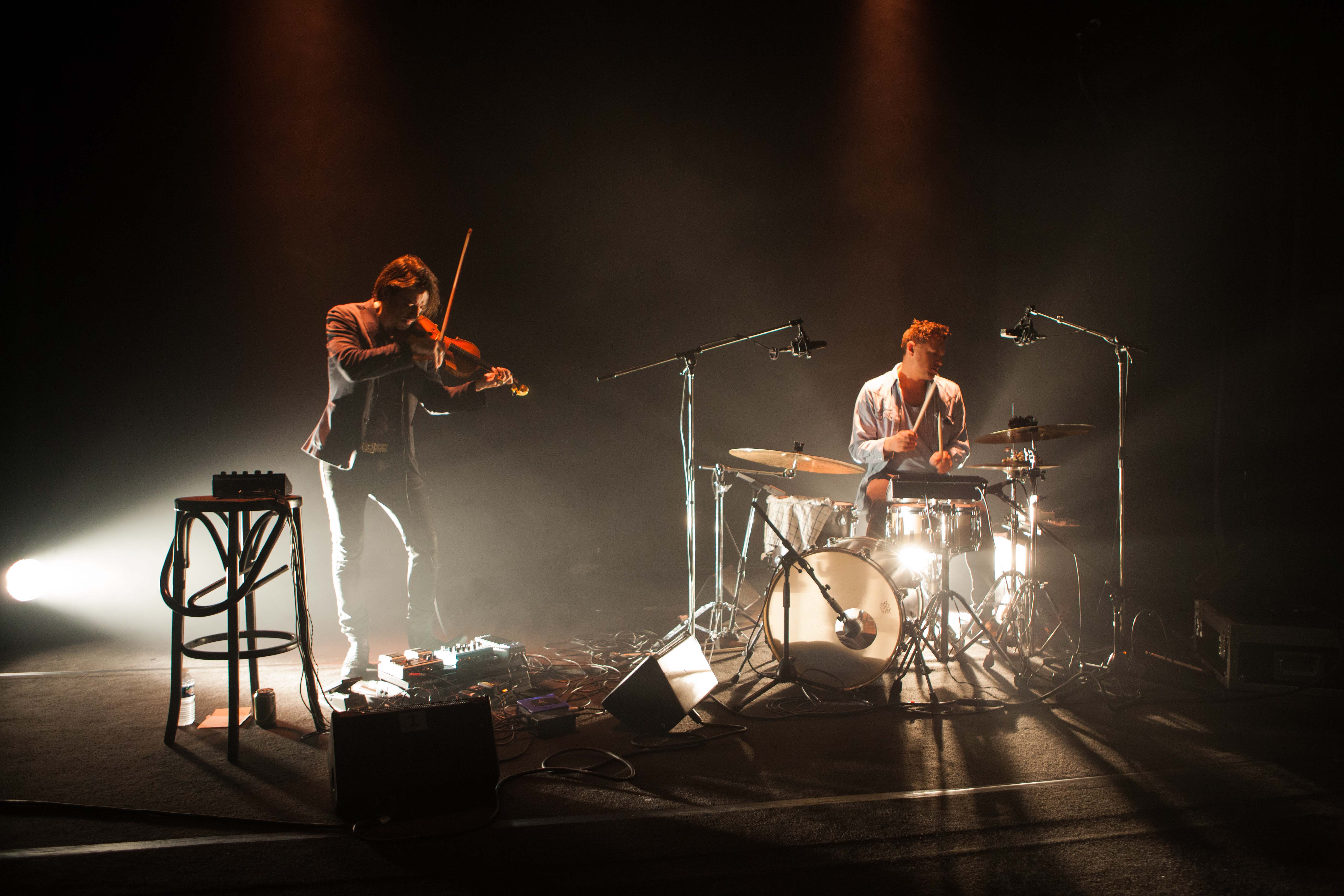
Nous vous avons déjà abondamment parlé de Egopusher dans ce blog. Ce duo constitué du violoniste Tobias Preisig et du batteur Alessandro Giannelli a décidé de lâcher les amarres et de se lancer dans un work in progress permanent. Peaufinant leur morceau sur scène, ils les mettent ensuite à disposition des internautes via soundcloud puis les retravaille, et ainsi de suite. Une prestation qui s’inscrit donc aux confluents de l’expérimentation sonore, des rythmes déconstruits ou répétitifs et des musiques improvisées. Une musique qui semble chercher à revenir vers une pulsion primale, essentielle.
Entendus dans un set flirtant avec la techno au Cully Jazz, puis plus sages dans l’émission de Manoukian sur France Inter le 29 mai, ils se présentent dans une version plus théâtrale et plus subtile au Ccs. Ce dialogue inédit entre la batterie et le violon est aussi visuel. Tobias Preisig travaille son instrument au corps pendant que les baguettes d’Alessandro voltigent sur les fûts. Le principe de l’exercice fait que l’on n’évite pas quelques moments de flottement, mais ce même principe invite aussi à la curiosité, à une attention extrême de la part de l’auditeur qui ne s’y trompe pas. « Vraiment nouveau », « Franchement étonnant »,« excitant » sont les commentaires qu’on entend fuser dans l’assistance à la fin de leur set. Quant à Preisig, il définit sa musique comme du « Brahms sous psychotrope ».
Jeudi 5 juin Swiss Vibes goes jazz
En Suisse, jazz rime souvent avec diversité stylistique. Le double concert d’Orioxy et de PommelHORSE en fut la preuve.
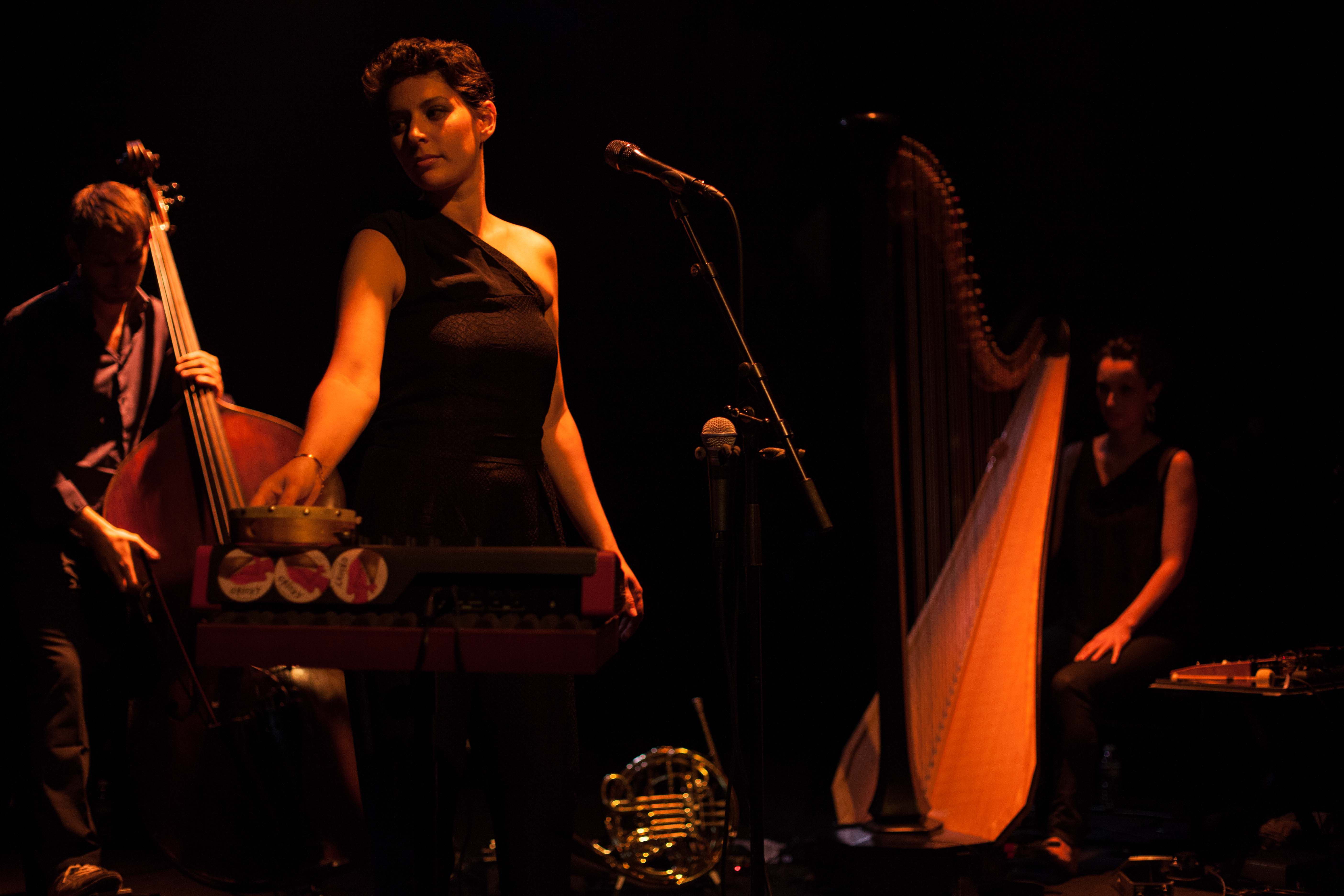
Orioxy séduit en finesse avec une approche très féminine (que la rythmique masculine veuille bien m’excuser pour ce commentaire). Yael Miller, Israélienne de Suisse, impose sa marque au chant. En hébreu en anglais, entre rap, scat et chuchotements, sa voix tisse un univers d’émotions à fleur de peau, d’impressions parfois enfantines, parfois matures et engagées. Auquel répondent les mouvements du corps habité de Julie Campiche et sa gestuelle précise qui, d’une main tire un foulard entre les cordes de son instrument, de l’autre bidouille ses effets électroniques quand elle ne se sert pas d’une baguette de feutre. Le travail sur le son est subtil, pénétrant. Dans cet univers le cor de Baptiste Germser, l’invité français de la soirée, s’intègre naturellement, comme si il allait de soi. « Dans nos chansons on cherche aussi à exprimer les non-dits» nous expliquait Yael Miller sur ce blog il y a deux ans. Pari tenu au Ccs.
Quant à PommelHORSE, leur fonds de commerce est l’expression en musique de sentiments peu ordinaires : le stress d’un homme devant passer un scanner, les rythmiques techno qui continuent de résonner dans la tête d’un fêtard qui n’arrive pas à s’endormir à l’aube, les frémissements d’un cerf pourchassé. Pour expliquer ce monde de sensations primaires avec beaucoup d’humour, le clarinettiste Lukas Roos joue de son accent suisse-allemand avec décontraction. Lui vient plutôt du classique, le batteur à la rythmique métronomique du heavy metal, le clavier qui est aussi celui d’Evelinn Trouble aime le rock, l’électronique et à peu près toutes les musiques que vous lui nommez…. Vous l’aurez compris chez PommelHORSE, le jazz est un état d’esprit placé sous le signe de l’innovation, de la sensation, de l’énergie, de l’humour. Personnes sérieuses s’abstenir.
Hors de leurs murs, originaires de différentes régions de la Suisse et sans qu’ils ne se connaissent les uns les autres, ces sessions musicales de trois soirs ont permis de faire passer un courant entre ces différents groupes, d’affirmer haut et fort que la scène suisse se porte de mieux en mieux. « J’ai découvert des musiciens extraordinaires et des projets vraiment originaux. C’est excitant et ça donne envie d’en connaître plus ! » s’exclame le pianiste français Alexis Anerilles (qui office entre autres aux côtés de Sophie Hunger), spectateur assidu de ces trois soirées de concerts. Merci à Evelinn Trouble, Puts Marie, Larytta, Egopusher, Orioxy et PommelHORSE pour ces moments enthousiasmants et fédérateurs.
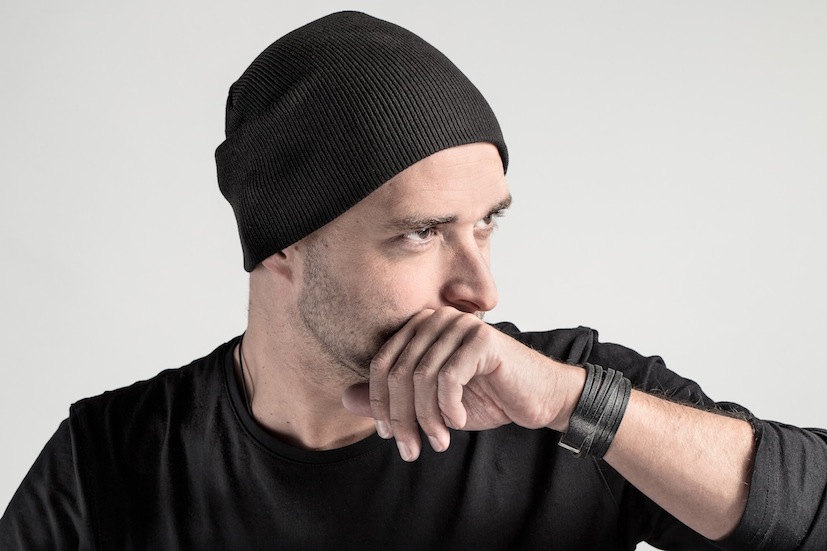
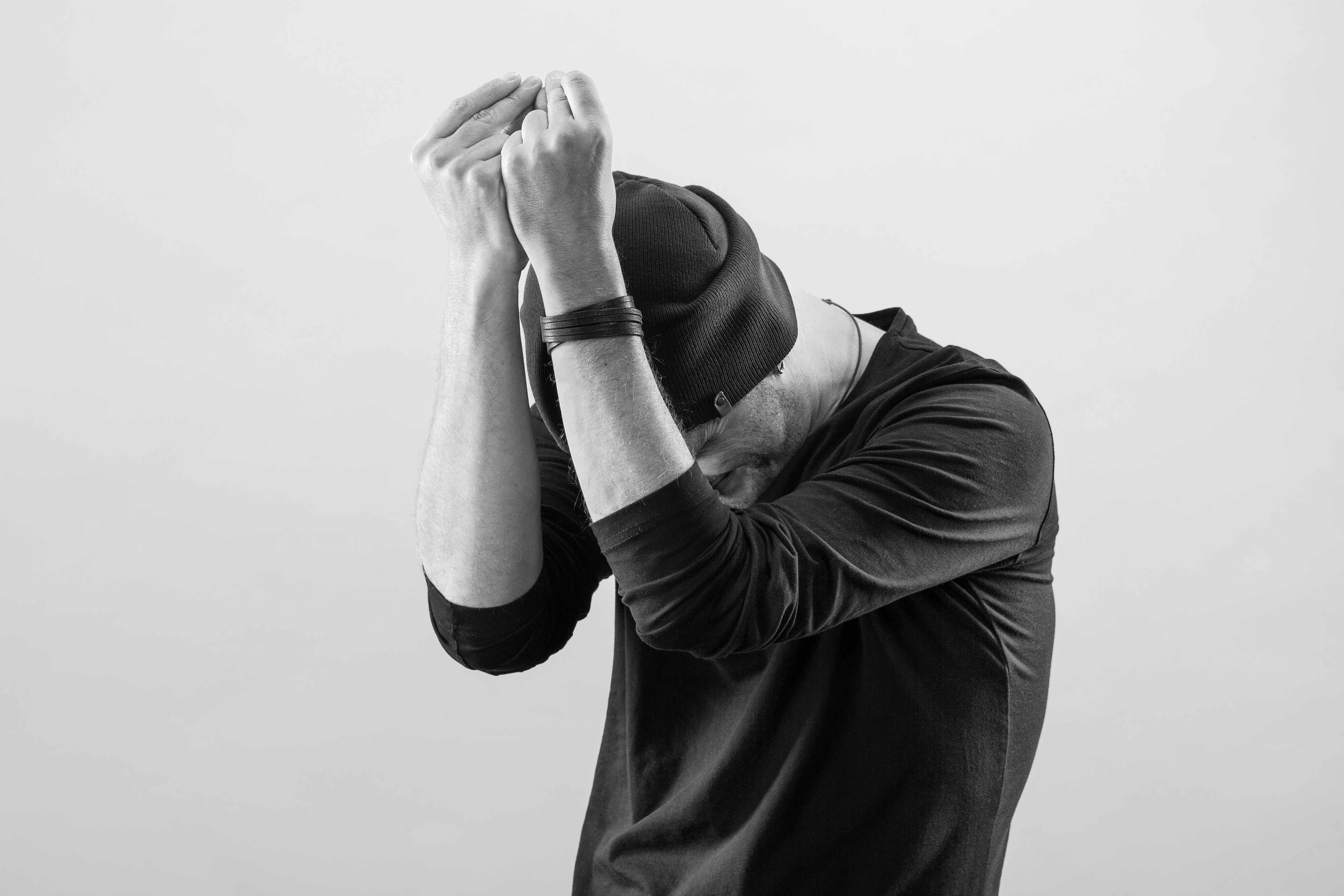
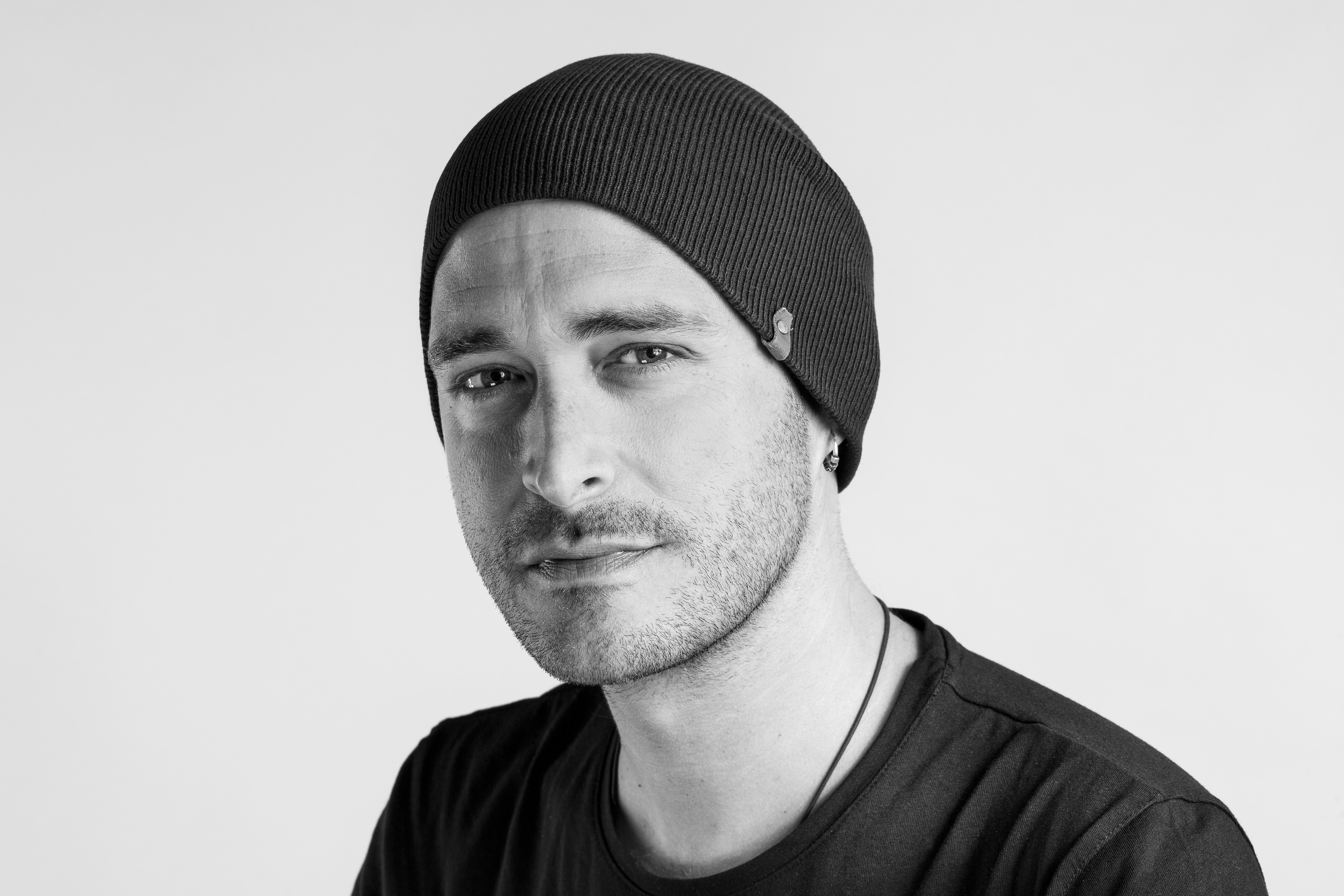
Andreas Schaerer bekommt in Hamburg den Echo Jazz als „Sänger des Jahres International“
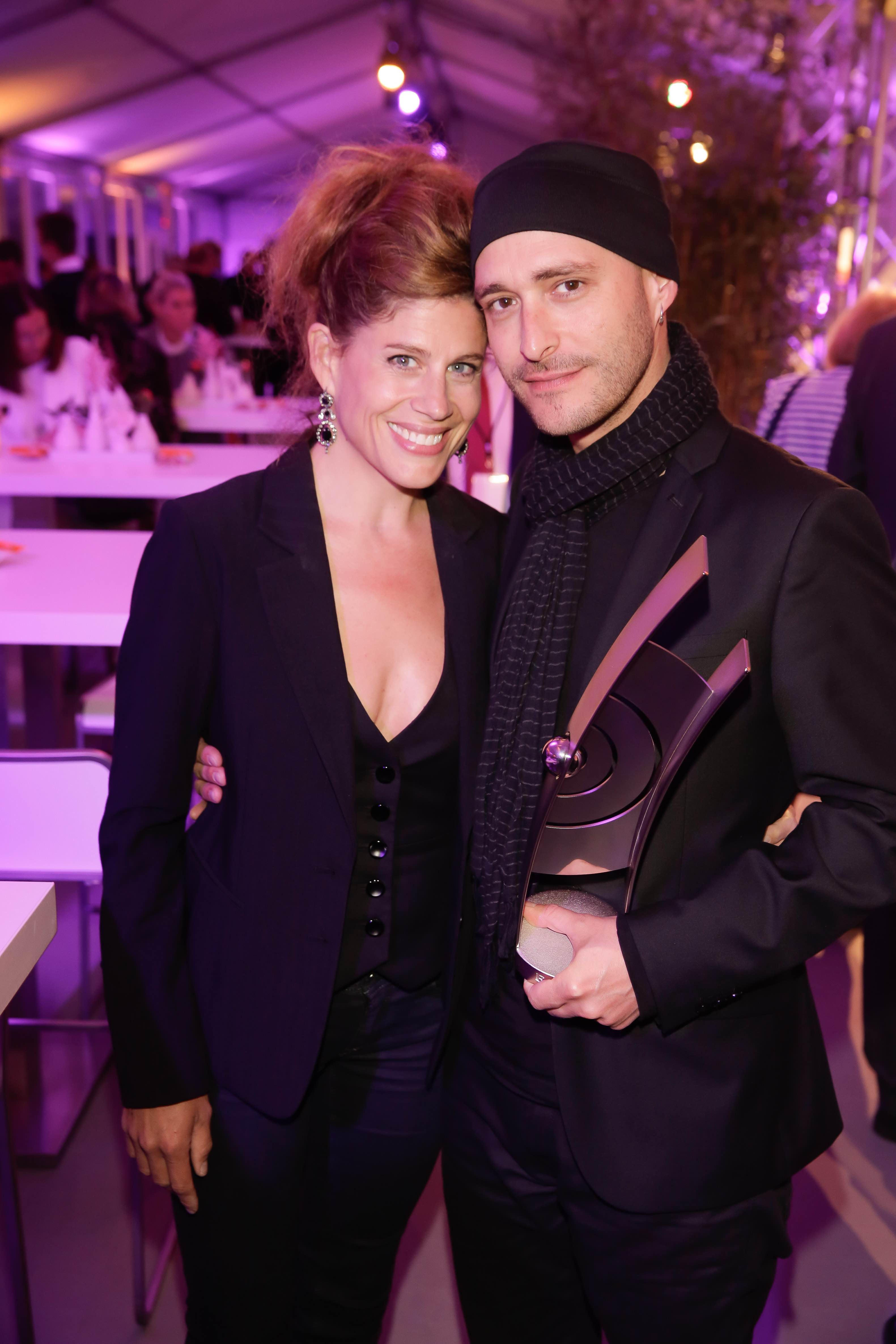
Andreas Schaerer ist in Deutschland angekommen. Im vergangenen Jahr gewann der Berner Sänger mit seiner wilden Band Hildegard lernt fliegen in München den mit immerhin 10.000 Euro dotierten BMW Welt Jazz Award. Jetzt durfte er in Hamburg den Echo Jazz in der Kategorie“ „Sänger des Jahres International“ – sein direkter Vorgänger war kein Geringerer als Gregory Porter – entgegennehmen. Zwar undotiert, aber vom Renommee her inzwischen doch eine Art deutscher Grammy. „Ich freue mich unglaublich über die Auszeichnung“, sagte Scharer, kurz bevor er den Spießrutenlauf auf dem roten Teppich zur Fotowand nach amerikanischem absolvierte. „Das ist ja eine Form der Anerkennung, die einen in seinen Überzeugungen bestätigt. Eine Resonanz, die einen motiviert, das oft unglaubliche Arbeitspensum auf sich zu nehmen, Gas zu geben, alles auf eine Karte zu setzen.“
Schaerers Auszeichnung hat Signalwirkung
So wie der Begriff Jazz inzwischen kein fest definierbares Genre mehr beschreibt, sondern für individuelle Musik heterogenster Quellen steht, so ist auch die Kategorie „Sänger“ bei Andreas Schaerer ein hilflose Untertreibung. Er setzt nicht nur alle Stile von der Opernkoloratur und dem klassischen Liedgesang über Crooner-Swing und Bebop-Scat bis zu expressionistischen Vokalisen und Experimentalgesang ein, er imitiert auch Geräusche und Instrumente und beherrscht überdies Multiphonic-Beatboxing. In den verschiedensten Projekten, vom Duo mit dem Schlagzeuger Lucas Niggli über das Trio Schaerer-Rom-Eberle über die Kollaboration mit dem Arte Quartett und dem Bassisten Wolfgang Zwiauer bis zum Vorzeige-Sextett Hildegard lernt fliegen er damit gleichberechtigtes Instrument, ja als Komponist vieler Stücke auch oft Erster unter Gleichen. Als weiteres Alleinstellungsmerkmal kommt der direkt der Musik entspringende wie in den Moderationen gepflegte Humor dazu, der seinen Auftritten oft schon kabarettistische Züge verleiht. Leider durfte Schaerer beim Echo nicht auftreten, der wie viele andere beim Festakt selbst die Musik jenseits des Mainstreams vermisste.
Dafür gab es eine schöne Laudatio von Mr. Tagesschau Jan Hofer , der Schaerers Auftritte als „Orgien der Fantasie, famoses Chaos und Anschläge auf der Musikverständnis“ rühmte – obwohl er ihn noch nie live gesehen hat, wie er im kleinen Kreis bei der anschließenden Party verriet. Schaerer griff in seiner kurzen Dankesrede die Erwähnung seiner klangexperimentellen Jugend in den Emmentaler und Walliser Bergen gewohnt humorvoll auf: Er habe sich als Kind oft gefragt, wie das Echo aussieht, das ihm aus dem Tal zurückkam. Jetzt – und dabei reckte er die sperrige Trophäe empor – wisse er es. Wie ein Schweizer Echo idealerweise klingt, das erfahren demnächst die Besucher von „Bingen swingt“ und des Südtirol-Festivals, bei dem Schaerer zu den favorisierten Stammgästen des innovativen Festivalleiter Klaus Widmann gehört.
Blaser trills and sways with a wonderful, inebriated tone
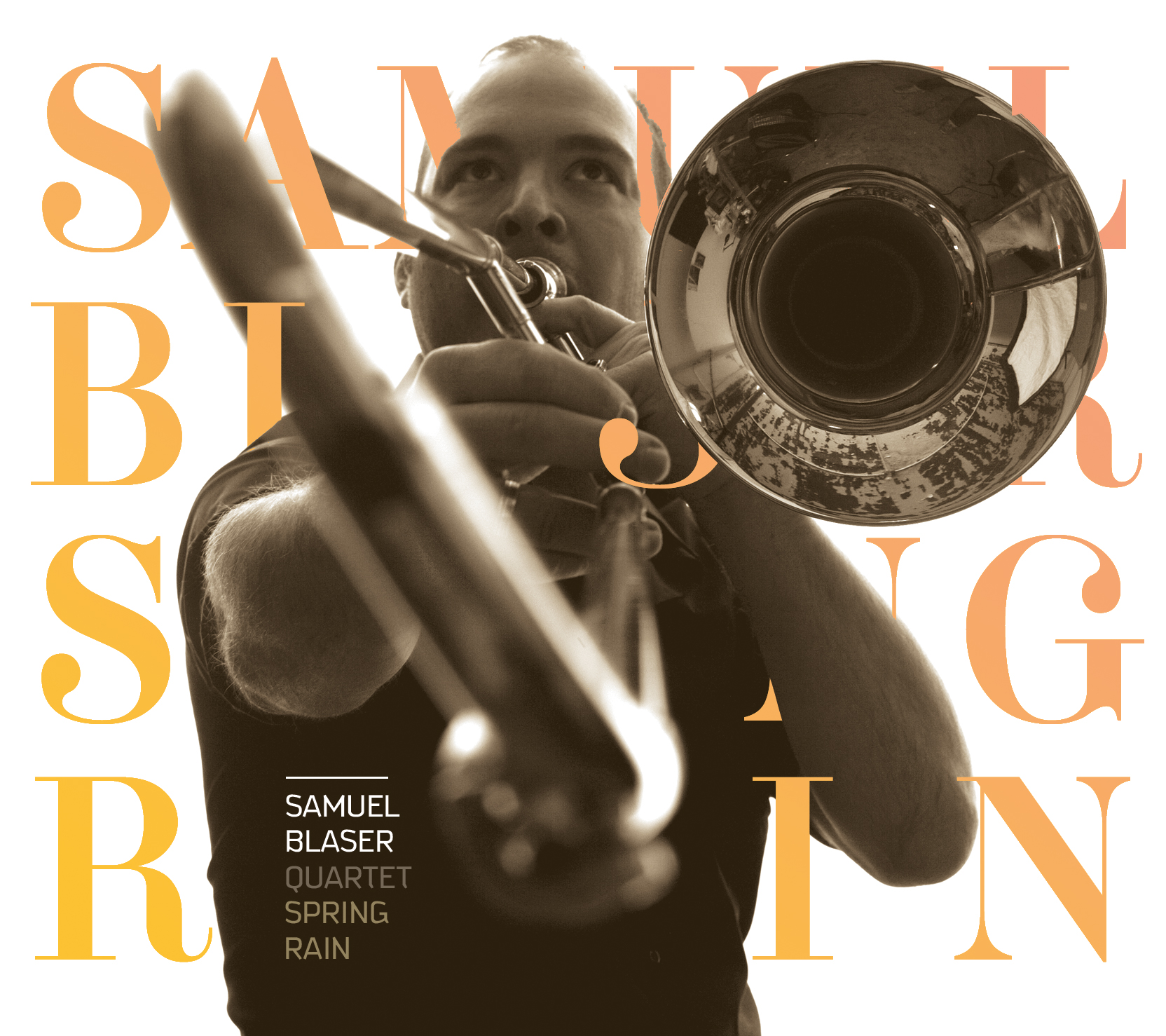
Samuel’s opening notes of ‘Jesus Maria’ emit a tone of skewed warmth, imperfect but aglow. What follows is an almost heartbreaking conversation between Blaser, Russ Lossing whose piano notes fall as clear spring raindrops, and the ghostly double bass of Drew Gress. Gerald Cleaver locks into this sensitivity brushing drums or rustling cymbals and I drifted into a meditation that I didn’t want to leave. It’s a gorgeous piece written by Carla Bley and was featured on the Jimmy Giuffre 3‘s album Fusion, 1961. Spring Rain is a tribute to Giuffre, specifically his now-revered, explorative work with Paul Bley and Steve Swallow and combines covers with original compositions in a conducive listen.
Lossing makes the difference in ‘Missing Mark Suetterlyn’: as Blaser trills and sways with a wonderful, inebriated tone, Russ brings the double joy of piano and keyboards (he plays Minimoog, Fender Rhodes and Wurlitzer on this album). His electronic runs and chord stabs funk it up, space it out and take us into a thrilling, lawless landscape. All the time Cleaver is finding off-beats with laudable subtlety; he’s finely integrated but always notable.
A warm ’60s jazz homecoming
This track leads straight into the lucid melody of ‘Temporarily’ (another Carla Bley composition). There’s a sense of the recognisable here, like a warm ’60s jazz homecoming. Blaser hits the spot in the way a trumpet can – with soulful, cool sensibilities. Spring Rain has been directed by Robert Sadin, a classical conductor (a vital point as there are flavours of classical expressionism in Blaser’s playing) who also arranged and produced output such as Gershwin’s World by Herbie Hancock. From the musical themes to the sequencing, this feels a quality production.
I adored Blaser’s short solo ‘Homage’, its romantic grief like a modernist ‘Last Post’. If it was played with Blaser’s late manager, Izumi Uchida in mind, I can’t think of a more touching goodbye. ‘The First Snow’ is a free-for-all improv that again shows how this quartet is greater than the sum of its parts. They entangle themselves yet create space for ideas to breathe a fresh air.
Blaser: “Beautiful melodies and no boundaries” If I’m honest I don’t find the trombone an easy listen, but the combination, especially with Lossing’s exquisite electronic touches, creates both an engaging tension and harmony. Blaser says, “I want people to know that there is jazz, blues, classical music, beautiful melodies and no boundaries,” and maybe that’s why I like this album. However I also think taking Guiffre as inspiration has given Blaser permission to incorporate five interpretative covers as well as provide a fertile direction for composing.
The Giuffre 3 are now recognised for their crucial contribution to free jazz, but disbanded in 1962 after the avant-garde album Free Fall and a gig where they earned 35 cents each. I’m certain there are quite a few musicians out there now who can relate to that.
 So ist Wintsch immer ein Avantgardist gewesen; einer freilich, bei dem die als klassische Avantgarde angesehene Moderne Musik nur ein kleiner Baustein ist. Der Spirit des Freejazz, die formalen Strukturen der Orchesterkomposition, die radikale Reduktion der Minimal Music, die Energie des Progressive Rock, die Sounderweiterungen der Elektronischen Musik – all das fließt in seiner Musik zusammen. Das machte ihm zum idealen Gefährten von Freigeistern wie Han Bennink, Ray Anderson, Michel Doneda, Fred Frith (zusammen mit der Schweizer Experimental-Vokalistin Franziska Baumann, der chinesischen Pipa- und Guqin-Spielerin Yang Ying oder dem Quintett desjungen Schweizer Trompeters Marco von Orelli; zu einem gefragten Theater- und Filmmusikkomponisten, zum Beispiel für zwei Spielfilme von Alain Tanner; vor allem aber zum immer noch unterschätzten spiritus rector diverser eigener Projekte, vom Trio WWW mit Christian Weber und Christian Wolfarth bis zum Sextett Face Nord.
 Dazu kommt mit „Roof Fool“ jetzt wieder ein Soloprogramm, das den eingeschlagenen Weg fortsetzt. In den meisten der 14 ganz disparaten, oft ganz auf eine starke Idee vertrauenden und deshalb erfreulich kurzen Stücken brodelt ein nach allen Seiten offener Urklang vor sich hin. Es kann dann ganz atonal und sprunghaft werden („Shopping Ladies“), aber auch sphärisch-melodisch („Phytihob Wag“), mal ein Spiel mit Pausen und Anschlägen („Là où y a des croîtres“), ein wilder rhythmischer Parforderitt („Si c’est assez, cessez“) oder eine locker vor sich hinschaukelnde Miniatur („Adroit à gauche“). Selbst wenn die technischen Anforderungen hoch sind wie bei „Dyuke“ und das Timekeeping in die Nähe des Schlagzeugspiels rutscht wie beim Titelstück, steht das Pianistisch-Virtuose nie im Vordergrund, stets geht es um die Klangidee.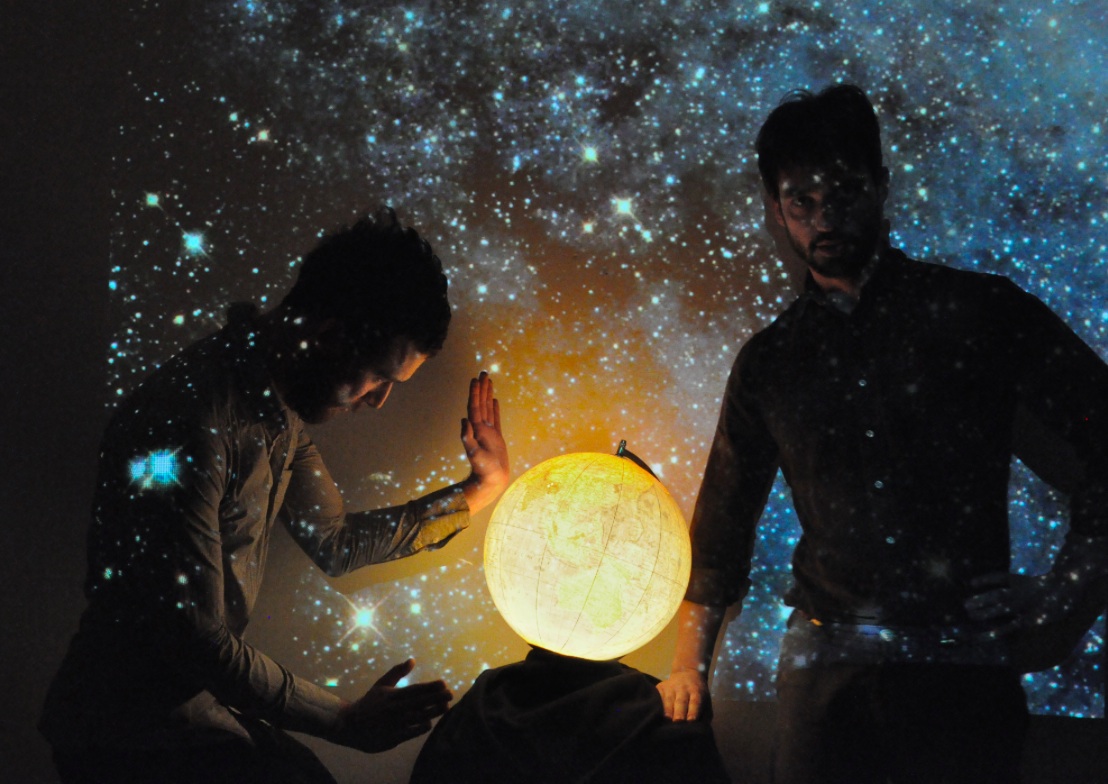


 Not a great fan of distorted digital noises of any kind, I was not prepared to like the work of Blaise Caillet – AKA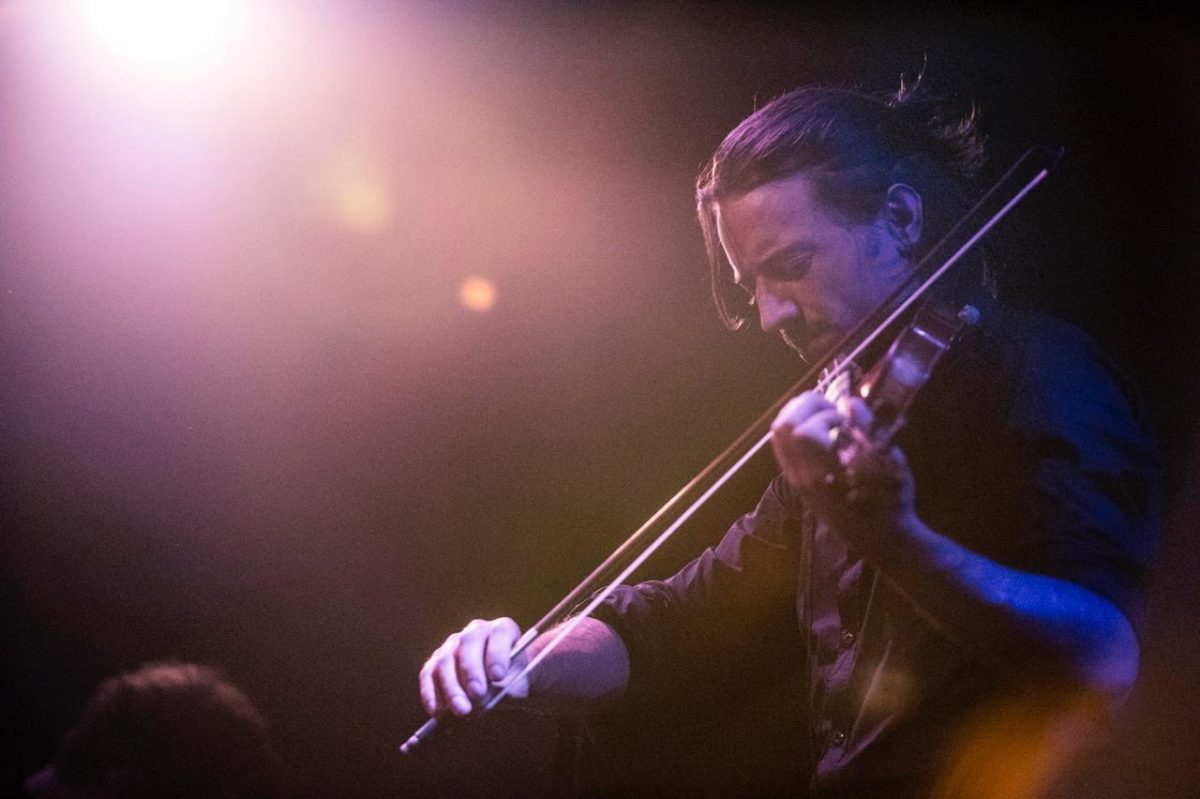
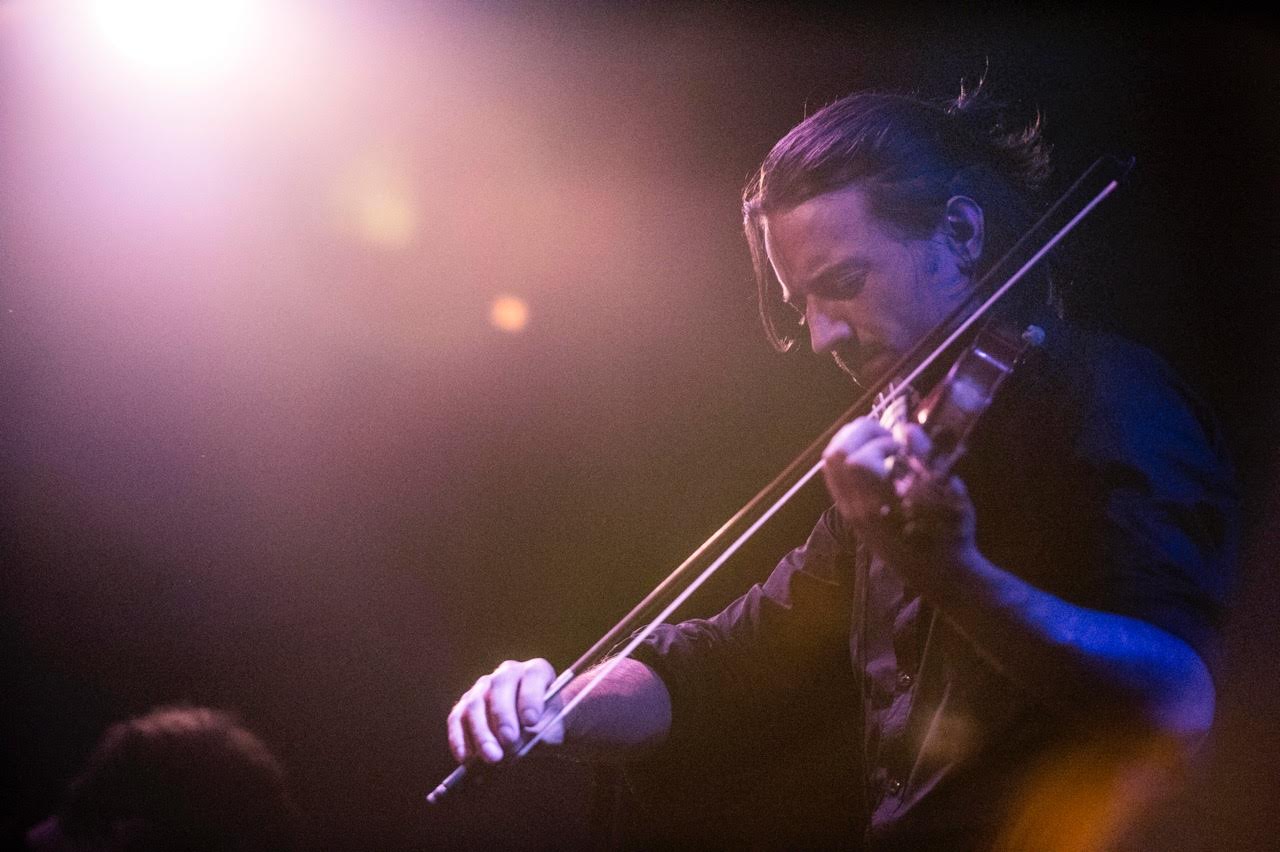 Après nous avoir séduit avec son quartet, après nous avoir surpris avec son projet électro
  Tobias Preisig: C’est un nouveau défi pour moi. Faire un concert en solo implique de gérer en même temps les rythmes, la mélodie, la situation du moment. C’est très difficile, très extrême, mais ça amène aussi des nouvelles idées, ça permet d’avancer musicalement. Le pianiste

 En fait, c’est à un concert du groupe de hip hop hard funk allumé,
  Aujourd’hui,
  Sur la scène du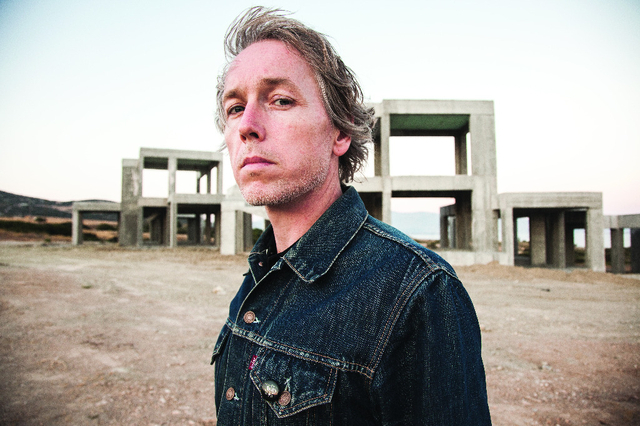
 Au cours des dix premières années de son parcours de chanteur, Eric Linder, alias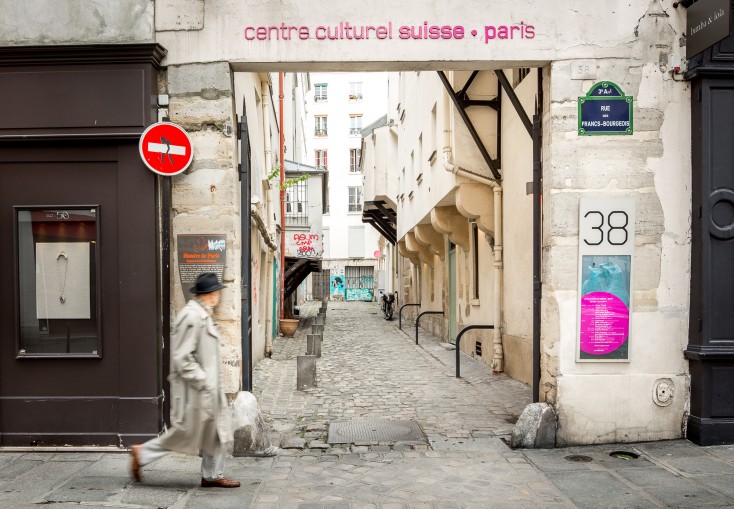
 En cette première semaine du mois de juin,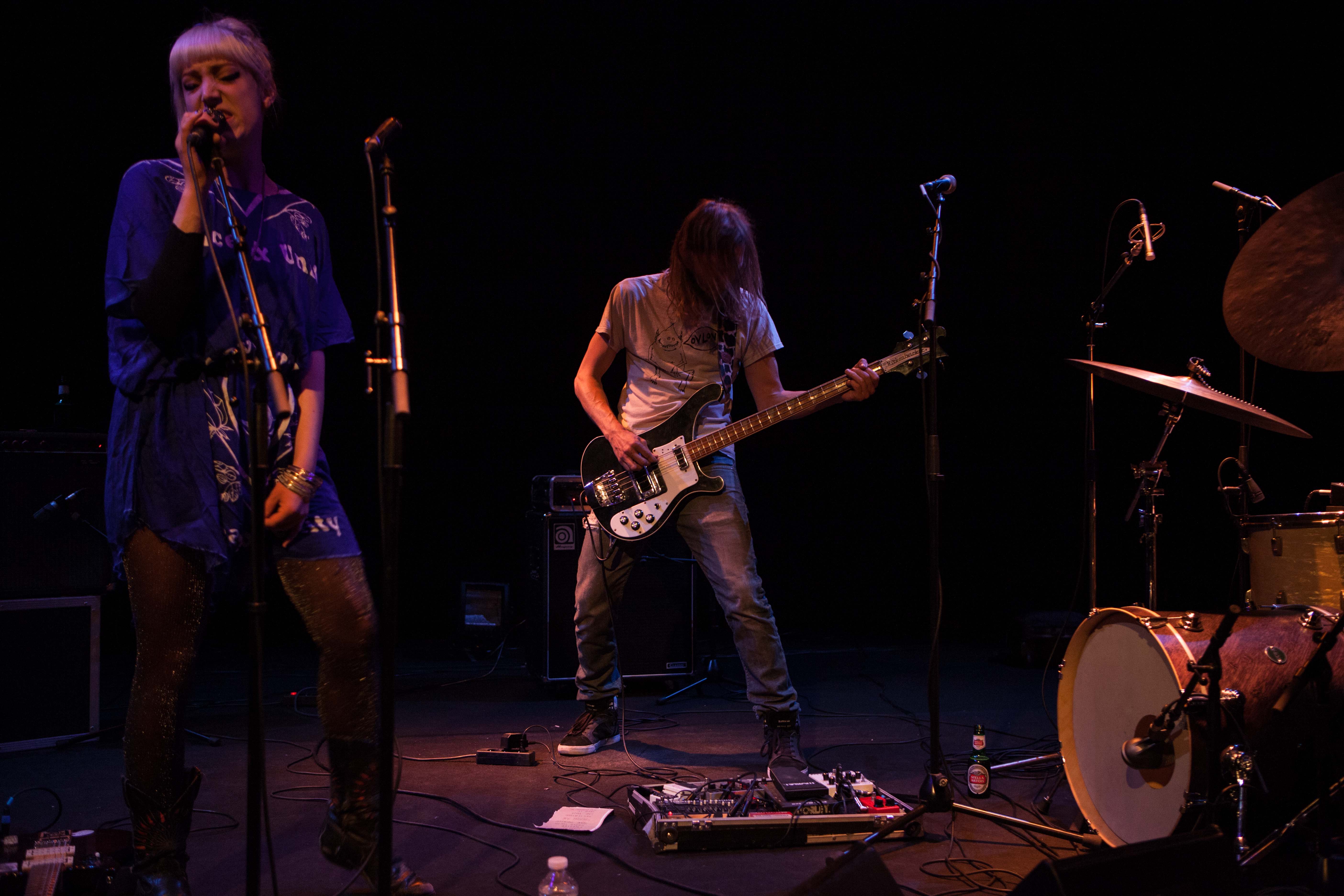
 Andreas Schaerer
 So wie der Begriff Jazz inzwischen kein fest definierbares Genre mehr beschreibt, sondern für individuelle Musik heterogenster Quellen steht, so ist auch die Kategorie „Sänger“ bei Andreas Schaerer ein hilflose Untertreibung. Er setzt nicht nur alle Stile von der Opernkoloratur und dem klassischen Liedgesang über Crooner-Swing und Bebop-Scat bis zu expressionistischen Vokalisen und Experimentalgesang ein, er imitiert auch Geräusche und Instrumente und beherrscht überdies Multiphonic-Beatboxing. In den verschiedensten Projekten, vom Duo mit dem Schlagzeuger