Fabio Friedli, aka Pablo Nouvelle, is a young Swiss German soul-boy turned bedroom-rocker whose first album couldn’t get an official release because of all the Marvin Gaye and Smokey Robinson samples that needed clearing. The term “plunderphonics” seems to have been coined for this studio magician thanks to his particular talent for the art of sampling and restitching. Three years later, his new album, All I Need, is less of a post-modernist chop-up job and more of an organic studio project full of contemplative beats and atmospheric vocals, both skillfully employed to tease out a strong feeling of space and mood.
A surprisingly mature and emotionally delicate second album from a 29 year old who, when not winning awards for his work in film animation, finds time to record 4o tracks for his new album in London and Los Angeles. It has slick, catchy, pop/soul electronica stamped all over it, a feast for chill out lounges, downtempo playlists and elegant Manhattan shopping arcades. Though shamelessly commercial in its intention, the album is rich in feeling and texture thanks to a minimalist approach to the production that lets each track breathe in its landscape. Little wonder it struck me as the potential soundtrack to a film featuring hypersensitive characters figuring out their mercurial relationships on a snowy horizon.
Fabio explains that what starts off as a vague musical sketch at home on the keyboard and drum machine then gets elaborated in the studio with a singer who helps co-write and develop the piece turning it more into a song rather than just a sampling mosaic, a new situation for him formerly used to solitary confinement with his machinery. However sampling still features heavily as the vocals are often looped, chopped, slowed down and generally manipulated in some way to create the essential, raw direction of the track. Often compared to the likes of DJ Shadow and The Avalanches, the beats are tight, crisp, the uptempo numbers aching with dance floor potential.
Joined by a drummer and bassist on stage, Pablo Nouvelle will be on tour throughout Europe for most of spring 2016. Quoting Bonobo, the XX and Radiohead as his influences, I wouldn’t be surprised to find the work of Pablo Nouvelle alongside his heroes on heavy rotation on an intelligent radio station near you soon. With the one Marvin Gaye sample on the LP finally cleared, All I Need is out now on the award-winning Dutch label, Armada Music.
Pablo Nouvelle tour dates in March and April are on bandsintown
Not a great fan of distorted digital noises of any kind, I was not prepared to like the work of Blaise Caillet – AKA Sknail – the main perpetrator of the nu-electronica subgenre called ‘glitch jazz’. However, one must always be ready to eat one’s hat. In the intelligent hands of Caillet, the Sknail project is carried off with such graceful modernity and beauty that no one could begrudge him a few mechanical distortions here and there.
A mercurial soundscape
« Snail Charmers » is the second LP that spearheads this sci-fi fusion of jazz and the dark side of modern electronics. Listening to the album is like stepping into a mercurial soundscape where drums are replaced by subtle, finely-tuned scratches and digital malfunctions. Thanks to Caillet’s gifted production skills, they actually are made to sound beautiful, sitting perfectly at ease next to six professional jazz musicians and their elegant experimentation. The LP is a seamless work, fabulously suited to the soundtrack of a would-be Nordic thriller set in a misty land of half human, half robotic jazz warriors.
This Mad Max journey of confrontation between man and machine.
The chilly, not-quite-human electronic glitches are woven with great craftmanship into the sinuey hues of voice, trumpet, bass clarinet, piano and double bass. The result is a silvery, thin blanket of sound that is far warmer and more welcoming than expected. ‘Snail Charmers’ and ‘Something’s got to give’ are probably my favourite tracks of the year so far. Rapper/narrator/singer, Nya, works wonders with his languid, lilting vocals, adding the needed human guidance along this Mad Max journey of confrontation between man and machine. This work is cleverly thought-out and studied from every angle: concept, sound and visuals. Glitch jazz is indeed a product of our digital times, proving that the conquering and innovative spirit of jazz can be merged with anything, even “the aesthetic of failure”.
In conversation with Blaise Caillet:
Did you come up with the term ‘glitch jazz’?
Blaise Caillet: Glitch jazz is a subgenre of electronica. When I checked it on google, the term “glitch jazz” already existed. There are mostly DJ productions, in other words an electro beat with jazz samples and some little glitchy sounds thrown in. When I created the “Sknail” project, I wanted to take the word “glitch jazz” quite literally, ie: real glitches with real jazz! It felt really new. Now when you google “glitch jazz”, the first result that appears is sknail.com.
How was your first LP, ‘Glitch Jazz’ received?
Blaise Caillet: Some listeners were shocked and still are now! The first time I heard Alva Noto (pure glitch music) I was shocked too but it’s good to be troubled or affected when listening to new music. Personally, I always look for this sensation when listening to music. The first Sknail LP was generally well received by people looking for these kind of sensations. I prefer developing an original musical project, taking a path where nobody has gone before, even if it’s something shocking or displeasing.
Drums? Is this the role of the glitches?
Blaise Caillet: Yes, you can look at it this way. The glitches are micro samples and micro sounds stemming from machine failures, electronic malfunctions. When these micros samples are cut, clipped, treated, stuck together, you can get a very smart and definite percussion sound. In the end, the way to give a pulse to a track doesn’t matter, the important thing is getting the pulse, feeling the vibe. Also, using glitch rhythms in electronic music gives a different, finer sound than the “classical” electro drum machines. It results in a different aesthetic.
A lot of the tracks on both LPs have a very filmic, soundtracky quality. Do you plan to work in this domain?
Blaise Caillet: Yes I do. I worked last year with a French producer to adapt a Sknail track for a short movie that was featured in the “Nuit des Images” at Lausanne’s Elysée photography museum.
The timbre of the music has a beautiful melancholic quality. Do you think glitch jazz can ever be upbeat and joyful?
Blaise Caillet: I always use minor and modal (without harmonic changes) tonalities in this project. That gives a very specific mood to the music with a melancholic timbre. This timbre is specific to a certain kind of avant-garde jazz and, when it’s mixed with a cold and clinical electronica glitch music, it transcends itself. This is what I’m into: mixing the timbre and the styles, finding new aesthetics. At the beginning, I tried to make some tracks that were joyful and upbeat, but that didn’t work. They had a kitschy side, a kind of a hopping experimental electrojazz house sound which wasn’t what I was after.
Your rapper, Nya, touches on some relevant points about today’s decaying society, (especially in ’Slow Poison’). Is the band more a celebration or an attack on the digital age and what’s it’s brought to the world?
Blaise Caillet: I’ll let Nya answers this question: “It’s neither an attack nor a celebration of the digital age. It’s a balancing act, as with so many things in life. Trying to stay true to our human selves while at the same time evolving and adapting to our environment. Never losing sight of the essential things.”
How important are the visuals to your music? Who’s in charge of them?
Blaise Caillet: It’s very important. When you listen to music, you automatically create images and scenes in your mind. So I think it’s a very smart way to deliver the sound and the image of the music together, to suggest an entire artistic concept to the listener. And the aim is the same as the music: to create something innovative. Online, I met Efrain Becerra from Phoenix, Arizona, I stumbled upon his FB page and was very impressed with his 3D graphical work. I contacted him with the instruction: “Imagine how a jazz club might be in the year 3147 ». We had a lot of brainstorming ideas and exchanges via e-mail, Facebook, Whatsapp but I still haven’t seen, touched or talked to him yet face to face. Welcome to the 2015 dematerialized world!
What’s the Sknail live experience like?
Blaise Caillet: It’s important to understand that my musicians have never met (for both albums!). I recorded each musician one by one and created the tracks layer by layer because I’ve got only one microphone and because I really didn’t know where this project was going at the start. My objective was to realize an entire project by myself: artistic concept, creation, composition, arrangement, recording, mixing, promotion. The only thing I haven’t done myself is the mastering. I’m now working on how to produce the live show. First I have to find the adapted hardware and software, then, figure out how to perfectly synchronize the glitches with the double bass player to make the perfect rhythm section. In a live situation, I want the musicians to be very free like in a “classic” jazz concert, we play the theme and/or the vocal part very straight and arranged, and then the improvisations take off with great interaction between musicians.
Do you have any other music projects outside of Sknail?
Blaise Caillet: I did all the electronic musical arrangements for the last album of Ultra Dieez from Geneva, (Mathieu Delieutraz: composer, singer and guitarist who plays French rock/folk). When we decided to work together, I mixed the electronica glitch timbres to his roots bluesy French rock music and the result was great.
Described as “a laboratory of ideas, where you will assist the birth of creation live and direct, public jam sessions, pure sound research”, there’s a sense of anticipation in the air as I wait for The Treichler-Pizzi-Trontin Experience to take to the small stage at the Hundred Blue Bottle Club. It’s the last night of their OFF festival residency in Cully and a tightly-packed crowd of loyal Young Gods fans of all ages are giving off the distinct impression that something thrilling and unique is about the take place. It’s the coming together of well-seasoned, deeply-connected musical partners still capable of enthralling their audience with new ideas and aural concepts. The three musicians share a musical history of almost 30 years, yet everybody present knows that old school nostalgia is not on the menu tonight.
A tight whirlwind of gripping sound
Indeed, for those not familiar with the three-decade towering inferno that are Treichler and company, it might be a surprising sight to see men over 50 producing such a tight, trancy, experimental, head-nodding wall of sound. From the get-go there is a sense of journey, like being yanked onto a rhythmic train moving with pleasant urgency from station to station, hypnotising you with varying degress of intensity and volume along the way. Rhythms are created slowly, electro beats taking their time before coming at you like a whip and ensnarling you into a tight whirlwind of gripping sound.
It’s a technological playground for bedroom rockers
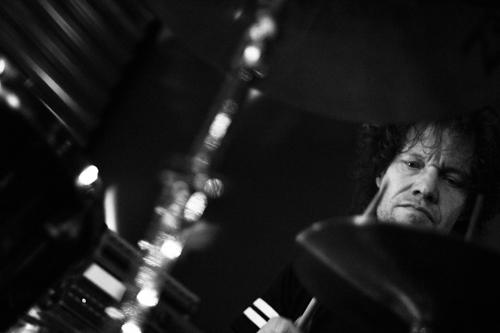
Franz Treichler, the archetypal gum-chewing rock legend, weaves his often unintelligeble vocals in and out of the soundscape tapestry. His words are at times irrelevant and haphasard but serve to add a darker edge to the swirling, dubby rhythms. Interesting effects are used to create echo, reverb, loops and playback – it’s a technological playground for bedroom rockers who like their soundtrack trippy, hypnotic and just that little bit sinister. When things get a little too bouncy, Treichler comes in with a good dose of tough-love guitar to remind us there is beauty in light and shade. However, for me, the greatest of props go to drummer, Bernard Trontin, who steers a tight ship full of funky breakbeats and unparalleled rhythmic structure. Watching his dexterity and joy behind the drumkit is a rare delight.
Four questions to Franz Treichler
What was your reasoning behind “a laboratory of ideas”?
Franz Treichler: We were invited to do a residency at the Hundred Blue Bottle Club as part of the OFF festival at Cully Jazz. It seemed a perfect occasion to try out new ideas without the pressure of having to play Young Gods material. The OFF festival attracts a very open-minded audience at Cully, the atmosphere on stage is very free, basically ‘anything goes’. This felt appropriate for the band. Some ideas were born in the afternoon and played out the same night. Tracks changed every evening. I played guitar in a style I don’t normally use for The Young Gods, the same for my vocals – I couldn’t really call it singing, it was more sound improvisation and throwing things into the mix. There weren’t even any track titles, each piece was considered a session, a one off.
Why didn’t you bill yourselves as The Young Gods?
Franz Treichler: This would have changed the expectations of the audience and would have limited our freedom to experiment. We really wanted to create a mysterious vibe during the residency, encourage the listeners to be curious and progressive with us. Expect the unexpected.
What was happening on stage from a technical point of view?
@J.-Ch.Arav www.sweat-and-tears.ch
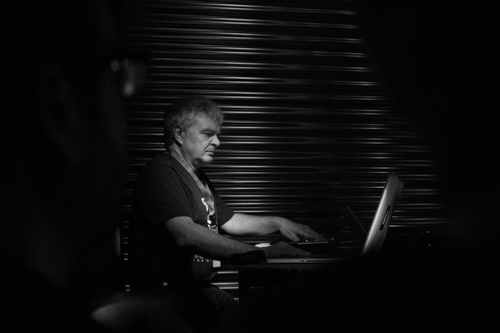
Franz Treichler: Cesare and I both had computers loaded with programmes that activate sound, sequencing, loops and pitch. Our computers were synchronised so that I could affect what he was playing and vice versa whilst keeping in rhythm. It was a very free and interactive process, although I must admit that there were times when it was hard to know who was doing what! What we set out to create was a sound of elevation, (music doing the job of the drugs!)
Is this in some way the future sound of The Young Gods?
Franz Treichler: We’d like to do something for the next album that’s in a similar vein, by that I mean not totally sequenced. We’ve always been categorised somewhere between rock and electronic music. It would be good to expand our experimental ambiant side, something less structured, more free.
Band line up:
Franz Treichler – vocals, guitar
Cesare Pizzi – keyboard, sample
Bernard Trontin – drums
Flying the flag for Swiss indie electro pop, TRUE are highly creative Bern-based duo formed by Daniela Sarda on vocals & keys and Rico Baumann on keys, drums, drum machines & sound design. Emerging out of the jazz scene and having cut their teeth on numerous musical projects, the duo came together just over two years ago with the aim of putting their brand of sleek, elegantly-produced synth beats on the European electronica map.
Their sound is deliciously enveloping
True to their aim, the duo have already gained quite a reputation for their sultry, downbeat singles and EPs which are always accompanied by exquisitely made art-house videos directed by film duo Nicole Pfister and Kapuly Dietrich. Their sound is deliciously enveloping due to many strong ingredients: Daniela’s rich sultry voice very apt at carrying emotion, haunting synth arrangements and sparse, compelling beats. As Rico explains, “We like songs that you could play on a guitar or piano, and we put it into an electronic context”. Singles like ‘What I’ve Lost’ and ‘Colors of my Estimation’ are late-night slow-burners that cast shadows on the musical landscape. The lyrics are full of bitter-sweet introspection which hint at the origins of the groups name – “a commitment to unadulterated truth”.
A collectable item in a precious series
Visually, each video and photograph is a studied performance in itself. Not only are True’s videos filmed with a fully live rendition of the song, but each clip has its own particular style, colour and tone, almost as if it were a collectable item in a precious series. The quirky, upbeat ‘Vertyko’ is a seamless take of Japanese 80s-style choreography, blueish hues, mixing up the retro with the futuristic. The timbre of ‘Colors of my Estimation’ is sombre and monochrome to match the moody beats whereas ‘What I’ve lost’ comes at you with dazzlingly bright lights, white attire and a sharp, bouncy rhythm.
Championed regularly by BBC Radio 1 and 6 Music, the duo can be seen at the prestigious M4 festival on the showcase stage at the Moods club in Zurich on 28th March. Keep an eye on this classy Swiss synth pop outfit, released on Mouthwatering Records out of Bern, their name is and their aim is TRUE.
Interesting additional reading: an in depth article entitled “Switzerland: in the creative Spirit” on The Formant blog where TRUE, Kamikaze, Snow Ghosts, Len Sander among other artists from the Swiss electronic scene are well represented.
Akwaaba! Welcome to the “No Problem Saloon”, the second album from OY, (previously released under the name “Kokokyinaka” last year on Creaked Records), this time repackaged on the Belgian label, Crammed Discs and featuring some extra tracks.
OY are a Berlin-based duo composed of Swiss-Ghanaian vocalist, story-teller, musician, sound sampler Joy Frempong and mysterious drummer & producer Lleluja-Ha. This album is a refreshing, improvised breeze of African-influenced electronica based on a road trip that absorbed sounds and experiences from Ghana, Mali, Burkina Faso and South Africa. Tales, proverbs and folklore were gathered along the way to be retold in an experimental, kaleidoscopic style, at times dark and mercurial, other times as joyful as walking through an African market place. As OY sings: “Life is like a mobile phone your unit comes, your unit goes”…
A charmingly beguiling, left-of-centre, musical adventure
The slam of a taxi door becomes a drum, an antiquated washing machine provides a bass sound, conversation and street noises drift in and out of songs, the lyrics naturally develope from the stories and fragments of popular African wisdom encountered along the way. It makes for a charmingly beguiling, left-of-centre, musical adventure told in Joy’s elegant, playful voice that is as ease in English and French as it is in the numerous regional dialects.
Full of observational delight
Songs about bizarre name choices “My name is Happy” and the sexual politics of afro hair “Halleluja Hair” are pure poetry in motion full of observational delight, colourful local custom and Joy’s own personal fire. Her velvety speaking voice entertains us with tales of how you should never run to a funeral of the man who stumbled and died (“Don’t RunRun”) and should you ever find yourself in a village where snoring is a crime punishable by death just start singing instead (“I don’t snore”).
Compassionate observation of humanity
Graced with ambidextrous talents, Joy is mistress of many synths and sound machines, often distorting her voice and playing it back as haunting accompaniment or backing vocals. An impressive wall of sound is at times created between herself and partner as in “Doondari”, where dark voice effects and heavy synth rhythms clash with swirling drum beats as menacing as a locust storm. Contrast this with a playful singing voice that combines rare soothing sweetness and reassuring confidence. ‘No Problem Saloon’ exudes compassionate observation of humanity and wraps it up in multi-textured, exhuberant electronic soundscapes.
OY are a wonderful live experience, catch them on stage here!
Marcel Gschwend ist Bit-Tuner.Seit 1997 produziert der St. Galler, der mittlerweile in Zürich lebt, basslastigen Electro, spannt mit Rappern wie Dani Göldin zusammen, vertont live Stummfilme und spielt Bassgitarre bei Stahlberger, der Band, die mit ihrem dritten Album «Die Gschicht isch besser» auch die Schweizer Hitparaden erobert hat.
Solo veröffentlichte der 36-Jährige zuletzt «The Japan Syndrome», das nun auch auf Vinyl erschienen ist. Es ist nach «The China Syndrome» bereits die zweite Platte, die während seiner Live-Residency im Zürcher Club Helsinki entstanden ist.
Auf «The Japan Syndrome» bringt Bit-Tuner seine Sounds aus seinem stetig anwachsenden elektronischen Gerätepark mit Alltagsgeräuschen zusammen, die er auf seiner Japanreise im Frühling 2013 gesammelt hat. Grossstadtlärm und Vogelgezwitscher treffen auf mächtige Bässe, auf Beats, die sich langsam entwickeln und auf zirpende Höhen.
So entwickelt sich eine eigentümliche Dub-Atmosphäre, die zwischen tiefen Strassenschluchten und Stadtpark und zwischen Club und Schlafzimmer anzusiedeln ist. Bit-Tuner ist auf «The Japan Syndrome» einmal mehr ein überaus einfallsreicher Soundarchitekt, der auch dank seinem Band-Hintergrund weit über die Electro-Landschaft hinausweist.
It begins like a fairy tale: a newly-formed country, east of Switzerland and west of Turkey, led by a young music-loving president especially keen on electronic music.
President Kadebostan
The country’s called Kadebostany and its president Kadebostan. During a diplomatic tour of Belorussia, Kadebostan stumbles across and makes friends with an accoustic orchestra in Minsk, and since his young nation doesn’t yet have a national ensemble of its own, he takes them on.
Better still, he decides that this troupe must be liked by all his people, that includes every generation. With the help of his computers and samplers, he sets to work and begins to compose music around the recorded parts of the brass section and other instruments in the orchestra. Other musicians stop by the studio to record their solos. “Each time, I tried to push them into their corner for them to find their extreme animal instinct. I try to capture these crazy moments that only happen once”. Always open-minded, the President also recruits Corina for a track, a Romanian beggar that he met on in the streets of Geneva whose reality is 10,000 leagues distant from his own.
For practical reasons, the fanfare settle in Geneva, the town of their label: Mental Groove. In the record shops today, «Songs From Kadebostany» is a musical UFO that continues to increase the group’s popularity. Kadebostan, with his haughty look and dictatorial moustache explains: “I’ve always been an outsider in electronic music”. Before his concert at Le Romandie in Lausanne he tells me: “I like to describe myself as musically illiterate. I can’t read music at all. I’ve got some vague notions of harmony, but I stopped short when I realised that I was about to acquire the skills that would kill off the magic of the moment”.
Refusing all musical labels (techno, folklore, etc..), the National Fanfare of Kadebostany plays on the curiosity and mystery which surround its name and country. After having met with varied audiences from Holland, Germany and Mexico, the band continues along its virtual path. Their new opus has already gone into the best top ten albums on itunes Japan. Their video have reached more than 700’000 views on Youtube. It gives you a good idea of the energy that this strange national band gives off. You can make them win the best Swiss Video clip in a competition organized by M4Music and Mx3. The National Fanfare Kadebostany is playing worlwide, including Athens recently. It will also close the Caprices Festival in Crans-Montana on the 16th of March and will play at the Geneva Electron Festival on the 31st. Be there!
This article was first published on swissvibes.org in french in May 2011. Translation: Beatrice Venturini


 Not a great fan of distorted digital noises of any kind, I was not prepared to like the work of Blaise Caillet – AKA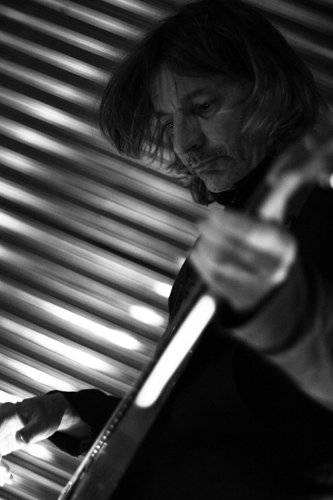



 Graced with ambidextrous talents, Joy is mistress of many synths and sound machines, often distorting her voice and playing it back as haunting accompaniment or backing vocals. An impressive wall of sound is at times created between herself and partner as in “Doondari”, where dark voice effects and heavy synth rhythms clash with swirling drum beats as menacing as a locust storm. Contrast this with a playful singing voice that combines rare soothing sweetness and reassuring confidence. ‘No Problem Saloon’ exudes compassionate observation of humanity and wraps it up in multi-textured, exhuberant electronic soundscapes.
 Marcel Gschwend ist
 For practical reasons, the fanfare settle in Geneva, the town of their label: Mental Groove. In the record shops today, «Songs From Kadebostany» is a musical UFO that continues to increase the group’s popularity. Kadebostan, with his haughty look and dictatorial moustache explains: “I’ve always been an outsider in electronic music”. Before his concert at Le Romandie in Lausanne he tells me: “I like to describe myself as musically illiterate. I can’t read music at all. I’ve got some vague notions of harmony, but I stopped short when I realised that I was about to acquire the skills that would kill off the magic of the moment”.