‘Levitation’ by Tobias Preisig & Stefan Rusconi – Le Temple, Cully, 9/4/16
@J-C Arav
Tobias Preisig and Stefan Rusconi are Swiss pillars of the Cully Jazz musical institution. Their Saturday night performance at Le Temple church marked a return to sacred ground that the duo had already trodden a few years ago. This is the venue that inspired and housed their Levitation project that tonight is played out to an eager audience, most of whom are already familiar with the powerful, intimate exchange between violinist and pianist.
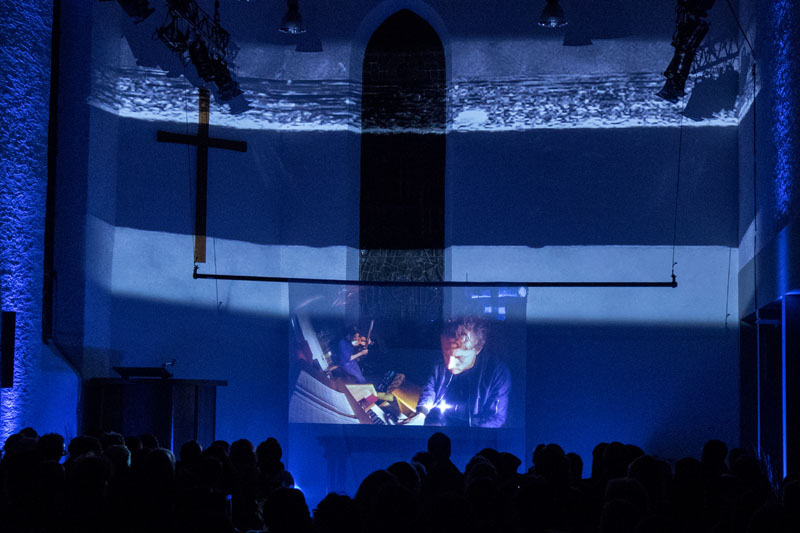
The key feature of the Levitation project is the sensitive, gradually drawn out soundscape created in great part by Rusconi on the church organ which is then supported and teased out by the strings. In practical terms this means having the two musicians play upstairs in the church gallery, heard but not seen from the audience down below. Deciding that this year’s jazz audience needed something to look at, the entire concert was projected on screen at ground level, which, ironically – because of the very bright projector light that was aimed right at the audience – meant that many of us listened with eyes tightly shut, (it was a bit like staring at the solar eclipse without eye protection). Possibly the best way to appreciate the moody, almost Gothic sounds raining down from above.
Some questions and answers with violinist Tobias Preisig:
What’s your relationship to the Cully Jazz festival?
Tobias Preisig: I have a special attachment to Cully Jazz. I’ve been playing here for the last 6 years, I started off in a small caveau as part of the ‘OFF’ programme, then they offered me residency, then larger stages as part of the main programme. There’s a extremely open-minded attitude here and strong commitment to push the next generation. Young and unestablished musicians find a stage here, right next to the superstars. Playing at Cully is definitely the highlight of the year for me. It’s become almost a family gathering with musical professionalism.
Was the material for ‘Levitation’ tailor-made for Cully?
Tobias Preisig: We played as a duo here at Le Temple in Cully a few years ago, performing for the first time with the church organ. Again, it was an opportunity that the festival gave to us. We fell in love with the sound and came back one summer to record at Le Temple for 5 nights. This music is now released as an LP called ‘Levitation’ and yes, it’s definetely tailor-made. So what’s nicer than to celebrate a recording that was actually made in this enviroment?!
Will there be more live gigs with the ‘Levitation’ project?
Tobias Preisig: This is a special side project for both Rusconi and I whose friendship and collaborations go back a long time. So far we’ve only played the material from Levitation live twice! There are a lot of underplayed organs and oversized churches, so we are looking forward to exploring them and awakening them with new music.
Pianist Stefan Rusconi über die Entwicklung seines Trios und das neue Live-Album mit Fred Frith
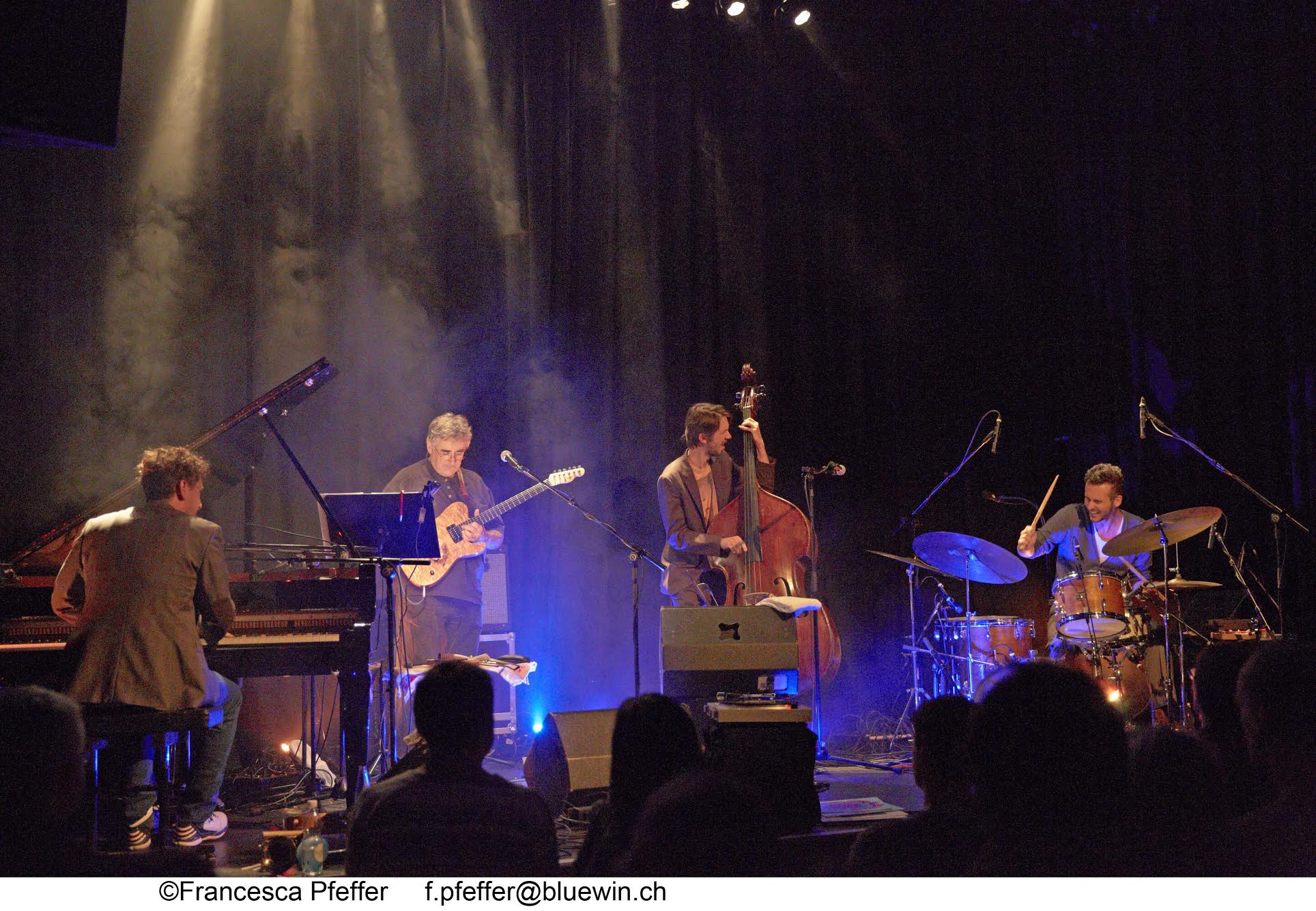
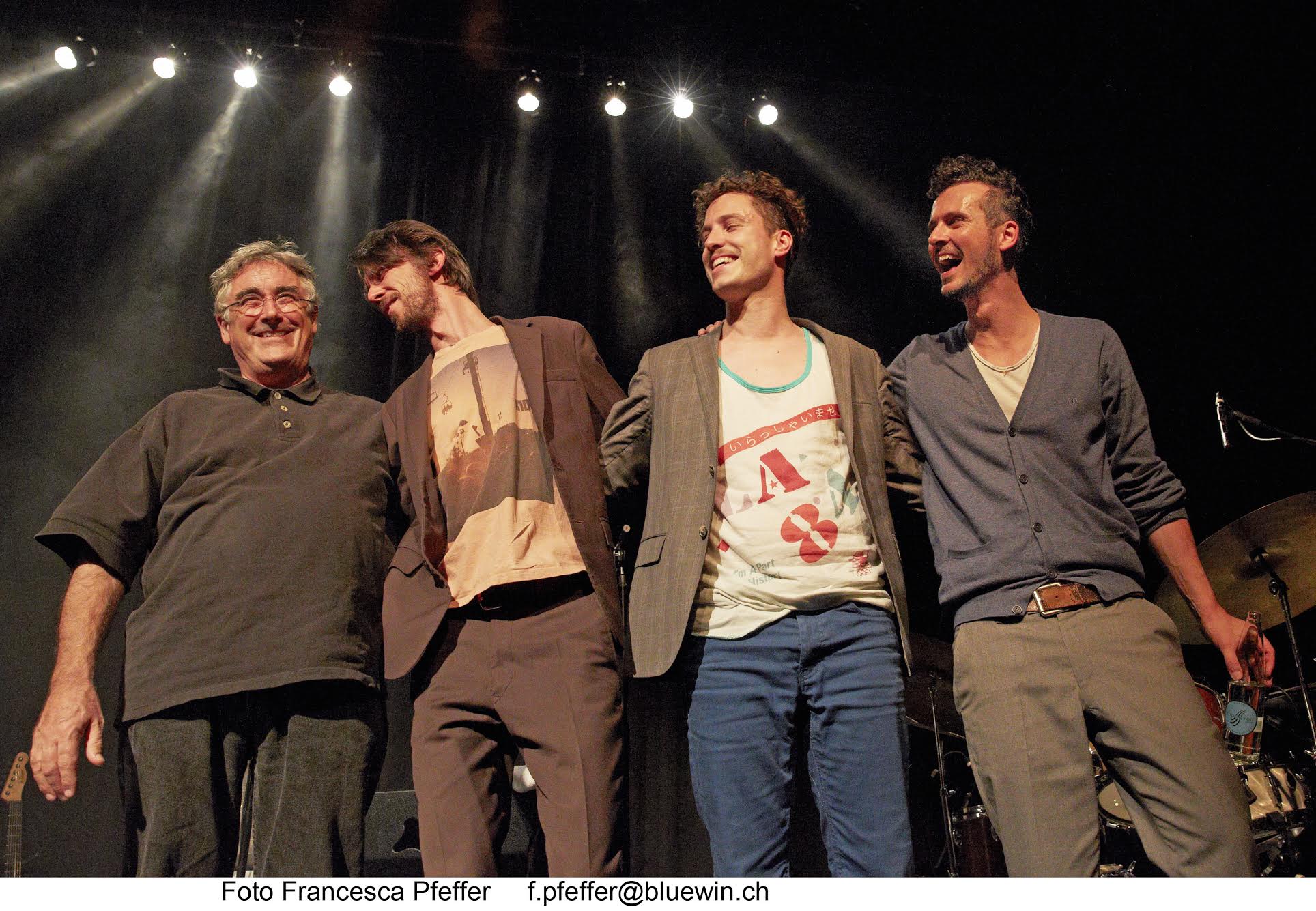
Mit Rusconi, seinem Trio mit dem Bassisten Fabian Gisler und dem Schlagzeuger Claudio Strüby, reiht sich der Zürcher Pianist Stefan Rusconi seit bald 15 Jahren in die Riege der Erneuerer des klassischen Klaviertrios im Jazz ein. „Garagen-Jazz“ nannten Kritiker ihren charakteristischen, sehr zugänglichen und bis 2012 bei Sony erscheinenden Mix aus Jazz, Rock und Pop, der Einflüsse aus der elektronischen Musik bis hin zum Noise-Rock einer Band wie Sonic Youth – deren Kompositionen sie 2010 auf dem Album „It’s A Sonic Life“ interpretierten – verarbeitet. Nun ist beim eigenen „Qilin“-Label das Album „Live in Europe“ erschienen, das die gemeinsame Tour mit dem amerikanischen Avantgarde-Gitarristen Fred Frith dokumentiert.
Wie habt ihr und Fred Frith euch gefunden? Stefan Rusconi Wenn man seit ein paar Jahren unterwegs ist, denkt man über Gäste nach. Wir haben uns zuletzt immer wieder mal mit verschiedenen Leuten getroffen und sie zum Mitspielen eingeladen. Bei manchen hat es wider Erwarten nicht gepasst, bei anderen sehr gut. Ich glaube, es geht natürlich um Geschmack und eine ähnliche ästhetische Ausrichtung, aber auch sehr viel um Haltung. Was will ich in der Musik oder sogar im Leben? Was ist es, das mich da fasziniert, was ich leben möchte?
Da seid ihr euch mit Fred Frith ebenso einig wie in der Liebe zu extravaganten Sounds? Stefan Rusconi Ja, da decken wir uns mit ihm exakt. Nicht im Musikalischen, die Musik seiner Bands ist ganz anderes als unsere, und das hat ihn ebenso gereizt wie uns. Aber die Grundeinstellung, auf der Bühne in einem definierten Kontext Dinge zu wagen und so anzuspielen, dass sie scheitern könnten, aber dann doch die Kurve kriegen, dieses Spielerische, das teilen wir. Wir kennen ihn inzwischen besser, er ist öfter bei Fabian in Basel zu Besuch, weil er ja in Basel unterrichtet. Wir spielen dann alle mit Fabians drei Kindern.
Einfach einmal geklingelt
Ihr habt ihn also einfach gefragt, ob er mitmachen will? Stefan Rusconi Naja, es war auch ein bisschen Zufall. Wir waren für unsere „Revolution“-Platte in dem Haus, in dem wir immer aufnehmen. Wir bauen uns da immer selbst ein Studio zusammen und nehmen uns selber auf, ganz ohne diesen Strukturdruck, dass Techniker da sind, die gerne nach Hause möchten. Nur aufnehmen, das ist echt einfach. Wir haben einen Techniker, der richtet uns alles ein, und dann darf er wieder gehen. Das ist für den und für uns schön. In dieser Atmosphäre kam uns dann bei einem Track, bei „Alice In The Sky“, die Idee, dass da der Sound von Fred Frith perfekt passen könnte. Und er arbeitete quasi nebenan. Wir haben geklingelt, ihn gefragt, und er war sofort dabei.
So einfach geht das manchmal. Stefan Rusconi Ja, und das ist schon sehr schön, denn zu der Zeit hatten wir noch einen Manager. Und es lief bei solchen Features normalerweise so, dass der Manager einer Agentur oder irgendeinem Assistenten eine Mail schreibt, und dann die Anfrage hin und her geht. Das ist oft ein bisschen verkrampft und komisch. So hieß es halt: Ja klar, lasst uns ein bisschen spielen gehen, in den Keller runter. So ist das Ganze dann entstanden.
Das war dann direkt vor den Konzerten, bei denen das Album entstanden ist? Stefan Rusconi Nein, wir hatten etwa ein Jahr Pause dazwischen. In der hat Fabian immer mehr Gitarre gespielt, weil wir durch Fred gemerkt hatten, wie sehr wir diesen Sound gebrauchen können. Da kamen wir auf die Idee, mit ihm ein paar Konzerte zu spielen. Es hat sich also ganz natürlich ergeben, war kein Festivalprojekt – was auch toll sein kann -, und war deshalb total entspannt.
Ihr tourt jetzt aber gar nicht mit Fred? Stefan Rusconi Nein, im Moment spielen wir ohne ihn. Ich weiß, das ist jetzt nicht im Sinne eines klassischen Marketings. Aber wir hatten viele Gastfeatures zuletzt, und es ist jetzt schön, mal wieder auf einer Tour zu sein, wo wir mal wieder den ganzen Abend nur für uns haben (lacht).
„Die Schweiz ist so klein“
Du hast in Zürich studiert, Fabian in Basel und Claudio aus Luzern. Wie habt ihr euch denn gefunden, damals vor bald 15 Jahren? Stefan Rusconi Die Schweiz ist so klein. Da ist dann halt die eine Jam Session in Bern, die nächste in Luzern, da bist du eine Stunde unterwegs. In Berlin, wo ich seit einiger Zeit wohne, brauche ich die fast, nur um in den Übungsraum zu kommen.
Kann man sagen, dass die klaren Strukturen, das Rhythmische und das Hymnische eurer alten Alben jetzt in einen starken Kontrast zu Noise- und freien Improvisationsphasen treten? Dass also eure Ästhetik offener ist als früher? Stefan Rusconi Ja, das Gefühl habe ich auch. Das hat sich aber schon mit dem „History Sugar Dream“-Album und in den vergangenen zwei Tour-Jahren so entwickelt. Die Funktion von Fred kann auch immer jemand von uns übernehmen. Ich spiele dann halt mehr Synthi-Bass und Fabian Gitarre. Wir haben dann freilich immer noch den Kontext einer quasi konventionellen Band; bei Fred konnten wir wieder auf unsere Ur-Instrumente zurückkommen, gleichzeitig ergab sich sehr viel Raum, eine Spielwiese zum Ausprobieren. Die Stücke sind verschachtelter. Das ist, wo wir jetzt stehen, denke ich.
Esbjörn Svensson hat von seinem Trio mal gesagt: „Wir sind eine Rock-Band, die Jazz spielt“. Trifft das auch für euch zu? Stefan Rusconi Das würde ich nicht sagen. Der Claudio etwa spielt schon ein sehr distiguiertes Jazz-Schlagzeug. Esbjörn Svensson war so zehn Jahre vor uns, aber wir haben das schon mitbekommen: Es war damals richtig, sich ein bisschen zu distanzieren, zu sagen: Wir sind eine neue Generation, wir schauen auf die Geschichte ein bisschen anders, wir haben andere Höreinflüsse. Aber trotzdem: Für uns bleibt Jazz immer ein wichtiger Bezugspunkt. Es gibt halt viele Schnittstellen, auch bei der Film- und Theatermusik, die ich schreibe. Auch für Claudio und Fabian, wir loten unsere eigene Welt aus, eine sehr bildhafte.
„Wir fühlen uns Leuten verbunden, die an den Rändern arbeiten“
Dazu passen die Licht- und Videobegleitung eurer Konzerte. Ihr denkt Musik wohl sehr interdisziplinär? Stefan Rusconi Ja, wir haben an der „Art Basel“ sogar mit einer Modedesignerin gearbeitet, was aber nichts mit „Germans Next Top Model“ zu tun hatte oder an was man so denken könnte. Wir fühlen uns sehr verbunden mit Leuten, die an den Rändern arbeiten, ob die nun vom Film, von der Kunst oder aus der Mode kommen.
Ihr wart früher bei Sony, jetzt habt ihr „Live in Europe“ wie schon zuvor „History Sugar Dream“ beim eigenen „Qilin“-Label herausgebracht, das auch eine Plattform für befreundete Künstler sein soll. Ist die Zeit der Majors für Jazzmusiker vorbei? Stefan Rusconi Ich weiß nicht. Es muss einfach passen, und bei uns hat’s nicht mehr gepasst. Große Labels schauen sich Musik nach einem Verkaufsargument an, und dann läuft die Maschine Major auch. Es gibt immer noch Jazz, den man so unter die Leute bringen kann. Unser Sonic-Youth -Album wurde damals in den Magazinen besprochen, die beim Friseur liegen. Das ist einfach nicht unser Publikum. Wir haben uns auseinanderbewegt bei dem, was so ein Major gut kann, mit uns aber gar nicht mehr umsetzen konnte. Am Anfang war das noch anders, da war alles noch offen. Das hätte Zukunft haben können, das haben wir dann irgendwie anders entwickeln lassen. Bei einem Till Brönner zum Beispiel, ein toller Musiker, mit dem ich auch schon gespielt habe, kann das prima funktionieren. Für uns aber sind gewisse konkrete Erwartungshaltungen inzwischen ein Horror. Wir fühlen uns sehr wohl, wo wir sind. Auch wenn die Konsequenz ist, dass alles etwas länger dauert, und die Leute dich ein bisschen suchen gehen müssen. Das ist aber auch was Schönes, das hat für uns viel mit einer Lebenshaltung zu tun, bei der wir alles an uns genommen und unter Kontrolle haben. Das färbt auch auf die Musik ab: Es ist dann etwas konsequent Eigenformuliertes.
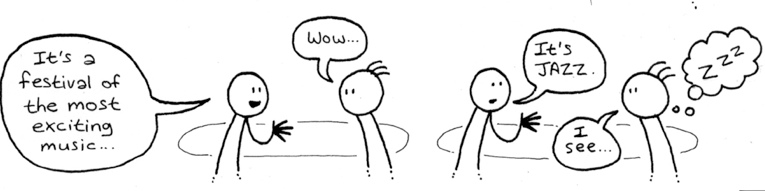
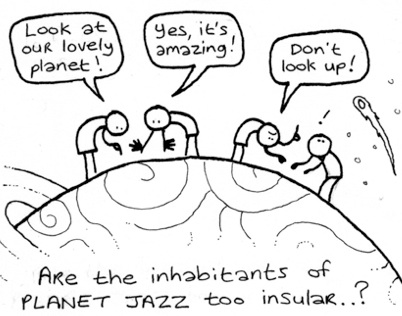
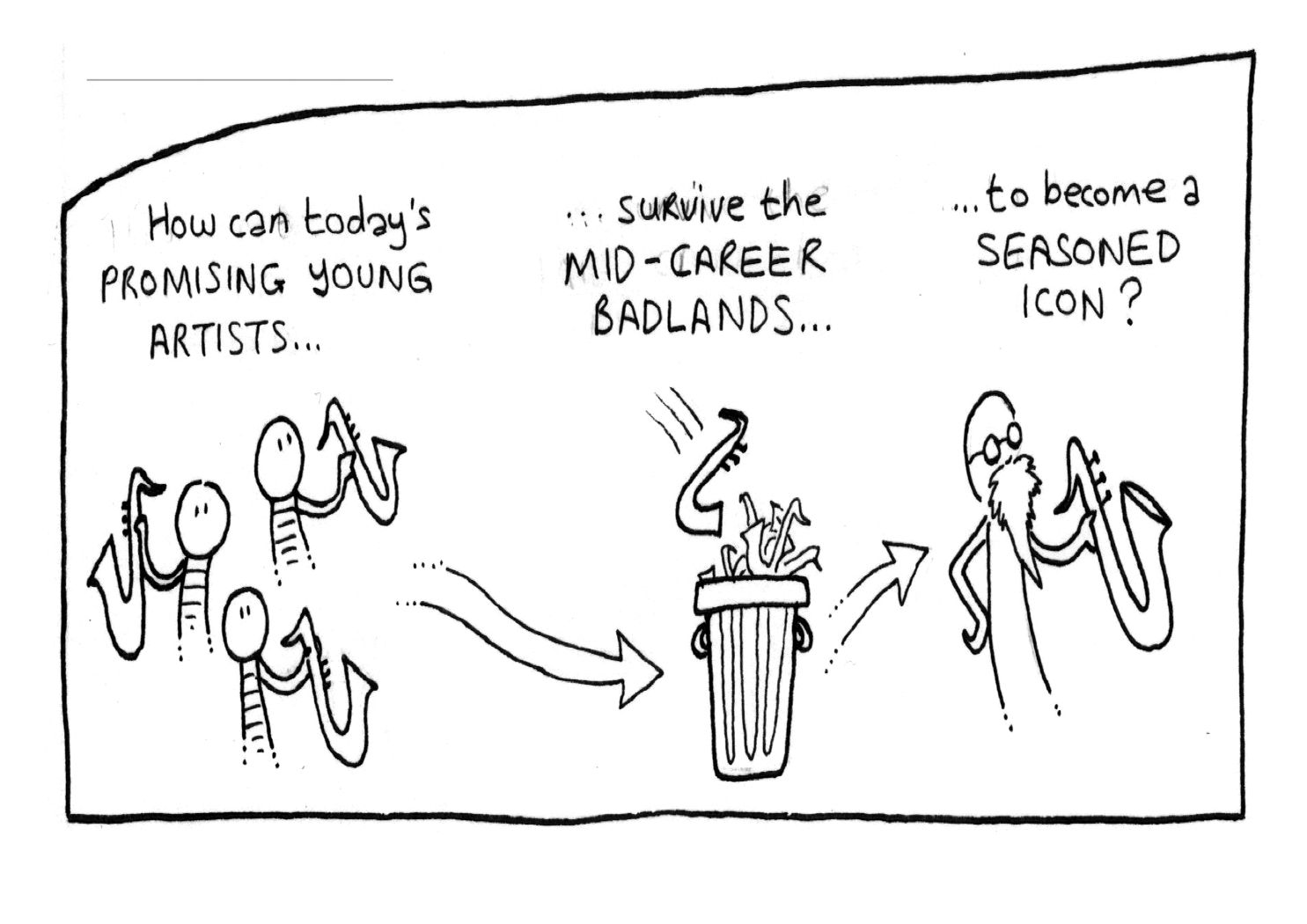
When I reviewed the Schaffhausen Jazz Festival, questions emerged – is Rusconi‘s new album, jazz? What should jazz be in 2014? Gerry Godley of the Improvised Music Company and 12 Points festival worked with cartoonist Patrick Sanders on a presentation that made some vital points for the industry. I particularly liked the analogy – are we selling candles or are we selling light? Put crudely if we carry on focusing on traditional forms of jazz we may go out of business.
Godley referred to America’s major arts survey of 2012 and although I don’t see Europe in the same grip of the “heritage” of jazz, it’s probably a similar picture here: audience numbers are declining and they are growing older (as I saw at Schaffhausen and see in London). As Terry Teachout of the Wall Street Journal wrote, “Jazz musicians who want to keep their own…beautiful music alive…have got to start thinking hard about how to pitch it to young listeners.”
“What is jazz about & who is it for? – grows unclear.” Phil Johnson
To be frank, jazz has lost its hipness. Young urban ‘gunslingers’ are more likely to listen to new folk or the myriad forms of electronica. Last year journalist Phil Johnson wrote in the The Independent, “The essential narrative and context – what is jazz about and who is it for? – grows unclear. An increasing lack of visibility in the mainstream media contributes to a growing credibility gap…” This is an issue; print and radio (let’s not even go there with TV) influence tastes and with diminishing support it’s difficult for promotors to take risks. The respected critic, John Fordham commented on the lack of press coverage for jazz in 2010, “…the most routine performances by an orchestra, or the most mundane gigs by fading pop stars will usually grab the space from innovative jazz artists who may well be shaping the future of music…”
Godley also addressed the “J” word and whether it’s doing music a dis-service. I don’t feel overarching terms such as jazz, classical or rock are relevant in the age of the internet. My favourite phrase is ‘music for curious ears’ and London’s Cafe Oto bills itself as a venue for “creative new music”. Phil Johnson suggests Oto could be a good model for other European clubs as it’s found success by, “building an audience from the bottom up through artist-run co-ops and club-nights.” They are managing to attract a mix of ages, at least.
BBC Radio 3 (plays classical music and some jazz) is rightly obsessed with the phrase “replenishing audiences” as their core listeners age. Attracting new audiences requires new marketing tones. Rusconi have been so successful at building an online rapport with their fans that they won the voted-for ECHO Jazz Award for Best Live Act 2012. But the music itself needs to be relevant.
Build on traditions, but break the rules
Some promotors I spoke to felt Rusconi were being gimmicky – maybe they haven’t quite hit the right spot (as they did with Alice in the Sky) but I’m more engaged by them than I am by clever musicians desperately trying to re-create a time that has gone. Build on traditions, but break the rules, or at least put in your own life, your emotion. My musical axis has been informed by being a DJ where it’s all about the new, and I’ve always admired pioneers who faced enormous criticism but changed things up; as much as I adore Miles Davis’ Kind of Blue I’m glad he heard Hendrix and got re-inspired.
A band who is getting the balance right is Hildegard Lernt Fliegen. They played a triumphant set at Moods a few weeks ago. The music builds on traditional jazz and improvisation and yet is modern. They’ve got a strong look going on and their video for the track Don Clemenza is perfectly pitched. OK, not everyone has to (or can) wear a breadstick on their head, but what brings it all together is that it feels utterly genuine, it’s ‘authentic’. And that’s the word Godley finished his talk with and it’s an important one.
Labels like ECM are “borders-blind”
What I’d like to see is European countries co-operating at supporting talent from a wide spectrum of ‘jazz’ and from regions beyond their own. Labels like ECM are “borders-blind”, venues could be better at this too. I believe: “If it ain’t broke, change it!” Or it dies. Keep jazz relevant, think about new ways to package it and consider who we want to promote it to. There are audiences out there who are missing out on heart-pounding, incredible music.
As I walked into the ex-yarn factory, Kulturzentrum Kammgarn, it was clear the organisers put passion and care into their festival. The place was warm and intimate with candlelit tables and there was a relaxed, convivial vibe. Over four evenings the audience was treated to a variety of Swiss improvised music and there was a day of professional talks.
Without doubt, this is an ambitious festival
I missed the compelling Elina Duni Quartet who opened the event, but was there to experience BASH. I’m getting to know Lukas Roos through his outfit, pommelHORSE, but here the clarinetist/saxophonist played with guitarist, Florian Möbes, Domi Chansorn on drums and Samuel Gfeller on graphic novel, literally. A massive screen behind the band showed the story of a prisoner drawn into increasingly twisted events that lead to his end. The style of Gfeller’s drawings, Robert Crumb in feeling, are so powerful that at times, I tuned out their sensitive and minimal music. On speaking to Roos he explained that cutting the set to 40 minutes affected the balance – a point echoed by Andreas Schaerer and Rusconi on appearing at this festival.
Schaerer’s vocal noises ran amok
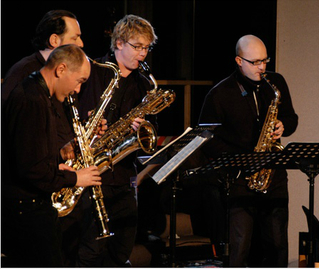
Andreas Schaerer was performing Perpetual Delirium, his composition for the saxophonists, the Arte Quartett with Wolfgang Zwiauer on electric bass. It had the quartet interlacing with a naturalness that was almost child-like in it’s fun and freedom. There were fascinating textures as soprano sax took over from alto, or tenor had a furious and thrilling exchange with the baritone, whilst Schaerer’s vocal noises ran amok adding sparkle, or hiding within their vibrant sound.
For pianist Gabriel Zufferey the time limit was perfect. His music was fluid with notes as sweet as fluttering butterflies yet underpinned by such knowledge and skill that he came across as an eccentric wizard. I liked the echoes of classical music and he incorporated an Eric Satie piece – it might sound tacky, but in his hands it lifted the hearts of the audience who then demanded two encores.
Is Rusconi’s music, jazz, or not?!
I was recently critical of Rusconi‘s gig at the Cully Jazz festival, but at Schaffhausen they were more confident in their ideas and I totally got into the groove of Hits of Sunshine and am warming to the strangeness of Change Part 1. However, on talking to some of the European promotors invited to the festival, questions emerged – is Rusconi’s music, jazz, or not? Is it gimmicky or authentic? I felt some answers were suggested by Gerry Godley of 12 Points who tackled the issue of the future(s) of jazz in his presentation with cartoons from Patrick Sanders, at the festival. But I’ll go into that more in my next Swiss Vibes’ blog, ‘How is Jazz?’
In the meantime I’ll leave you with the Bill Evans‘ quote that Godley used, “Jazz is not a what, it is a how. If it were a what, it would be static, never growing. The how is that the music comes from the moment, it is spontaneous, it exists at the time it is created.” If the Schaffhausen Jazz Festival has its sights set on being a relevant platform for jazz then it needs to continue putting on bands that question our perception of this rich and challenging music, as well as, those that celebrate it.
I was reminded of the story of the Sorcerer’s Apprentice watching this trio perform. Keen to make magic and mischief, Rusconi sometimes found themselves unable to control the proceedings. This was the first gig of the tour and I think their playfulness will win over audiences, they just needed more child-like energy, a sort of innocent conviction, to pull it off at Cully. However, the band were most captivating when they painted afresh their best compositions from the new album, History Sugar Dream.
‘Psychedelia for Laika’ Ankor was a trademark piece, with Stefan Rusconi’s mournful yet sweet piano, rich with echo and thought, sensitively interlaced with Fabian Gisler’s handsome bass notes. The sparse, crispy drum beats of Claudio Strüby balanced the sound perfectly. Sojus Dream used a repetitive theme as its foundation before a synth keyboard sneaked in, providing Herbie Hancock-like funky accents. The track grew in stature as it built a platform for Fabian’s electric guitar to glide through, providing, as they tell us, ‘psychedelia for Laika,’ the dog who was sent out to orbit the earth in 1957 (and died within hours of lift off). I didn’t feel Fabian pierced deeply enough, so it was down to Stefan’s collapse into a warped and weird circus-style piano to trip the track out.
Bowie’s Life on Mars? started up So, to the ‘high jinks’ – such as swapping instruments amongst themselves, as in Change (Part One), with Claudio on piano, Fabian on drums and Stefan on guitar, and stopping everything for Fabian to put a record on the Technics deck set up onstage. Bowie’s Life on Mars? started up, complete with vinyl crackles to re-enforce the theme of History Sugar Dream – childhood memories, “A time when dreams and hopes, fantasy and illusion, were reality,” as they write in their press release.
This trio is capable of subtle and complex emotions I like the way Rusconi seem to feel their way through unknown landscapes in their music, playing with fantasy. At one point I thought of dark, rainy scenes in the film Blade Runner with its sense of nostalgia, loss and romance. This trio is capable of subtle and complex emotions. I’d like to have been taken more deeply into these worlds, that’s where the real playfulness lives.
En 2012, le CD “In transit” de Tobias Preisig figure parmi les meilleures ventes de disques jazz au Japon. Le violoniste suisse est sur le point de repartir avec son band pour une tournée de six concerts sur l’île nippone. Interview exprès.
Alors que ta carrière décolle à l’étranger, pourquoi être resté à Zürich et ne pas avoir déménagé, à Berlin ou Paris ? Tobias Preisig Etonnamment, c’est plus pratique pour moi de rester par ici. Mon groupe est éparpillé un peu partout en Suisse, entre Bâle, Bern et Lausanne, et je peux les retrouver en un clin d’oeil. Pareil pour voyager à l’étranger : Zürich a une position tellement centrale en Europe que l’on peut se rendre partout sans problème. Enfin, c’est bête à dire, j’ai la chance d’avoir mon bureau et mon espace de répétition dans un club d’ici, l’Exil, et cela me permet de me concentrer sur mon travail. En plus, je peux profiter des conseils d’un ancien d’ici, Nik Bärtsch, et évoluer dans un environnement où les musiciens prennent des risques, et c’est la seule chose que je recherche.
Comme le pianiste Stefan Rusconi, par exemple, avec qui tu partages une approche originale de vos instruments respectifs? Tobias Preisig Et oui, non seulement je m’essaie au jazz au violon, ce qui est très rare (à part Stéphane Grappelli, j’aurais du mal à citer d’autres violonistes de jazz!), mais en plus j’essaie d’exploiter mon instrument au-delà des canons du genre, sinon je m’ennuie. Il y a tellement de gens qui savent jouer du violon parfaitement, cela ne sert à rien de d’être un nouveau disciple appliqué. A vrai dire, j’ai eu de la chance de pouvoir rencontrer un professeur au conservatoire et à l’école de jazz suffisamment ouvert pour me dire : « ce n’est pas grave si tu joues la tête en bas, du moment que tu joues bien… » Ca m’est resté… et effectivement ca me fait un grand point commun avec Stefan Rusconi. Lui, c’est comme c’est comme un frère pour moi, nous formons une petite communauté à nous deux. On a énormément joué ensemble pour d’autres musiciens et maintenant, nous avons un drôle de duo, à l’orgue et au violon, qui nous ouvre un espace pour explorer de nouveaux sons.
Justement, comment peut se dérouler le processus créatif qui amène à dénicher ces nouveaux sons ? Tobias Preisig Comme pour tout le monde : avec beaucoup de travail, et un peu de chance. Prenons l’exemple de « Transforming », l’un des morceaux les plus connus de « In Transit ». Au départ, j’ai eu huit mesures en tête, dans la rue, et je me suis empressé de les noter sur le carnet où je note toutes mes idées. Plus tard, en répétant, je me replonge dans mon carnet et je me rend compte que ces mesures pourraient bien s’accorder avec d’autres, que j’avais notées plusieurs pages plus tôt. En les réarrangeant, j’avais la base de mon morceau… mais ce n’est pas tout ! Un peu plus tard, je me suis mis en tête d’apprendre à jouer du theremin, alors je me rend sur youtube pour trouver un tutoriel… et je tombe sur la vidéo d’un type qui joue le thème principal de « Transforming » – sans le savoir, j’avais repris un morceau de Gabriel Fauré ! C’était moins une : la pochette de l’album partait le lendemain à l’impression, j’ai appelé le label en catastrophe pour qu’ils « créditent » Fauré sur le livret …
il paraît que « In Transit » est rentré dans les tops albums au Japon… Tobias Preisig Oui, c’est incroyable, n’est-ce-pas ? Il y a deux ans, le bureau export nous a permis de faire une petite tournée à Tokyo et Kyoto; une excellente expérience. Non seulement les ingénieurs du son ont été formidables, mais notre mélange de rock, de jazz et de musique expérimentale a paru complètement avant-gardiste aux oreilles du public japonais… et ils en redemandaient ! En exagérant à peine, les filles étaient en pleurs à la fin des concerts. Du coup, nous avons prévu d’y retourner cet automne pour flatter nos nouveaux fans hystériques (il rit ).
En concert au Japon: Shikori Fukuoka, sa 12 octobre 2013. Hiroshima, Speak Low, di 13. Osaka, Mister Kelly’s, lu 14. Kyoto, Live Spot Rag, me 16. Tokyo, Spiral Lay, je 17. Kyoto, Left Alone, ve 18.
Forget Twitter’s 140 character limit and just post a photo, or 15 second video – and you’ve got the new digital craze, Instagram (16 million active users per day). It’s responsible for the widespread ‘selfie’ (taking a picture of yourself and posting it) and along with Facebook, YouTube and camera/video devices within our smartphones, tablets and consoles has blown the importance of our own image into a monstrous size. This is impacting society and culture, and that includes jazz.
“You can take a stand and decide what emphasis you will apply to your image” Elina Duni
There is resounding evidence that Dr Catherine Hakim was bang on the money when she wrote a book asserting that those who use beauty, physical fitness, charm and sexiness will find success (Honey Money: The Power of Erotic Capital) and it’s especially true in the music industry. “I am so sad about what I see today, what are the role models for young girls? Mostly women stars who don’t represent the feminist way of thinking, but represent the sexual object,” says vocalist Elina Duni when I ask her about women’s image in music, “but you can take a stand and decide what emphasis you will apply to your image, if any, or what it says about you.”
Duni instinctively realized the importance of engaging visuals from the start of her career, but it was when she found a kindred spirit in the Albanian photographer Blerta Kambo that she could realize her ideas. “Some things can be sensual or sublime without being cheap or sexual,” comments Duni, “she represents me very well.” Trombonist Samuel Blaser didn’t have the same issues to face but admitted he’d changed his thoughts on his image, “Now I’ve hired a fashion consultant. We went shopping for a day together. I spent way too much money, but I think it’s important to present yourself well.
“In some parts of Europe music is more connected to hipness than to good music” Florian Arbenz
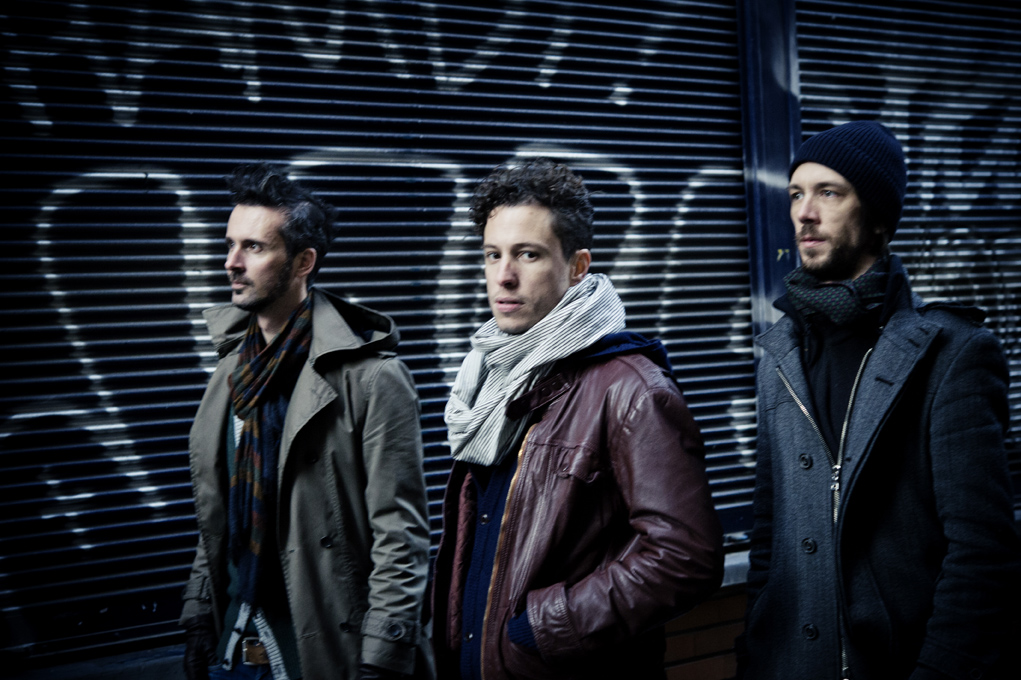
In my own career I witnessed how having a strong visual identity helps people remember you (I had dreadlocks for many years), but as pianist Rusconi notes, it has to be genuine, “If it comes from you and who you are as a band then great, but there’s no need to force it.” Some people have a natural visual intelligence, such as Tobias Preisig. He plays violin and in a subtle way, plays upon the look of a free and fiery but very modern gypsy. He forges a clear identity, very useful when establishing a ‘brand’. If any artists out there are flinching as I use the word ‘brand’, consider the creative accomplishments of Björk, one of the most magical musicians of my generation whilst being one of the strongest brands. Brands enable people to get who you are and, if it’s strong or unique, remember it. You may not say Eric Vloeimans’ indulgence in colourful clothes and ‘funky’ shoes launched his career, but you could see how his image, along with his playing has set him apart.
Florian Arbenz of Vein commented that not everywhere was infected by “fashion”, “In some parts of Europe music is more connected to hipness than to good music. In Eastern parts [of Europe] you are still judged very hard when you play and I like that.” He found that his band’s classical training and passion for vintage jazz, not their choice of clothes, had given Vein a strong profile in those regions.
Image in music isn’t just about personal appearance
Bebop and modernist jazz was helped by the daring graphics of Reid Miles at Blue Note in the 50s and 60s, whilst Manfred Eicher’s audio vision for ECM was perfectly interpreted by designers Barbara Wojirsch in the ’70s and Dieter Rehm who nurtured the photographic style of windswept trees and monochrome landscapes. On the other hand you could argue that GRP Records sold a lot of albums despite some of the ugliest record sleeves ever (though they were operating in the ‘style-free’ era of the 1980s). As digital downloads and streams find their feet there’s less attention paid to album covers, but a few of the Swiss artists I interviewed confirmed their audiences were still buying CDs. In the wider picture of music, however, the music video, once the marketing tool of pop alone, has taken on increasing weight. Use of YouTube as a device for discovering music is mostly responsible.
Samuel Blaser has found himself experimenting more with visuals such as photos and videos and, like Duni, recognizes their importance as publicity. They also have both relished these added dimensions to their creativity. Blaser met Polish video maker, Ewa Kozanecka in New York and asked her to shoot something for a shorter version of Pieces of Old Sky. “I don’t know if it was totally useful because we did it like a piece of art.” From a listener’s point of view that video held the music more firmly in my memory. And that’s where videos and photos can really assist musicians – by etching their sound into the consciousness of the public. Rusconi are a band that have also naturally partnered with video to explore ways to extend their expression.
“The video thing opened up our music to a totally different crowd” Stefan Rusconi
They have forged a successful pairing with the film collective, Zweihund, producing engaging and professional work for comparably small budgets. Stefan Rusconi told me, “The video thing opened up our music to a totally different crowd. What we’re interested in as an audience is people that are interested in different fields of culture. Doing the video got people interested that would never have come to a Rusconi jazz gig,” and it enabled them to crossover to contemporary music festivals outside of the ‘jazz’ genre.
This has proved useful as a piano trio, because as Marc Perrenoud, the leader of another piano trio, noted, “You have to find something different form other trios, find another visual identity.” Some of the artists I interviewed were also filming their gigs, tours and recording sessions as ‘documentaries’ in order to extend their ‘visual presence’. The digital world is forcing the hands of musicians, “You have to be very connected on the web, you have to have very good presentation and have very good pictures [and] you need good clothes,” noted Marc Perrenoud.
A few months ago I went to a jazz festival. One of the bands I came away very firmly etched in my mind were Snarky Puppy – they had great stage presence (helped by the fact there were so many of them) but also their fans were wearing well-branded T-shirts, with a print of a dog’s head wearing headphones. Jazz musicians may not feel the pressure to look like George Clooney, yet, but the world is changing rapidly and visual intelligence or ‘erotic capital’ if you like, won’t be diminishing their influence in the near future.
As far as I see it, social media is a form of Internet dating, just without the romance (though not always). It’s relationships, connecting, communicating, dare I say, flirting, and showing off your best photos. There’s also a lot of hype about what it can do for a career.
Example: kid playing guitar uploads to YouTube, sets up Facebook page to consolidate following, finds a manager via Twitter, releases EP, tweets to major UK shop about singing on their next Christmas advert – gets job, the track goes to no.1 in UK charts, she gets lots of press. This is the true story of Gabrielle Aplin who literally created her own career in a few years using digital media and it shouts at us, “Digital and social media matter!”
“It’s the most neglected field in jazz music” Stefan Rusconi
But what are the implications of this explosion of media for the new generations of jazz musicians? Out of the eight musicians I spoke to they had all breathed the same air, tainted by these hyped success stories of social media, but only three were already forcing themselves to fully utilize the Internet. Stefan Rusconi observed, “I understand our music is about being a master of playing for real, you invest a lot of time in your instrument, you’re a craftsman and it’s sometimes hard to accept the digital side, but I think it’s the most neglected field in jazz music.”
“it’s not up to me to decide if it’s important or not, it’s just a fact that it’s important” Andreas Schaerrer
Certainly they don’t share the same audience as Justin Bieber (over 42 million Twitter followers) but Herbie Hancock has doubled his followers in the last year to 54,000 and it’s doubtful the trend will reverse. Andreas Schaerer reflected the thoughts of others when he said, “I personally don’t enjoy Facebook…This concept of communication is a fake one to me, but I realize I’m living in a time when it’s not up to me to decide if it’s important or not, it’s just a fact that it’s important.” However, the issues around digital media aren’t only about personal taste, a key problem mentioned by all the musicians was, time.
“To create, you really have to shut down your Internet and phone” Elina Duni
Creating and updating websites, Facebook pages, blogs and tweets take an enormous amount of time and more notably, headspace, because it’s ongoing, always on the ‘to do’ list. Smartphones have supported social media by making it easier to update ‘on the go’ but as Elina Duni noted, “It’s not just posting things, you have to be active, to answer, people have to feel you’re near to them.” It’s this consistency that can be at odds with a creative process such as composing that demands focused, uninterrupted time. Duni explained, “To create you really have to shut down your Internet and phone…but today you always have to be reachable…It’s not easy and sometimes it depresses me, but I try to find a way…I try to improve.”
Building a database of loyal fans…
There are other issues such as keeping your website alive and relevant and the cost of that. The pianist Marc Perrenoud realized, “I just made my new website last year, but I want to change it already.” These Swiss musicians accepted that their websites needed good translations into English for the international market (which they need to survive), but this point leads us on to one of the big positives of digital media: it makes musicians completely accessible. When researching these artists I watched all of them live, got their discography, biography and the geography of their forthcoming gigs without leaving my South London apartment.
The Internet has also helped them connect with other musicians and collaborators, and most importantly, in the case of Rusconi, their audience. This group took time to research these new forms of promotion and communication, watching e-marketing videos by Seth Godin amongst others. They decided to adopt the ‘download and donate what you want’ approach to their recent album, Revolution, as opposed to giving it a price tag. Not only did it help the band connect to a broad-based audience beyond the jazz market, “people that are interested in different fields of culture…people who are active, who want to be a part of society, who are aware of others and a vibrant thing…” but also it helped them win the Echo Jazz Award for Best Live Act (up against Wayne Shorter, no less). That’s a big win that would not have been possible without having built a database of loyal fans.
“it can be serious stuff that you post on your Facebook page which people would enjoy” Florian Arbenz
I’m going to skirt around the subject of digital downloads and e-commerce here as it’s a big and complicated field. However, as a marketing tool, digital media is up there as a new force. In some ways Rusconi are lucky in that their explorations of the digital world and the videos and imagery that need to accompany that fit naturally with their own tastes and interests. Drummer Florian Arbenz of Vein was one of the artists who openly admitted that he hated social media, but realized he’d been looking at it in the wrong way. “We didn’t want to write stupid stuff like, ‘I’m waking up in Paris, yeah guys,’ so we rarely wrote anything. But if you think business-wise, you can connect with your audience.” He was going to look again at digital media from a new persepective, “The music is still the priority but we could build some concept around that, it could be art, a series of films – it can be serious stuff that you post on your Facebook page which people would enjoy – and reflects us.”
Digital media can also consolidate an artist’s musical expression, make them appear stronger and bigger, as well as provide more aspects to their personality when they use other art forms. Imagery and Swiss jazz is something I’ll write about next time but for now, it’s worth considering that whatever your opinion of social media, understand that you can interact with it in whatever way you want. And in doing so, connect to like-minded people. In terms of time, money and energy, digital media can suck you dry, but what musician wants to risk missing out on its benefits? It’s not just about crossing borders and continents to make sure people turn up at your gigs, it’s also about developing your ‘voice’ and at what volume it’s heard.
“You can tap into resources and support and it’s there” Leo Tardin
The Swiss jazz scene is evolving and has been for some time. Music education at institutions such as the Bern University of the Arts, professional support for artists and an expansion of the term jazz, have helped the emergence of new and award-winning talent. I asked musicians who’ve had help from Pro Helvetia, how being Swiss has impacted their music and careers and if any changes could be made for the better.
They unanimously acknowledged the funding system that exists. Drummer Florian Arbenz said financial help was a huge advantage, “Because of the spare time we have for our heads to create something…(and) work on our own concepts.” Leo Tardin, who spent a significant time building his reputation whilst living in New York, said that being abroad gave him perspective on being Swiss, “You can tap into resources and support and it’s there. It’s shrinking just like everywhere else but we’re still very privileged and that’s a fact.”
Several artists did refer to the Nordic scene as an example to follow, with its huge investment in jazz and organic creation of an almost tangible ‘brand’, encompassing artists from Jan Garbarek to E.S.T. However, the journalist Arnaud Robert said recently, “Switzerland creates individuals, not schools or movements of music,” and musician Stefan Rusconi agrees, “It will always be diverse, musically, I don’t think it will be like the Nordic sound, I think it will be an approach, an attitude that could come out of Switzerland.”
I would agree; as a DJ visiting Switzerland, I was drawn to the open-minded spirit of people less concerned with being cool, than being free (whilst getting things done, of course!). Humour and a spattering of crankiness are somewhere in the mix and as the Zurich-born violinist, Tobias Preisig, says, “I’m pretty amazed how small this country is but how rich it is music and cultural-wise.” Maybe this is entangled with the make up of Switzerland as noted in Wikipedia, it’s not, ‘a nation in the sense of a common ethnic or linguistic identity’ and over one fifth of the population are immigrants.
Vocalist Elina Duni says of her quartet, “This music wouldn’t exist without Switzerland because it is the fruit of bringing together my Albanian roots and my Swiss culture.” Having moved to Geneva when she was ten, Duni sees her music as building bridges between people and acknowledges the support she’s had with that, “Switzerland, for me, is a big chance.”
Andreas Schaerer also feels that being Swiss has informed his compositions and vocal work in an interesting way. He refers to the Swiss obsession with detail, “We work so long to make things better and better until every last corner of the product is perfect…What is good is if you can be brave and destroy it…so that you see these pieces of complexity (and detail) but the environment is complete chaos.”
Schaerer also observed that the Swiss are good at technology and high quality products that take the spotlight, as it allows ‘their creator’ to stay in the shadows. Elina Duni also commented on this Swiss characteristic of humility, “It allows people to learn further and go further,” but too much of it prevents the Swiss from exporting itself with pride. Rusconi pointed to the same issue, that it’s not ‘Swiss’, “to stand there and say we’re proud of ourselves, we want to get out there, we’re great.” Self-promotion is a pre-requisite in the music world today and Schaerer has had to confront his discomfort with that, “You need to get rid of it without becoming arrogant or losing respect for others.”
“It’s hard to cross borders in music and life”Tobias Preisig
Several of the artists have lived or are living abroad. Samuel Blaser now resides in Berlin but spent time in New York. Although none of them felt that ‘being Swiss’ made them particularly exotic, Blaser felt, “It’s stronger if you live in New York because you can then ‘export’ your music back into the EU market (from the US).” Being an ‘export’ is vital to these musicians because as they pointed out Switzerland is not a big enough market for them to survive there alone. “It’s hard to cross borders in music and life,” reflected Preisig, and it’s why support to tour is key. Pianist Marc Perrenoud saw this as a positive, “I use the obligation to export yourself as a way to travel, meet people and experience other cultures.”
Being a Swiss musician is packed with advantages, not least because being brought up in a culture of excellence, passion and professionalism has impacted the standard of playing. Being a jazz musician anywhere is not an easy choice but that can’t be changed, neither can the size of Switzerland. However the discomfort with ‘blowing your own trumpet’ can be discarded along with the Swiss milkmaid. These musicians are cultivating a confidence in their own unique ‘voices’ and this needs to be reflected in the way they are promoted. I’m certain cheese and chocolate will always sell but now there’s a chance to add a new and more emotionally expressive export to the table.
Rusconi et La Fanfare Kadebostany, deux artistes qui figurent sur la compilation Swiss Vibes 2, ont remporté respectivement le prix du jury et celui du public du “Best Swiss Video Clip”. Tous deux ont été projetés ce soir aux Docks de Lausanne, lors de l’ouverture du M4Music Festival.
Le concours était organisé en collaboration avec les Journées de Soleure, le jury était présidé par le réalisateur parisien Tony T.Datis, auteur de clips pour Skrillex, Modeselektor et Katy Perrry. Les autres membres du jury étaient le réalisateur lausannois Laurent Fauchère et la productrice et rédactrice musicale zurichoise Eliane Laubscher.
Les réalisateurs du clip “Alice in The Sky”de Rusconi sont Jonas Meier et Mike Raths. Ils ont été salué pour leur inventivité, savoir-faire et visions poétique.
Les réalisateurs du clip “Walking With A ghost” de la Fanfare Kadebostany sont David Houncheringer, Steven Blatter, Mirko Eremita. Ce prix du public a été décerné au moyen d’un vote en ligne de 3500 personnes sur la plateforme mx3. Les deux lauréats empochent chacun 5000.-
Le festival M4Music lieu ce soir à Lausanne et vendredi et samedi à Zurich. Défileront entre autres dans les clubs de la capitale économique de la Suisse, Oy, La Gale, Velvet Two Stripes, Domi Chansorn et Evelinn Trouble.
 Stefan Rusconi Nein, wir hatten etwa ein Jahr Pause dazwischen. In der hat Fabian immer mehr Gitarre gespielt, weil wir durch Fred gemerkt hatten, wie sehr wir diesen Sound gebrauchen können. Da kamen wir auf die Idee, mit ihm ein paar Konzerte zu spielen. Es hat sich also ganz natürlich ergeben, war kein Festivalprojekt – was auch toll sein kann -, und war deshalb total entspannt.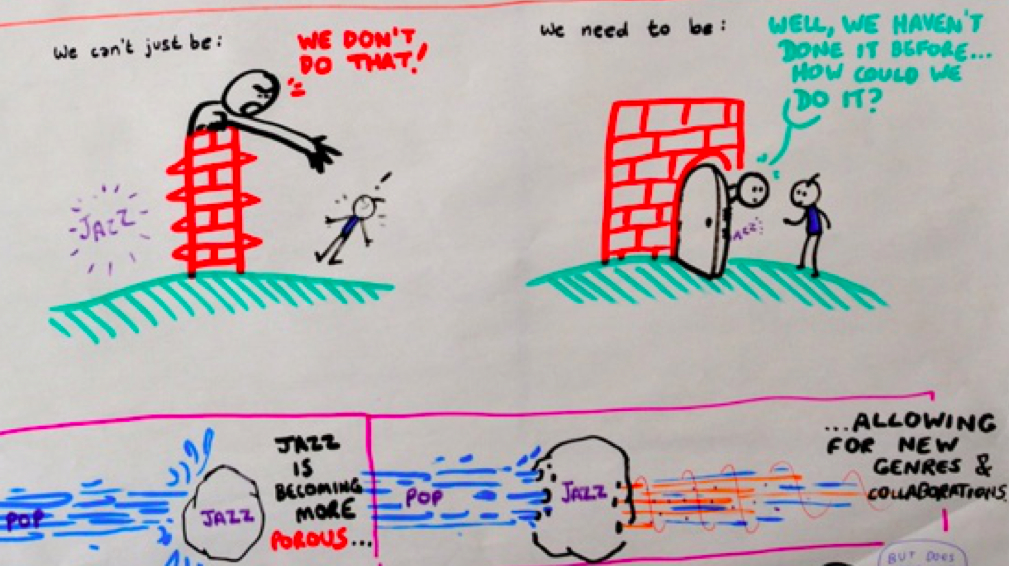

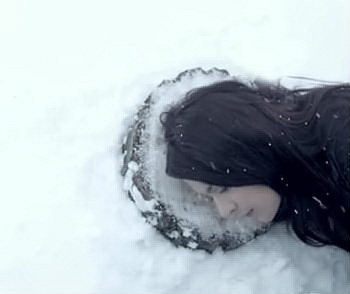 There is resounding evidence that Dr Catherine Hakim was bang on the money when she wrote a book asserting that those who use beauty, physical fitness, charm and sexiness will find success (Honey Money: The Power of Erotic Capital) and it’s especially true in the music industry. “I am so sad about what I see today, what are the role models for young girls? Mostly women stars who don’t represent the feminist way of thinking, but represent the sexual object,” says vocalist Elina Duni when I ask her about women’s image in music, “but you can take a stand and decide what emphasis you will apply to your image, if any, or what it says about you.”
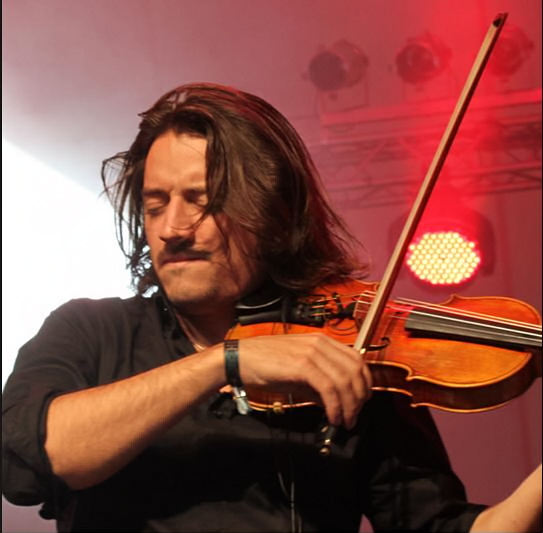 when establishing a ‘brand’. If any artists out there are flinching as I use the word ‘brand’, consider the creative accomplishments of Björk, one of the most magical musicians of my generation whilst being one of the strongest brands. Brands enable people to get who you are and, if it’s strong or unique, remember it. You may not say Eric Vloeimans’ indulgence in colourful clothes and ‘funky’ shoes launched his career, but you could see how his image, along with his playing has set him apart.
 Samuel Blaser has found himself experimenting more with visuals such as photos and videos and, like Duni, recognizes their importance as publicity. They also have both relished these added dimensions to their creativity. Blaser met Polish video maker, Ewa Kozanecka in New York and asked her to shoot something for a shorter version of Pieces of Old Sky. “I don’t know if it was totally useful because we did it like a piece of art.” From a listener’s point of view that video held the music more firmly in my memory. And that’s where videos and photos can really assist musicians – by etching their sound into the consciousness of the public. Rusconi are a band that have also naturally partnered with video to explore ways to extend their expression.
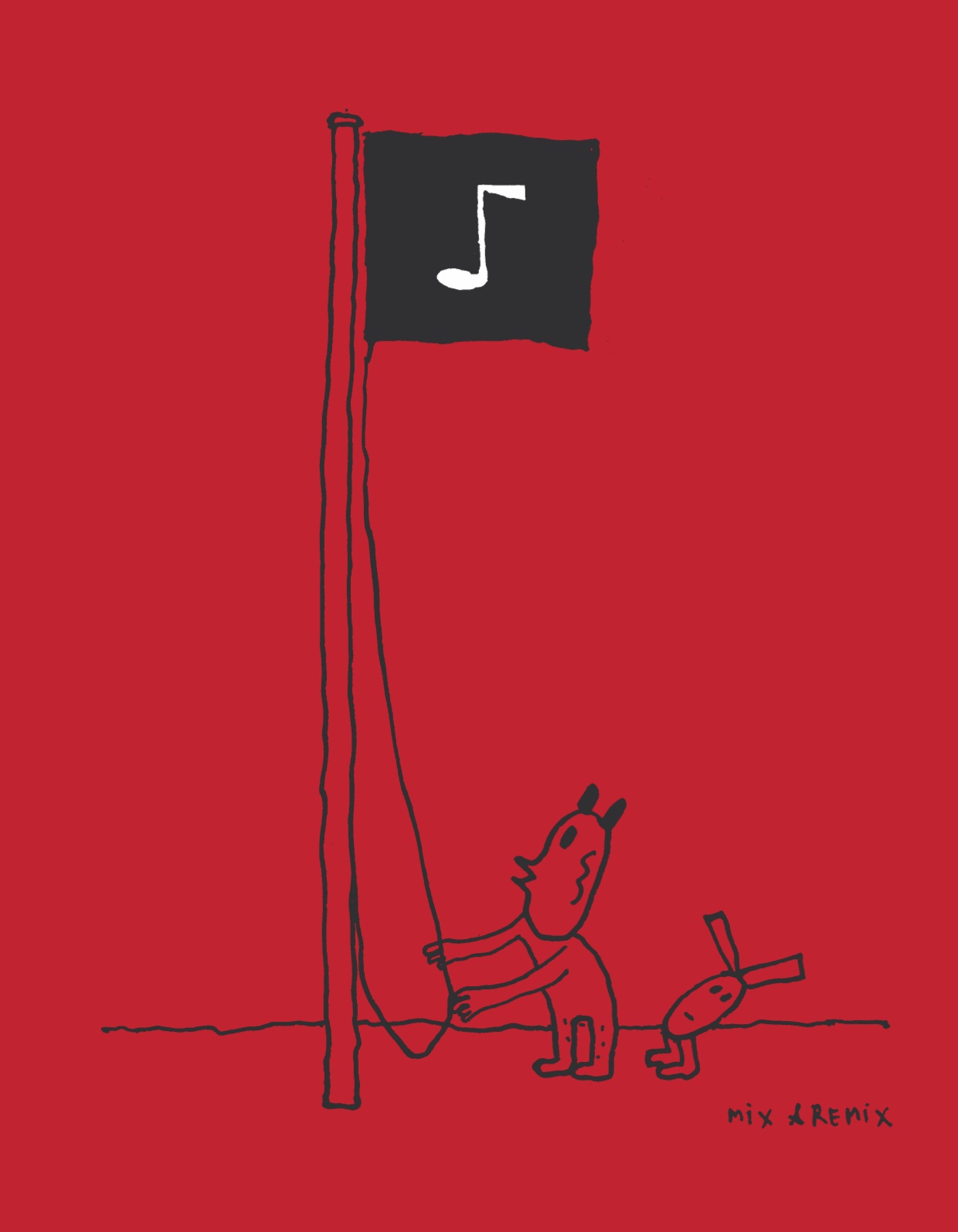 As far as I see it, social media is a form of Internet dating, just without the romance (though not always). It’s relationships, connecting, communicating, dare I say, flirting, and showing off your best photos. There’s also a lot of hype about what it can do for a career.
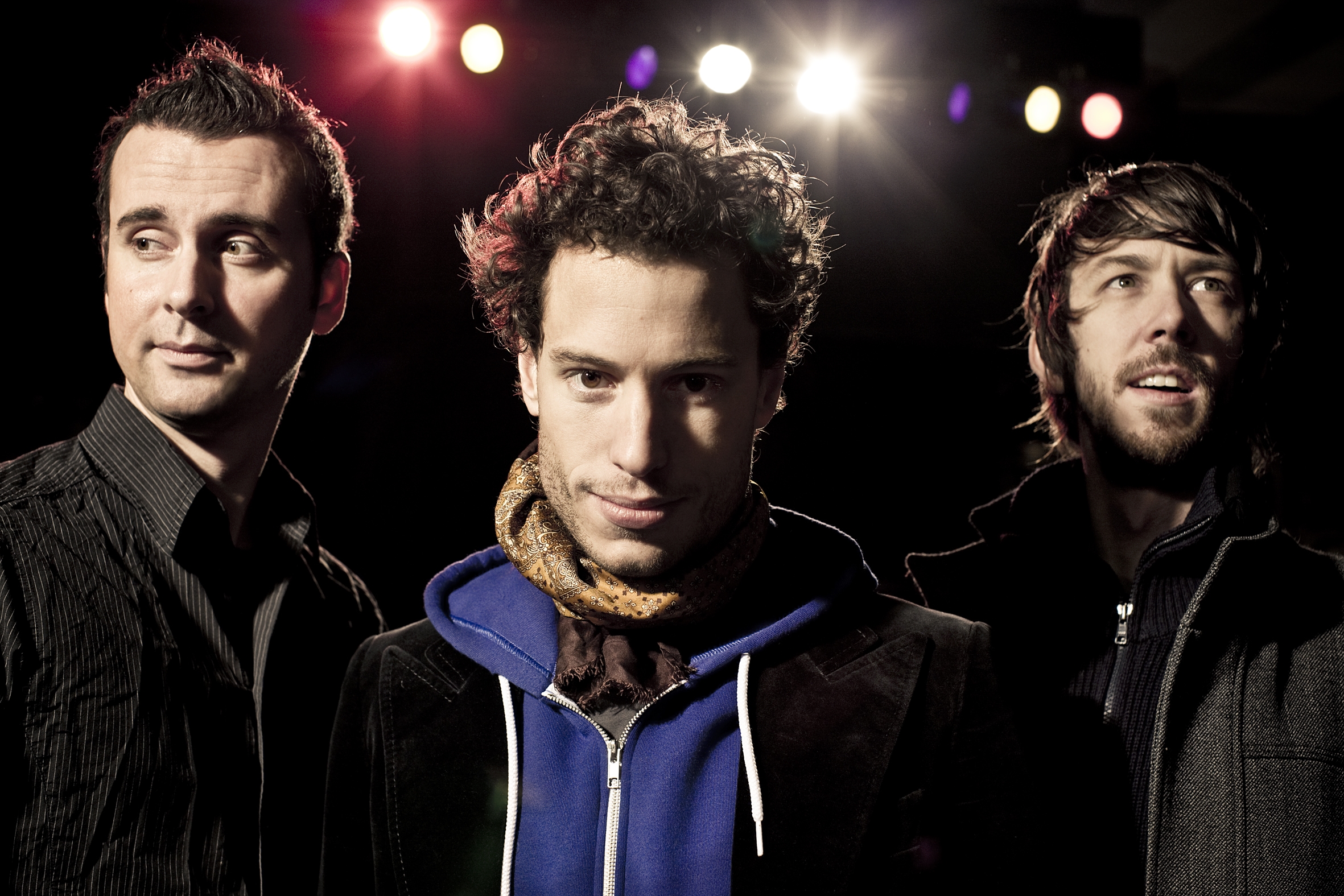 But what are the implications of this explosion of media for the new generations of jazz musicians? Out of the eight musicians I spoke to they had all breathed the same air, tainted by these hyped success stories of social media, but only three were already forcing themselves to fully utilize the Internet. Stefan
  Certainly they don’t share the same audience as Justin Bieber (over 42 million Twitter followers) but Herbie Hancock has doubled his followers in the last year to 54,000 and it’s doubtful the trend will reverse.
  Creating and updating websites, Facebook pages, blogs and tweets take an enormous amount of time and more notably, headspace, because it’s ongoing, always on the ‘to do’ list. Smartphones have supported social media by making it easier to update ‘on the go’ but as
 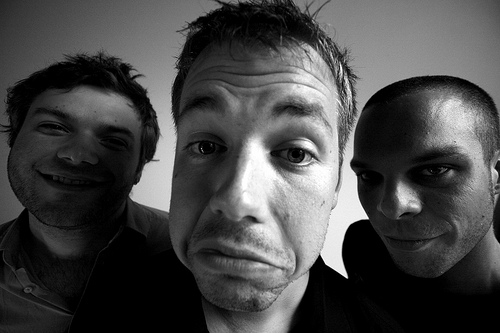 There are other issues such as keeping your website alive and relevant and the cost of that. The pianist
 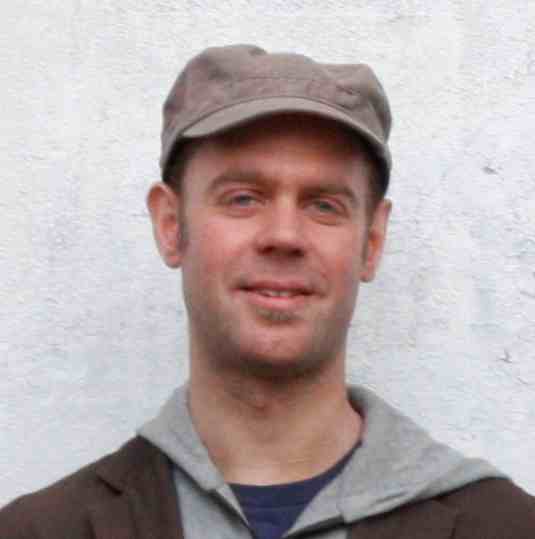 I’m going to skirt around the subject of digital downloads and e-commerce here as it’s a big and complicated field. However, as a marketing tool, digital media is up there as a new force. In some ways Rusconi are lucky in that their explorations of the digital world and the videos and imagery that need to accompany that fit naturally with their own tastes and interests. Drummer Florian Arbenz of
  “You can tap into resources and support and it’s there”